
NEWS
Subramani Wants a Military UPI Because Weapons Still Do Not Talk
CDS Raja Subramani used UPI as the template for military networks, while radios, a cancelled battalion system and a draft buying rulebook still do not talk.

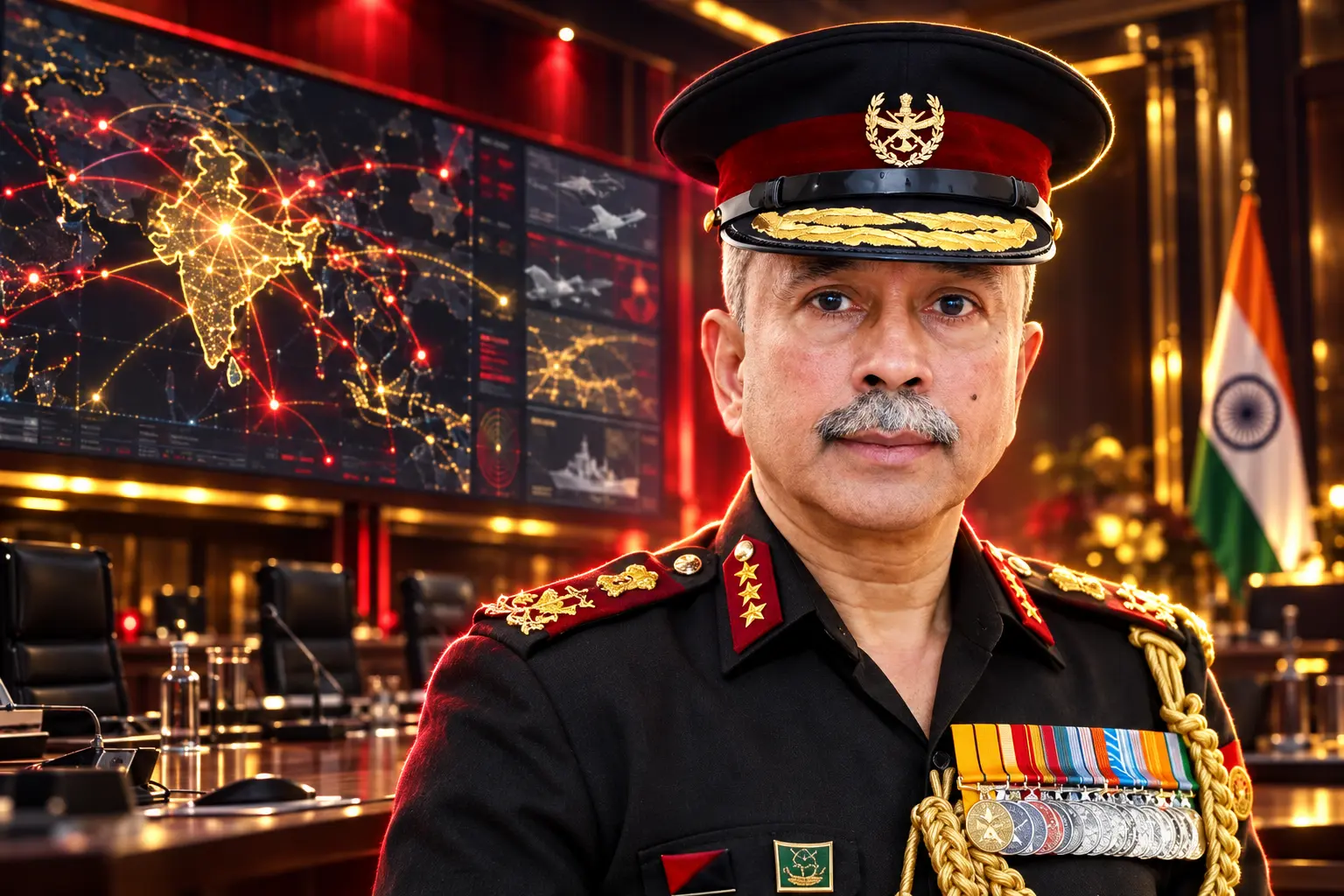
General NS Raja Subramani told a New Delhi defence summit on September 24 that India must build military networks on the scale of UPI. The Chief of Defence Staff said software, data and algorithms will decide the next fight, and that the buying system has to move at that speed.
He has held the post since May 31, 2026, the third officer in the job. The line that travelled was the payments one, because India already taught rival banks to share a single rail, and its own weapons still keep their data in separate rooms.
Subramani Puts Software Ahead of the Next Platform
Subramani, commissioned into the 8th Battalion of the Garhwal Rifles on December 14, 1985, spoke at News18 Defcon 2026. He said future military power will rest on networks, data, software and algorithms, and on the ability to grow, feed and repair those tools under fire.
Today software is the king – future battlefield winning capability will increasingly depend upon the networks, data, software and algorithms…Just like we built UPI, we now need to build similar equivalents for the military on scale.
General NS Raja Subramani, Chief of Defence Staff, News18 Defcon 2026
“It is not enough to have weapons. Networks must talk, data must flow,” he said. He grouped the new war economy as three Cs: compute, compatibility and collaboration.
Compute. Compatibility. Collaboration.
Chief of Defence Staff General N. S. Raja Subramani decodes defence transformations and the developments that are driving it at DEFCON 2026.#CDS #ChiefofDefenceStaff #RajaSubramani #News18DEFCONIndia pic.twitter.com/tVcP0AWy1m
— News18 (@CNNnews18) September 24, 2026
He wants a layered mix of costly platforms and cheaper mass, electronic warfare, directed energy, deception, and kinetic and non-kinetic tools working together. Design, he said, should follow the cost of each engagement, not only the cost of the platform. He also wants AI that still runs for intelligence, analysis, mission planning, logistics, war gaming and decision support when the net is broken.
He packed the same brief into a five-step BUILD mantra, which he called the bridge between India’s defence ambitions and the fights ahead.
THE BUILD MANTRA
- Battlefield: The field is more open, linked and contested in every domain, with no safe place in a fight.
- Understanding: The money side of war is shifting toward compute, compatibility and collaboration.
- Integration: Technology, data and industry now decide outcomes as much as the platform does.
- Learning: The side that learns and adapts faster holds the combat edge.
- Delivery: Building quickly, cheaply and at scale will set how long the country can stay in the fight.
He tied that list to JAI, the Combined Commanders formula of jointness, Aatmanirbharta and innovation. Jointness on the technical side, he said, needs common standards, open architecture and systems that talk. Aatmanirbharta, in his telling, means owning the critical piece another country can deny, including the intellectual property and the ability to make it. Defence exports, he said, are touching ₹38,000 crore after 10 to 12 years of growth.
What UPI Built That Rival Banks Already Share
UPI is the civilian proof he was pointing at. The National Payments Corporation of India launched it on August 25, 2016, under Reserve Bank oversight, as a common protocol that lets public banks, private banks, payments banks and cooperatives clear funds through one rail instead of closed pipes.
The Ministry of Finance, citing NPCI, recorded 24,162 crore UPI transactions in FY 2025-26, worth ₹314 lakh crore, about 84% of India’s digital payments. Daily volume in 2026 ran at 66 crore. In 2025 the rail handled 49% of the world’s real-time payment volume and was live in 11 countries.
The first month, August 2016, cleared 90,000 payments across 21 banks. NPCI’s August 2026 product table now shows 752 banks live on UPI, with 24.51 billion transactions worth ₹29.82 lakh crore in that month alone.
UPI AT CIVILIAN SCALE
| Measure | Figure | Period |
|---|---|---|
| Banks on the rail | 21 | April 2016 launch |
| Banks on the rail | 752 | August 2026 |
| Monthly volume | 24.51 billion | August 2026 |
| Monthly value | ₹29.82 lakh crore | August 2026 |
| Annual volume | 24,162 crore | FY 2025-26 |
| Daily average | 66 crore | 2026 |
That is the template. Competing firms kept their apps and their customers, and still had to honour one set of messages. A military equivalent would force radios, aircraft, batteries and software houses onto shared data standards so a picture built in one service is usable in another without a human carrying it across.
Headquarters Networks Still Stop Short of the Battalion
India is not starting from a blank map. The Air Force Network, commissioned in 2010, carries the Integrated Air Command and Control System. The Defence Communication Network is the tri-service backbone that links the Integrated Defence Staff, the Strategic Forces Command and service headquarters so seniors can look at one operational picture.
Those pipes matter. They do not do the UPI job. Abhishek, in Observer Research Foundation Issue Brief No. 886, published in July 2026, wrote that the Defence Communication Network works at the strategic and operational tiers and was not built for the below-brigade digital void or for sub-minute sensor-to-shooter cycles.
The closest thing India now has to a UPI-style rule for radios is the Indian Radio Software Architecture standard. DRDO, the Integrated Defence Staff and the three services released IRSA 1.0 in October 2025. It is the first national spec for software-defined radios, splitting waveform software from the box so a waveform written for one maker can, in principle, run on another.
The Manohar Parrikar Institute for Defence Studies and Analyses note on the spec is blunt about the present market. Different vendors lock waveforms behind their own software, so even similar hardware will not share protocols without extra gateways. The waveform is the real property, because it holds anti-jamming, encryption, networking and spectrum use. IRSA adds portability and hospitality scores so a buyer can measure that claim. A standard on paper still has to be written into every contract, or the next radio arrives as another closed app.
The Army Radio Programme That Is 25 Years Late
The ground layer is where the UPI comparison hurts. The Battlefield Management System was meant to give a battalion commander a live picture down to companies and platoons. The ORF brief records that the programme was shut in July 2018 after seven years of work and about ₹5,000 crore spent on prototypes.
The Tactical Communication System, meant to replace the Army’s old radios with encrypted digital links from corps to section, has been in development for 25 years and had not been fielded when that brief was published. The result is a break between sensors, decisions and shooters, a gap in the design rather than a single late order.
THE DIGITAL MILITARY CLOCK
- 2010: The Air Force Network goes live as the IAF’s digital grid under IACCS.
- 2016: The Defence Communication Network is in service as a tri-service headquarters backbone.
- July 2018: The Battlefield Management System is cancelled after seven years and about ₹5,000 crore in prototypes.
- October 2025: IRSA Standard 1.0 is released as the national software-defined radio spec.
- February 11, 2026: The Ministry of Defence puts out the DAP 2026 draft, including source-code ownership.
- May 31, 2026: General Subramani takes charge as Chief of Defence Staff.
- September 19, 2026: At IIT Roorkee he warns that hyperconnected systems also carry vulnerability.
- September 24, 2026: At Defcon he asks for military networks on the scale of UPI.
Five years of faster platform buying sit on top of that clock. ORF records that between 2021 and 2025 the forces inducted the S-400, finished delivery of 36 Rafales, signed for 26 Rafale-M jets and bought 31 MQ-9B drones, while defence capital spend rose 52% from 2019-20 to 2024-25, to ₹1.72 lakh crore. Physical reach moved. The command architecture did not move with it.
Source Code Ownership Is Written Into a Draft
Subramani said the defence acquisition system has to adapt quickly. The ministry already wrote a version of that demand into the draft Defence Acquisition Procedure 2026, released on February 11, 2026, to replace DAP 2020. The press note lists fewer buying routes, a higher Indian-content floor, and a definition of indigenous design that includes software source code.
WHAT THE 2026 DRAFT CHANGES FOR SOFTWARE
- Design test: A system counts as Indian-designed only if an Indian entity owns the design papers, source code, architecture and critical data, not merely a factory licence.
- Content floor: Buy (Indian-IDDM) indigenous content rises from 50% to 60%.
- Route count: Procurement categories drop from five to four, with Buy (Indian-IDDM) at the top.
- Software trials: Software projects are to be tried on operational function, cybersecurity and integration, not as if they were hulls.
- Spiral orders: Make and iDEX projects get spiral development and five years of assured orders so code can be updated after induction.
The draft is the lever. Until it is the notified rulebook, a vendor can still sell a sealed box, and a service can still write a requirement that never asks whether the waveform will run on someone else’s radio. Subramani’s UPI line only works if that lever is pulled.
Why Startups Cannot Ship a Military UPI Alone
The CDS invited startups, universities, engineers, students and technology firms into the work. The door is already open. A Ministry of Defence account as of February 2026 put iDEX at about 676 startups, MSMEs and innovators, with 548 design-and-development contracts signed. Forty-five procurement contracts worth nearly ₹2,326 crore had been inked.
That funnel is the quiet problem. Hundreds of teams can write a prototype. A much smaller set becomes a store item. Even a store item is useless as a national rail if the Army, Navy and Air Force still certify different radios, and if a winning waveform cannot be loaded onto the next vendor’s box. UPI scaled because NPCI forced every live bank onto one message set. iDEX cannot force that from a grant.
He listed engines, explosives, sensors, repair shops and test benches as places where forces, factories and campuses still need to work as partners. Sensors and test benches are the UPI problem in hardware form: if each new sensor speaks a private dialect, adding another startup only adds another translator.
Theater Commands Need a Protocol Before a Map
Jointness is the reason the CDS post exists. Theater commands are the organisational bet. They still need a picture that is common at the speed of the shot, not at the speed of a staff chain.
May 2025’s Operation Sindoor was the live test ORF uses. The IACCS-Akashteer-Trigun air-defence fabric held together better than expected. Post-conflict work then flagged tactical datalink limits in the Air Force’s mixed fleet against a Chinese-supplied kill chain. Two findings, not one: the headquarters air picture can cohere, and the last mile can still stall.
Advanced forces have squeezed that last mile. A 2020 US Army run put a sensor-to-shooter cycle under 20 seconds, down from a 20-minute baseline, through FIRESTORM. Israel’s Fire Weaver, fielded from 2020, pairs a shooter in about five seconds. India’s own timings are unpublished. A Centre for Land Warfare Studies note after Sindoor set the aim as loops closing in seconds rather than hours.
SENSOR TO SHOOTER, AS PUBLISHED
| System | Cycle | Status |
|---|---|---|
| US FIRESTORM / CJADC2 | Under 20 seconds | Demonstrated 2020, MVP 2024 |
| Israel Fire Weaver | About 5 seconds | Fielded |
| India | Unpublished | Aim: seconds, not hours |
Abhishek’s brief argues that fragmented tactical datalinks constrain kill chains, and that India now has an effect-layer inversion: strike kit that can reach 300 kilometres sitting on a command chain built for an older tempo. A junior commander who can, on paper, point a BrahMos 400 kilometres still has to climb that chain to fire. The fix the brief wants is IRSA-compliant datalinks in every future buy, a modular ground digital layer, and a command design for an Integrated Rocket Force before that force matures.
Subramani had already described the civilian version of the same risk. On September 19 at IIT Roorkee he told graduates the world is disruptive, hyperconnected, asymmetric, realigning and chasing autonomy. “We are hyperconnected, not only in terms of WhatsApp and social media, in terms of our financial systems, our airlines, our networks and in terms of our energy systems. This interconnectedness also carries vulnerability with it,” he said, asking engineers for systems with resilience. That is the same demand as AI that still works when communications are degraded.
UPI began with 21 banks and 90,000 payments in a month. IRSA 1.0 is a spec. DAP 2026 is a draft. The military UPI he asked for on September 24 still needs the first rail that every radio, aircraft and battery is required to use.

A CubeSat Will Age Whisky That Never Comes Home

A Charity Quote Cost Shia LaBeouf the FKA twigs NDA

Looker Turned a Model’s Body Into Ad Inventory

Infinity Ward Bets a Paid DMZ Will Stick This Time

Disney Sidesteps a Kimmel Renewal as Failla Cites Losses

How to Get Pre Boarding on Southwest – Skip the Line with These Tricks

False AI Intel Nearly Put US Crews on a Chinese Ship

Tim Cook’s $4.6 Trillion Apple Still Runs on One Phone

OpenAI Posts a Navier-Stokes Proof Clay Has Not Touched

Dunes Air Sues Nora Fatehi Over Its Luxury Jet
-
 TRAVEL3 years ago
How to Get Pre Boarding on Southwest – Skip the Line with These Tricks
-
 NEWS1 month ago
False AI Intel Nearly Put US Crews on a Chinese Ship
-
 BUSINESS2 months ago
Tim Cook’s $4.6 Trillion Apple Still Runs on One Phone
-
 NEWS2 months ago
OpenAI Posts a Navier-Stokes Proof Clay Has Not Touched
-
 ENTERTAINMENT2 months ago
Dunes Air Sues Nora Fatehi Over Its Luxury Jet
-

 LIFESTYLE3 years ago
How Often Do You Have to Change a Monkey’s Diaper? The Truth About Pet Monkeys
-

 NEWS2 months ago
Australia Treats Cloud Software Payments as Taxable Royalties
-

 LIFESTYLE3 years ago
How Long Does It Take for Armpit Hair to Grow? The Stages of Hair Growth and How to Shave It