
NEWS
Italy Bans School Face Veils as a Language Cap Bites
Italy banned school face veils and set a 30 percent language cap, but the text, a 2010 circular, and a nearby-school waiver leave most crowded classes in place.

Italy’s cabinet banned full-face veils in schools on 24 September 2026 and capped first-year classes at 30 percent pupils who do not know Italian. Prime Minister Giorgia Meloni called the package common-sense tools that prevent “ghetto classrooms.” The veil clause will be felt in a thin slice of schools. The cap is the rule that claims to rearrange the rest, and it is written more narrowly than the speech that sold it.
Education Minister Giuseppe Valditara said the measures put Italian at the centre of integration. The decree-law now goes to President Sergio Mattarella, then to Parliament, which has 60 days to convert it. The language ceiling applies to new first-year classes from 2027/28. Current rosters stay put.
A Ban Aimed at a Handful of Classrooms
The text forbids anyone from taking part in lessons, after-school activities, or school-family meetings “with the face covered or with any other method that does not allow the face to be recognised,” unless there are specific health reasons or reasons tied to teaching. Headteachers report breaches; the prefect sets an administrative fine of 200 to 1,000 euros. If the person is a minor, the parent pays.
Burqas and niqabs are in. A hijab that leaves the face open is not. Helmets sit in the same bucket. A surgical mask is allowed only for illness. Valditara also restated that pulling a child out of school to dodge the rule can trigger the prison terms already in the Caivano decree on truancy.
Italy has never had a clean national burqa statute. Article 5 of Law 152 of 1975 bans helmets or any other means that make a person hard to recognise in public without a justified reason. In ruling 3076 of 2008, the Council of State said a full veil worn for religious or cultural reasons is not the same as a mask, which is why mayors who tried local bans lost. Lombardy wrote a sector ban in 2015; it has been weakly applied. The school clause is the government closing that gap inside the school gate, including for parents at meetings.
How many pupils wear a full-face veil is the part the ministry does not count. An education-sector estimate circulating as the decree was drafted put the figure at about 500 to 600 students nationwide. Teachers who work ordinary classrooms say they almost never see one. The national flashpoint is smaller still, and it has a street address.
THE VEIL CLAUSE IN PRACTICE
- Monfalcone’s five: At the Sandro Pertini high school, five girls have arrived in niqabs; staff identified them each morning in a side room so they could stay enrolled.
- The primary next door: At the Ezio Giacich institute, 560 of 734 new primary enrolments this year are foreign, and some rooms run 23 foreign children out of 25.
- No census: The ministry has not published a headcount of full-face veils, which is why the 500 to 600 figure remains an estimate rather than a register.
Valditara has called the burqa a symbol of a violent patriarchal view that treats a woman as property. Meloni, posting after the cabinet meeting, folded the ban into a wider integration pitch.
Oggi abbiamo approvato in Consiglio dei Ministri il decreto sulla scuola.
Un limite del 30% nelle classi per gli studenti che non conoscono adeguatamente l’italiano, più strumenti per imparare la nostra lingua e stop a burqa e niqab a scuola.
Strumenti di buonsenso che non… pic.twitter.com/JEbie74wYy
— Giorgia Meloni (@GiorgiaMeloni) September 24, 2026
“A 30% cap on the number of students per class who do not have an adequate command of Italian, more tools for learning our language, and a ban on the burqa and niqab in schools,” she wrote. “These are common-sense measures that do not divide but rather foster genuine integration, preventing the formation of ‘ghetto classrooms.’”
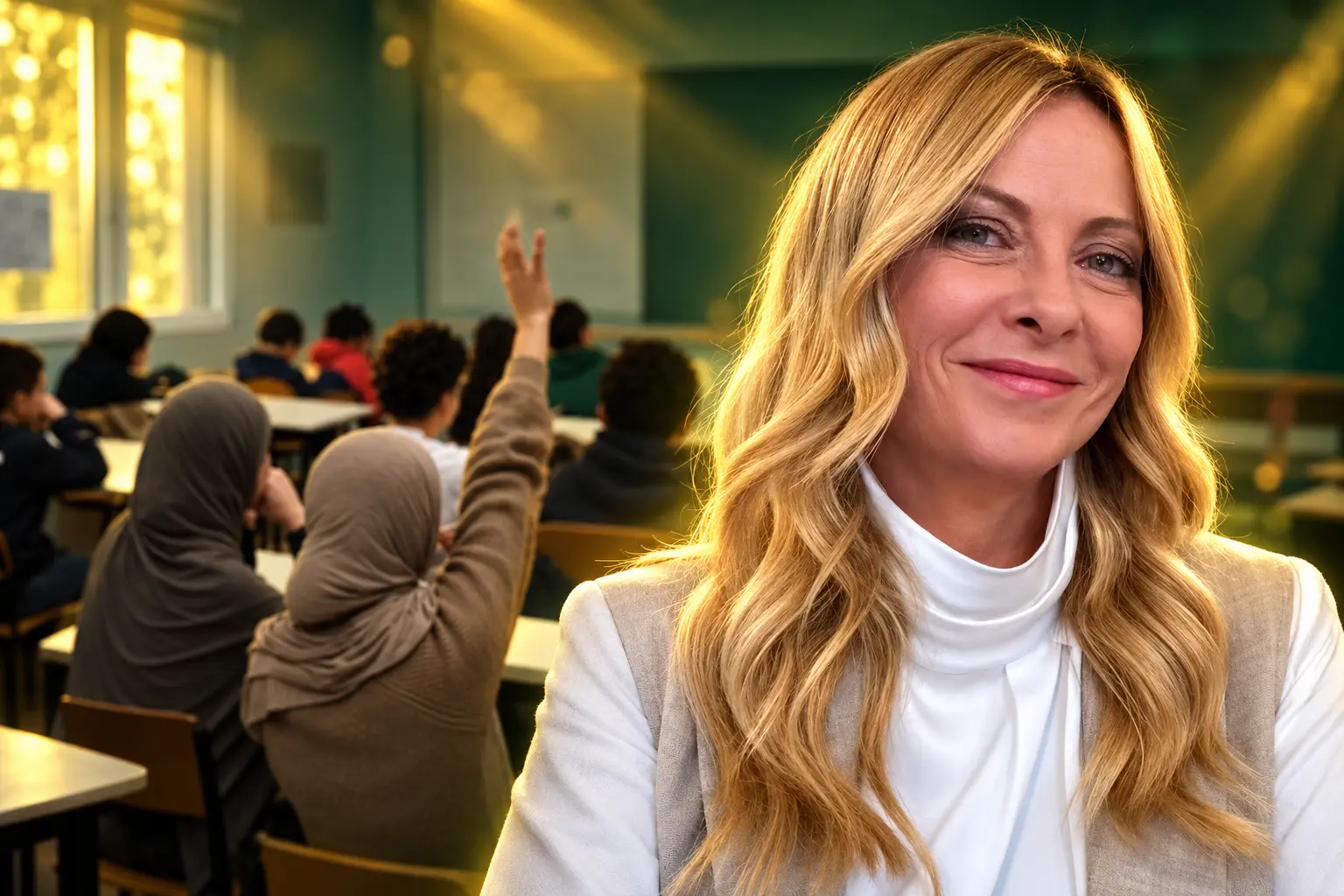
The 30 Percent Cap Counts Language, Not Passports
Meloni’s post talks about students who do not know Italian well. That is the legal target, even when the political slogan sounds like a cap on foreigners as such. Fondazione Ismu, working from Istat, counts 931,323 students without Italian citizenship in 2024/25, or 11.6 percent of a school population just over 8 million. More than 607,000 of those pupils were born in Italy. Primary school is the high-water mark at 13.7 percent. Upper secondary sits under 9 percent. Lombardy alone has 237,000.
Those born-in-Italy children are the ones the speech keeps tripping over. They hold a foreign passport and, in most cases, the language of the classroom. The decree tries to cut them out of the ceiling, with different tests by school level.
WHO COUNTS TOWARD THE 30 PERCENT
- Primary first years: Non-Italian citizens who were not born in Italy, or who have not done at least two years of Italian nursery school.
- Lower and upper secondary first years: Non-Italian citizens who have not completed at least three years in the national system with a pass.
- EU or non-EU: No split. A French new arrival and a Moroccan new arrival sit in the same count if they fail the school-history test.
- Already formed classes: Left alone. New arrivals this year can be steered without breaking rooms that already exist.
- The nearby-school hatch: If the 30 percent line is crossed, the provincial education office assigns pupils to a nearby school. Valditara said that does not mean “20 kilometres away.” If no nearby school can take them, the ceiling can give way and extra Italian lessons are supposed to arrive instead.
Giannelli, speaking for headteachers, said the cap will be hard to run because the real test in Italian enrolment is still how close the school is to home. Families already list several schools when they enrol. The state is adding a language filter on top of a map that does not stretch far.
Who Moves When a Class Hits the Ceiling?
After the cabinet meeting, Valditara told reporters that 34,000 classes already have a foreign-pupil share above 30 percent. That is the number that travelled. It counts every child without Italian citizenship, including those born here who speak the language. The decree does not.
TWO CEILINGS, TWO POPULATIONS
| Yardstick | Figure | What it actually counts |
|---|---|---|
| All non-Italian citizens, 2024/25 | 931,323 (11.6%) | Passport, not language |
| Classes over 30% foreign, Valditara | 34,000 | All foreign pupils, including Italian-born |
| Classes over 30% if only foreign-born | 0.6% of classes | Birthplace, still not a language test |
| Classes over 20% first-generation without Italian | About 1,000 of about 300,000 (0.33%) | The group closest to the new rule |
| Pupils FLC-CGIL thinks may be moved | Under 10,000 (0.14% of 7 million-plus) | Union estimate, not a ministry census |
Valditara also gave the dropout gap he wants the cap to close. He said first-generation foreign pupils sit about a year behind in Italian, and that “implicit dropout,” meaning a failure to reach required skills, is 5.7 percent for Italians and 10 percent for foreign pupils. Over 65 percent of non-Italian-citizen pupils are already in the north, which is where a nearby-school waiver does the least work, because the next school may be just as full.
The 2024 school decree had already funded an extra Italian teacher where new arrivals, or pupils below A2, hit 20 percent of a class. The new 30 percent line sits on top of that, with 14 million euros promised for Italian support in the schools that still overflow. Another 21 million euros is tagged for textbooks, and the ISEE aid threshold rises from 30,000 to 40,000 euros. The money is real. The number of children who will change buildings is the part nobody in government would pin down.
Mattarella Reminded Rome That School Is Open to All
Three days before the vote, on 21 September 2026, Mattarella opened the school year at the reconstructed Sergio Marchionne institute in Amatrice, ten years after the earthquake. He did not name the decree. He quoted the Constitution instead.
The school is the most effective lever of integration for those who come from other countries and for young people born in Italy who are children of emigrants. The school prepares everyone. It is open to all, as Article 34 of the Constitution provides. It must build bonds, win the trust of families, help not to form ghettos, not to raise barriers, to make our communities safer, to unite and not to tear apart, overcoming the walls of distrust and of the inability to communicate.
Sergio Mattarella, President of the Republic, Amatrice school-year opening, 21 September 2026
Meloni says the cap prevents ghetto classrooms. Mattarella says school must help not to form ghettos. They used the same Italian word in the same week for opposite instructions. The published text tries to live in the gap: it keeps the 30 percent line, then writes in the exclusions and the nearby-school hatch that make a hard quota hard to enforce. The school is open to all line is now the test the Quirinale will run when the decree reaches the president’s desk.
Cardinal Matteo Zuppi, speaking the same day, said a child’s place of birth should not set the chances of learning. Elly Schlein, leader of the Democratic Party, called the decree a disgrace and a witch hunt on the backs of children. Headteachers’ unions called it propaganda. The legal clock is quieter than any of those lines. Mattarella can send the text back. Parliament can amend it. If conversion fails inside 60 days, the decree dies.
A 2010 Circular Already Set This Ceiling
The 30 percent figure did not arrive with this cabinet. School leaders have been living with a version of it for sixteen years, and with a thinner version before that. In 1989 and 1990, when Mattarella was education minister, the ministry told schools how to place foreign pupils. There were 13,668 foreign pupils in 1989, or 0.14 percent of enrolment. Circular 205 of 1990 said pupils from the same language group should not, where possible, exceed five in a class. That was a grouping rule, not a foreigner quota.
HOW THE CEILING GOT HERE
- 8 September 1989: Circular 301 sets rules for placing foreign pupils in compulsory school, with foreign enrolment still under 14,000.
- 1990: Circular 205 on intercultural education says the same-language group should not exceed five pupils per class where possible.
- 8 January 2010: Circular 2 under Mariastella Gelmini says non-Italian-citizen pupils should not, as a rule, exceed 30 percent of a class, with room to raise or cut the line by language skill.
- 31 May 2024: Decree-law 71 funds an extra Italian teacher where new arrivals or pupils below A2 hit 20 percent of a class.
- 24 September 2026: The cabinet turns the 30 percent line into a decree-law for first-year classes from 2027/28, with the language and school-history filters attached.
Valditara said the 30 percent question has been around since 1990, that earlier ministers treated it as a recommendation, and that it is now binding. He also said this has “nothing to do with old circulars that addressed situations involving small numbers of foreign students per class.” The Gelmini circular already named language as the reason to raise or lower the line. What changes is the legal force, the first-year timing, and the provincial office’s power to move a child when headteachers stall.
Whether that force survives contact with a full neighbourhood is the open part. A circular that allowed exceptions produced 34,000 classes over the all-foreign 30 percent mark. A law that builds the exceptions into the definition of who counts may produce a smaller shift than the Fenix rally cheer suggested.
Fines Replace the Threat of Taking Children
The other social-policy piece is aimed at parents. Valditara said international studies, including OECD work, show that a parent’s part in a child’s schooling is tied to results. Where a child has serious trouble settling, the school must flag the family to social services, which can order a free Italian course. Skip the course, and the same 200 to 1,000 euro fine applies.
A draft that circulated before the meeting went further and talked about removing a child from the family. Valditara said he would not take children from families and blamed the leaked draft on the opposition. Forza Italia had already balked. The version that left Palazzo Chigi keeps the course and the fine and drops the removal threat.
That is the pattern of the whole packet. The rally version is a hard reset of Italian classrooms. The legal version is a face-covering ban for a practice measured in the hundreds, a language cap that excludes most foreign-passport pupils, a nearby-school hatch, and a parent fine. Each piece can still bite in a specific school. None of them, on the figures the ministry itself uses, rewires the 34,000 classes Valditara cited.
Vannacci Still Tells Meloni She Arrived Late
The political clock is the 2027 general election. Roberto Vannacci, the former paratroop general who leads Futuro Nazionale, has spent the year eating into the right of Meloni’s coalition. An EMG poll published on 24 September 2026 put Fratelli d’Italia at 25.1 percent, the League at 7.7 percent, and Futuro Nazionale at 6.7 percent. A YouTrend survey for Sky TG24, fielded 18 to 22 September, found 51 percent of centre-right voters, and 59 percent of Fratelli d’Italia voters, in favour of bringing Vannacci into the coalition. Ignazio La Russa has publicly closed that door.
Valditara said the government had been working on the school file well before Vannacci’s rise. Vannacci’s reply, as the decree landed, was that they should have done it earlier. That is the squeeze Meloni is in. Move on veils and class mix, and the party to her right calls it tardy. Soften the text so it can pass the Quirinale and a restless Forza Italia, and the same party calls it cosmetic.
The decree will not settle that argument. It bans a garment few pupils wear, restates a ceiling schools have had on paper since 2010, and leaves the crowded northern classrooms that produced the 34,000 figure with a nearby-school waiver. Parliament now has 60 days to decide how much of that signal becomes a statute, and first-year classes in 2027/28 will show how many children actually change rooms.

A CubeSat Will Age Whisky That Never Comes Home

A Charity Quote Cost Shia LaBeouf the FKA twigs NDA

Looker Turned a Model’s Body Into Ad Inventory

Infinity Ward Bets a Paid DMZ Will Stick This Time

Disney Sidesteps a Kimmel Renewal as Failla Cites Losses

How to Get Pre Boarding on Southwest – Skip the Line with These Tricks

False AI Intel Nearly Put US Crews on a Chinese Ship

Tim Cook’s $4.6 Trillion Apple Still Runs on One Phone

OpenAI Posts a Navier-Stokes Proof Clay Has Not Touched

Dunes Air Sues Nora Fatehi Over Its Luxury Jet
-
 TRAVEL3 years ago
How to Get Pre Boarding on Southwest – Skip the Line with These Tricks
-
 NEWS1 month ago
False AI Intel Nearly Put US Crews on a Chinese Ship
-
 BUSINESS2 months ago
Tim Cook’s $4.6 Trillion Apple Still Runs on One Phone
-
 NEWS2 months ago
OpenAI Posts a Navier-Stokes Proof Clay Has Not Touched
-
 ENTERTAINMENT2 months ago
Dunes Air Sues Nora Fatehi Over Its Luxury Jet
-

 LIFESTYLE3 years ago
How Often Do You Have to Change a Monkey’s Diaper? The Truth About Pet Monkeys
-

 NEWS2 months ago
Australia Treats Cloud Software Payments as Taxable Royalties
-

 LIFESTYLE3 years ago
How Long Does It Take for Armpit Hair to Grow? The Stages of Hair Growth and How to Shave It