
BUSINESS
NSE Shares Trade Below the IPO as Targets Stretch
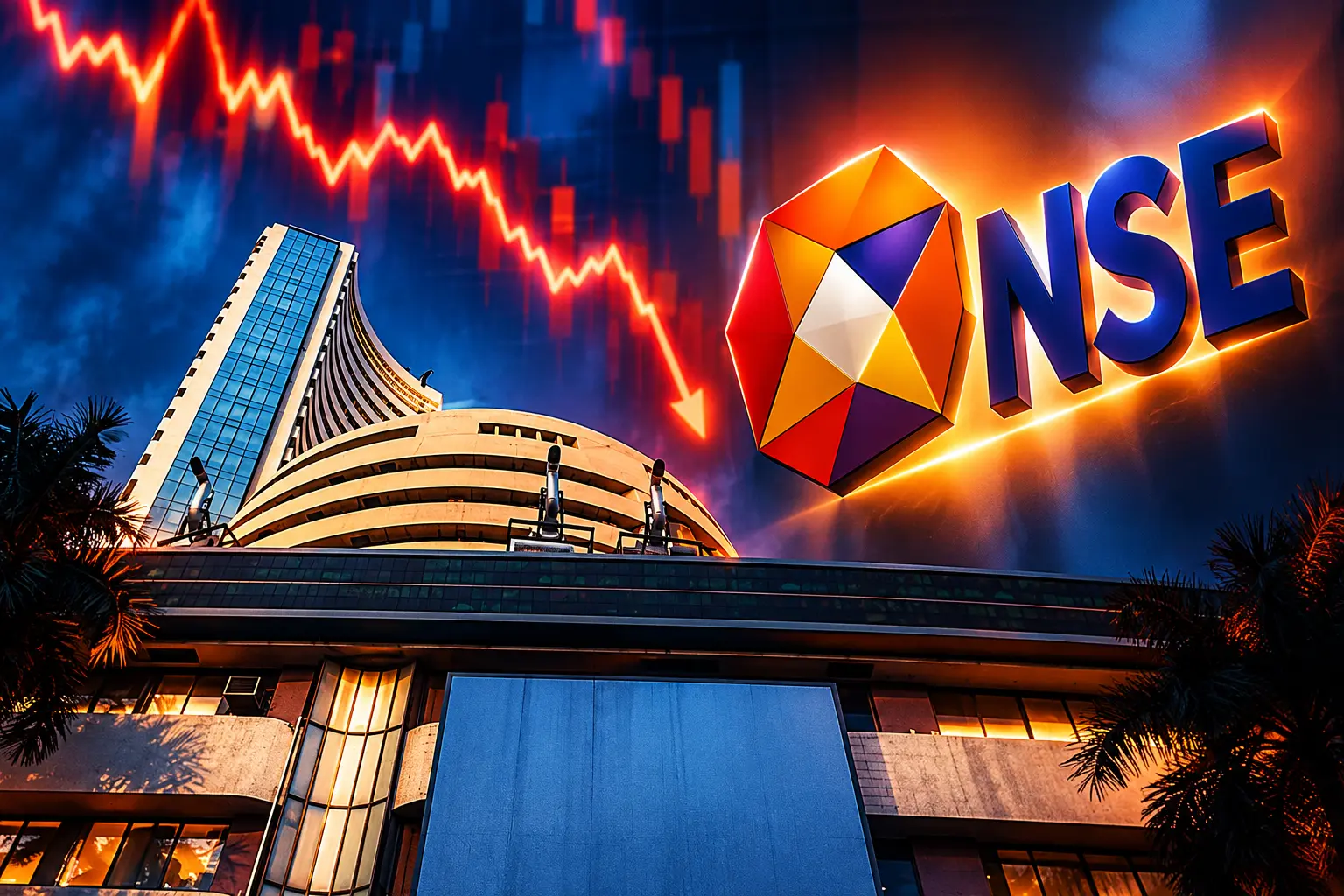
NSE shares closed at Rs 1,730.90, 3.03 percent under the IPO, so Macquarie’s Dominator targets now need a steeper bounce than the issue implied.

National Stock Exchange of India shares finished 9 October at ₹1,730.90, 3.03 percent below the ₹1,785 IPO price. That close is 7.83 percent under the ₹1,878 high printed on listing day, 24 September, and 4.79 percent under the ₹1,818 first-day finish.
Macquarie opened coverage by tagging the bourse “The Dominator” and setting a ₹1,965 target, about 10 percent above issue. Fifteen days later the stock is a recovery case. The 9 to 15 percent upside that three houses sketched from ₹1,785 now needs a steeper climb from the tape.
The Dominator Wager Is Already Underwater
The issue was priced at the top of a ₹1,700 to ₹1,785 band and listed on BSE at ₹1,800, a 0.84 percent premium that missed the grey-market hopes still circulating a month earlier. Grey quotes had run at ₹282 over the cap on 7 September and had already thinned to ₹60 by 23 September. The first session still squeezed out a 5.21 percent spike to ₹1,878 before settling at ₹1,818, a 1.85 percent gain that valued the exchange at ₹4,49,955 crore and put it among the world’s seven most valuable bourses on debut.
The second session brought the first real selling. The stock printed ₹1,790.10 intraday on 25 September. By 28 September it had broken the issue, touching ₹1,761, which was 1.35 percent under ₹1,785 and 6.23 percent under the listing high. Market value at that low sat near ₹4,37,580 crore. The tape did not recover the issue in the sessions that followed. The all-time low so far is ₹1,712.
THE NSE TAPE SINCE LISTING
| Price (₹) | Vs ₹1,785 issue | |
|---|---|---|
| 24 Sep open | 1,800 | +0.84% |
| 24 Sep high | 1,878 | +5.21% |
| 24 Sep close | 1,818 | +1.85% |
| 28 Sep low | 1,761 | -1.35% |
| 9 Oct close | 1,730.90 | -3.03% |
The stock closed at ₹1,730.90 on 9 October on BSE scrip 544937, up ₹6.30 or 0.37 percent on the day, after oscillating between ₹1,718 and ₹1,737.40 on volume of 958,929 shares. Market value was ₹4,28,397.75 crore, ₹21,557 crore below the first-day close. Trailing earnings multiple was 41.59 times, cheaper than the 42.9 times FY26 diluted EPS that the ₹1,785 cap implied, because the price has fallen while last year’s ₹41.62 of earnings per share has not been restated.
Shubham Gupta, a SEBI-registered analyst, had written before bidding closed that the stock “shouldn’t list in discount even if we break 23000” and that a discount “will bounce back with rocket speed.” It listed a shade above issue, then spent the next 15 days going the other way. Exchange names already in the market had been heavy for months, and that pattern, not the first-hour spike, set the tone.
An Offer for Sale That Put Only Sellers on the Tape
The ₹22,561.57 crore issue was a 100 percent offer for sale of 12.64 crore shares, or 5.11 percent of the 2,47,50,00,000 shares on the register. NSE received nothing. Face value stayed ₹1. Pre-issue and post-issue capital are the same number. That is why a muted float can still feel heavy: every share that changed hands on debut was a share someone already owned and wanted to sell.
Bidding ran from 17 to 21 September. The book was subscribed 5.71 times, with bids of ₹90,287.33 crore against the issue. Qualified institutional buyers took their quota 12.68 times. Non-institutional buyers were in 6.55 times. Retail, the slice that has to live with a dull listing, was in only 1.39 times. Lot size was 8 shares, so the retail minimum at the cap was ₹14,280. Employees had a ₹170 discount on up to 4,33,436 shares.
Anchors had already taken 3,77,93,739 shares on 16 September for ₹6,746.18 crore, across 189 accounts. That block is 29.89 percent of the issue and it is still partly locked. The public book did the rest. Kotak Mahindra Capital ran the books. MUFG Intime was the registrar. There is no identifiable promoter, so the register is 100 percent public on both sides of the deal.
Options Still Supply 60 Percent of Operating Revenue
The coverage notes that opened on listing day led with monopoly numbers, and those numbers are real. In FY26 NSE held 92.99 percent of cash-market turnover, 99.79 percent of equity futures, 99.48 percent of currency futures and 100 percent of exchange-traded currency options. It is the other line that pays the bills. Equity options, measured on premium, were only 74.71 percent of that market, down from 96.9 percent in FY24 and 87.4 percent in FY25, and they still produced ₹9,996 crore of transaction charges. That is 60 percent of ₹16,601 crore of operating revenue.
WHERE FY26 REVENUE CAME FROM
- Transaction charges: ₹13,057 crore, 79 percent of operating revenue, down 4 percent from ₹13,636 crore.
- Equity options: ₹9,996 crore of those charges, versus ₹1,555 crore from cash and ₹1,370 crore from equity futures.
- Profit after tax: ₹10,302 crore, down 15 percent from ₹12,188 crore, on a 22 percent rise in costs.
- The legal slug: SEBI settlement fees of ₹1,432 crore, against ₹670 crore a year earlier; normalised profit before tax, a management figure, fell 5 percent to ₹14,135 crore.
Operating EBITDA dropped 12.25 percent to ₹11,098 crore and the margin compressed to 66.85 percent from 73.78 percent. Average daily traded value was lower across the board: cash down about 7 percent, equity futures 15 percent, options premium 8 percent, currency 36 percent. The co-location settlement is now paid. NSE filed revised terms of ₹1,491.21 crore, SEBI accepted them in principle on 30 July, the balance was paid on 31 July, and the Supreme Court disposed of the related appeals on 3 September, questions of law kept open. That slug should not repeat. The options concentration will.
At Rs 1,700-1,785, the IPO is valued at around 40.9x-42.9x FY26 diluted EPS, at a discount to BSE’s 54.28x, offering valuation support. However, around 79 percent of revenue is linked to trading activity, making earnings sensitive to market volumes and regulatory changes.
Shivani Nyati, Head of Wealth, Swastika Investmart
The June quarter was cleaner. Revenue from operations rose 13.10 percent year on year to ₹4,560.41 crore, operating EBITDA rose 14.84 percent to ₹3,594.25 crore at a 78.81 percent margin, and profit rose 6.71 percent to ₹3,120.08 crore. Options premium share, though, had already eased to 68.48 percent in that quarter. MD and CEO Ashishkumar Chauhan said after listing that weekly equity options still account for around 40 percent of revenue, that the stretch of tighter derivatives rules has largely run its course, and that the exchange is beginning to win options share back. He is also pushing commodities, including crude and gas contracts, as a second engine. The listed stock is now scoring that mix in public, at 41.59 times trailing earnings, against BSE at 54.28 times when the issue was priced.
What the Listing Did for BSE
BSE got the listing, the turnover spike, and a Nifty 50 slot in the same fortnight. NSE shares could not list on NSE, so the entire debut book went through the older exchange, scrip 544937, ISIN INE721I01024, with a permitted-to-trade line on the Metropolitan Stock Exchange as a side door. On 24 September BSE’s cash turnover jumped to ₹20,672.36 crore, a 27-month high, and the new stock alone did ₹9,483.28 crore, 46 percent of the day’s cash book. About 5.15 crore NSE shares changed hands and 2.51 crore, or 48.78 percent, were delivered. BSE’s own cash-market share was still only about 7 percent in FY26. For one session it looked like a different venue.
WHAT BSE TOOK FROM THE DEBUT
- The listing itself: A Group admission from 24 September, special pre-open, market lot of 1.
- The cash print: ₹20,672.36 crore of equity turnover, more than double BSE’s FY27 average daily cash book of ₹10,117 crore.
- The index seat: BSE replaced Wipro in the Nifty 50 from 30 September after a six-month average free-float capitalisation of ₹1,40,879 crore.
BSE’s own shares closed at ₹3,183.8 on NSE’s listing day and at ₹3,287.20 on 9 October, a 3.25 percent gain across that stretch, even after a 3.5 percent drop on the inclusion print when Goldman Sachs and BNP Paribas sold stock. The listed challenger took the fees, the headline volume, and the benchmark membership. The Dominator took a quote below its issue price.
SBI Led the Sale While LIC Held Its Stake
BSE’s listing notice listed 2.475 billion fully paid shares and sent the lock-in schedule to the depositories. The people selling into that float were not a promoter group. They were banks, insurers, and long-standing financial holders sitting on cost bases that make even ₹1,730.90 look like a life-changing exit.
State Bank of India offered 1,59,69,410 shares, ₹2,849.75 crore at the cap, the largest disclosed ticket, after cutting its planned sale from 2.475 crore shares in the draft. Its weighted average cost in the offer document is ₹0.80. Canada Pension Plan Investment Board sold 1,18,74,060 shares, ₹2,118.93 crore. Aranda Investments (Mauritius) sold 1,12,46,336 shares, ₹2,006.92 crore. MS Strategic (Mauritius), a Morgan Stanley affiliate, sold 1.10 crore shares, ₹1,962.96 crore, after trimming from 1.60 crore. New India Assurance sold 1.05 crore shares, ₹1,873.73 crore, against a documented cost of ₹0.32. Bank of Baroda, Stock Holding Corporation of India, General Insurance Corporation, United India Insurance, Oriental Insurance, National Insurance, Indian Bank, ICICI Lombard and SBI Capital Markets were also in the book. Eight sellers cut their planned tickets between the draft and the red herring, shrinking the offer from 14.89 crore shares to 12.64 crore, about 15 percent.
Life Insurance Corporation, holder of 10.72 percent, sold nothing. That stake is now marked in public every session. New India Assurance’s remaining 1.42 percent, and Stock Holding’s 4.4 percent (IFCI owns 52 percent of Stock Holding), are the same kind of listed proxy. When NSE broke the issue on 28 September, IFCI closed 4.5 percent lower at ₹70.65 and New India Assurance 3.6 percent lower at ₹170.25. The selling shareholders who did get out at ₹1,785 locked in a gain the new public book does not have.
Macquarie’s 1,965 Target Needs a Steeper Bounce
The three initiation notes that framed the debut have not, on the public record, been pulled. They now describe a longer walk from a lower step.
THE BROKERAGE SCORECARD
| House | Rating | Target (₹) | From ₹1,785 | From ₹1,730.90 |
|---|---|---|---|---|
| PL Capital | Accumulate | 1,950 | 9.2% | 12.7% |
| Macquarie | Outperform | 1,965 | 10% | 13.5% |
| Emkay Global | Buy (Sep 2027) | 2,050 | 15% | 18.4% |
Macquarie’s ₹1,965 is 13.5 percent above the 9 October close, not 10 percent above issue. PL Capital’s ₹1,950 is 12.7 percent away. Emkay’s September 2027 target of ₹2,050, the 15 percent figure that travelled with the listing copy, is 18.4 percent above the tape. Emkay also pencilled about 13 percent EPS growth a year from FY27 through FY29 after 19 percent annual growth from FY22 through FY26, with regulatory consolidation as the kicker. Angel One, writing before the issue, had Subscribe at 35.4 times annualised June-quarter earnings against BSE at 54.2 times, and flagged the same volume risk Nyati named.
Dr Ravi Singh, chief research officer at Master Capital Services, put FY26 shares at 92.99 percent in cash, 99.79 percent in equity futures, 74.71 percent in equity options, 99.48 percent in currency futures and 100 percent in currency options. That is the franchise Macquarie was buying. The listed multiple is no longer a scarcity premium on an unlisted name. It is a daily quote next to BSE, MCX and the rest of the market-infrastructure tape, on a year when reported profit already fell 15 percent.
Half the Anchor Book Unlocks on 21 October
The free float is still not fully free. Anchors took 3,77,93,739 shares at ₹1,785. Half of that block comes off the 30-day lock on 21 October. The rest comes off the 90-day lock on 20 December. Those dates sit on a stock that is already under issue, so the first unlock is an overhang on a weak print, not a release into a squeeze. Pre-IPO holders who did not sell in the offer remain under the mainboard rule that puts a six-month lock on pre-issue capital from allotment on 22 September, which runs into late March 2027.
THE LOCK-IN CALENDAR
- 16 September 2026: Anchors take 3,77,93,739 shares for ₹6,746.18 crore.
- 17 to 21 September 2026: Public bidding; books close 5.71 times subscribed.
- 22 September 2026: Allotment; six-month pre-issue lock starts for unsold old holders.
- 24 September 2026: Lists on BSE at ₹1,800, closes ₹1,818.
- 28 September 2026: Breaks the ₹1,785 issue, low ₹1,761.
- 21 October 2026: 50 percent of the anchor book is due off lock.
- 3 November 2026: Next confirmed results date.
- 20 December 2026: Remaining anchor shares are due off lock.
As of 30 June the exchange had 261.36 million registered accounts, 132.37 million unique registered investors, 1,328 members and 3,005 listed firms, with listed market value of ₹474.08 trillion. In FY26 it handled ₹4.78 trillion of equity capital raising and ₹20.33 trillion of total fund mobilisation. The board recommended a ₹35 dividend on the ₹1 share for FY26, including a one-time ₹10, which is why the quote screen can show a yield near 2 percent that will not repeat at that rate. None of that cash accrued from the IPO. The IPO was someone else’s sale.
The next numbered print on the business is the results due 3 November. Until then the market has a 9 October close of ₹1,730.90, three houses still pointing at ₹1,950 to ₹2,050, and an anchor unlock 10 days after that close.
Disclaimer: This article is news reporting and analysis of a listed stock and an completed public offer, and it is for information only. It is not investment advice, a research recommendation, or an offer to buy or sell NSE or any other security, and it does not tell any reader to apply for, hold, or exit an allotment. Readers should consult a SEBI-registered investment adviser or other qualified financial professional who can judge their own objectives and risk before acting. Prices, subscriptions, targets, lock-in dates and financial figures reflect the cited market data, including the 9 October close, and those prints can change in later sessions.

A CubeSat Will Age Whisky That Never Comes Home

A Charity Quote Cost Shia LaBeouf the FKA twigs NDA

Looker Turned a Model’s Body Into Ad Inventory

Infinity Ward Bets a Paid DMZ Will Stick This Time

Disney Sidesteps a Kimmel Renewal as Failla Cites Losses

How to Get Pre Boarding on Southwest – Skip the Line with These Tricks

False AI Intel Nearly Put US Crews on a Chinese Ship

Tim Cook’s $4.6 Trillion Apple Still Runs on One Phone

OpenAI Posts a Navier-Stokes Proof Clay Has Not Touched

Dunes Air Sues Nora Fatehi Over Its Luxury Jet
-
 TRAVEL3 years ago
How to Get Pre Boarding on Southwest – Skip the Line with These Tricks
-
 NEWS1 month ago
False AI Intel Nearly Put US Crews on a Chinese Ship
-
 BUSINESS2 months ago
Tim Cook’s $4.6 Trillion Apple Still Runs on One Phone
-
 NEWS2 months ago
OpenAI Posts a Navier-Stokes Proof Clay Has Not Touched
-
 ENTERTAINMENT2 months ago
Dunes Air Sues Nora Fatehi Over Its Luxury Jet
-

 LIFESTYLE3 years ago
How Often Do You Have to Change a Monkey’s Diaper? The Truth About Pet Monkeys
-

 NEWS2 months ago
Australia Treats Cloud Software Payments as Taxable Royalties
-

 LIFESTYLE3 years ago
How Long Does It Take for Armpit Hair to Grow? The Stages of Hair Growth and How to Shave It