
ENTERTAINMENT
CBFC Post Stops Umar Khalid Documentary at IIIT-Hyderabad
A CBFC post tagging IIIT-Hyderabad cancelled an uncertified Umar Khalid documentary, even though the institute says it never hosted the student screening.

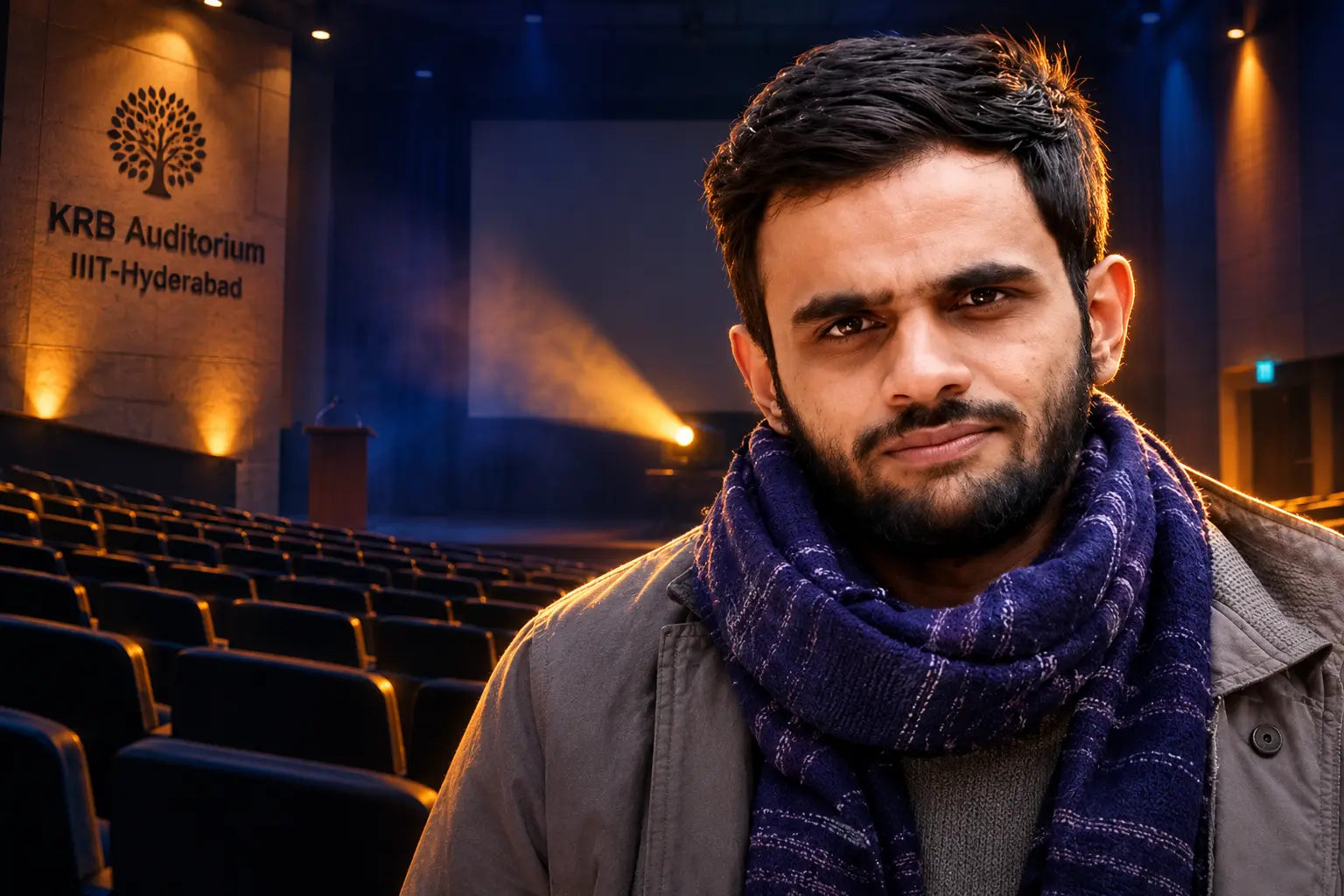
The Central Board of Film Certification warned IIIT-Hyderabad on September 17, 2026, that an uncertified Umar Khalid documentary would violate the Cinematograph Act. The film, Prisoner No. 626710 is Present, had been listed for 8 pm on September 18 in the campus KRB Auditorium. Students then called the showing off.
The board did not certify the title, refuse a certificate, or name a student organiser. It tagged the institute on X and told authorities to “take note for necessary action.” That public legal nudge was enough to end the night.
A Board Post, Then a Cancelled Screening
The Central Board of Film Certification sits under the Union Ministry of Information and Broadcasting. Its job under the Cinematograph Act, 1952, is to certify films meant for public exhibition. On Thursday it treated a student invite as exactly that kind of showing.
The post quoted the statute in plain terms and named @iiit_hyderabad. A screenshot circulating with it showed the plan: KRB Auditorium, 8 pm, September 18, 2026. The invite tied the evening to Political Prisoners’ Day and to Jatindra Nath Das, the revolutionary who died after a hunger strike in Lahore jail in 1929.
Public Screening of a Documentary film that has not yet been Certified by the CBFC is a violation of the Cinematograph Act unless a specific exemption has been sought under the Act. Authorities of @iiit_hyderabad may take note for necessary action. pic.twitter.com/KeZlkbqrFn
— CBFC केंद्रीय फिल्म प्रमाणन बोर्ड (@CBFC_Bharat) September 17, 2026
People familiar with the student plan said the group then cancelled. By Friday morning, the Hyderabad showing was off. The board issued no separate ban order in the public post. It pointed at the Act, pointed at the campus, and left the “necessary action” to the institute.
THE WEEK THE SHOWINGS STOPPED
- September 13, 2026: Organisers mark six years since Umar Khalid’s arrest and frame the date as Political Prisoners’ Day.
- September 14, 2026: NLSIU Bengaluru postpones its 7 pm screening; students still gather to read a letter from jail.
- September 16, 2026: An ABVP Bengaluru delegation meets Union law minister Arjun Ram Meghwal and seeks a lasting ban on the campus event.
- September 17, 2026: The CBFC posts that an uncertified public screening would violate the Act and tags IIIT-Hyderabad.
- September 18, 2026: The 8 pm KRB Auditorium plan is called off.
Two elite campuses, four calendar days, one uncertified title. The tools differed. The film still did not play.
IIIT-Hyderabad Says It Never Booked the Hall
The International Institute of Information Technology Hyderabad moved just as fast to separate itself from the invite. It said no recognised student club, cell, or organisation had organised or hosted a film that lacked a CBFC certificate. In its telling, the plan was not an institute event at all.
IIIT Hyderabad has established processes governing official events and activities on campus, and any claim attributing an unauthorised or unrelated activity to the Institute or its recognised student bodies is factually incorrect.
International Institute of Information Technology Hyderabad, campus statement
The institute added that students and faculty may meet people in their personal capacity, and that those meetings should not be read as official programmes or as the institute’s views. That line does legal work. If the showing was unofficial, IIIT-H can say it never applied for a certificate and never sought an exemption.
The board still tagged the institute, not a student WhatsApp admin. Once an invite names a campus auditorium, the legal risk sits on whoever controls the building. Unofficial organisers can vanish. A university cannot.
Three Days After Bengaluru, the Board Steps In
The Hyderabad plan followed a stalled night at the National Law School of India University in Bengaluru. The student-run Law and Society Committee had set Prisoner No. 626710 is Present for 7 pm on September 14, 2026, to mark six years of Khalid’s custody and to talk about pre-trial detention. The Akhil Bharatiya Vidyarthi Parishad, which is linked to the RSS, called the event political propaganda and told the university to stop it.
ABVP Bengaluru also wrote to Union home minister Amit Shah, education minister Pralhad Joshi, and law minister Arjun Ram Meghwal, asking that permission be revoked for good and that the administration face an inquiry. The student committee postponed the programme, citing “logistical and security considerations,” and said it was not backing out under pressure. It still promised to hold the screening later in the trimester.
HOW TWO CAMPUSES STOPPED THE SAME FILM
| Campus | Planned slot | Who organised it | What arrived first | Result |
|---|---|---|---|---|
| NLSIU, Bengaluru | 7 pm, September 14, 2026 | Law and Society Committee | ABVP letters to the university and Union ministers | Postponed |
| IIIT-Hyderabad | 8 pm, September 18, 2026 | Unofficial student group | CBFC post tagging the institute | Called off |
Bengaluru did not go quiet. At the scheduled hour, students met at the university amphitheatre and read Khalid’s letter “A Day in Tihar Jail.” They dropped the film and kept the date. Hyderabad did not get that far. The certificate argument landed before the lights went down.
ABVP tried politics and a minister’s door. The film board tried the statute and a public tag. Both routes left the same 60-minute documentary off Indian campus screens in mid-September.
What the Cinematograph Act Treats as a Public Screening
The Cinematograph Act requires a CBFC certificate before a film is shown to the public, and it lets the Central Government grant a written exemption; showing an uncertified film can bring a jail term of three years or a fine of up to one lakh rupees, or both. That is the lever the board named. It is also a narrower lever than a blanket speech ban, because the Act is built around public exhibition, not around every private playback of a file.
WHAT THE STATUTE ACTUALLY NAMES
- The certificate: A film meant for public exhibition needs a CBFC mark before it is shown in that way.
- The exemption: Section 9 gives the Central Government the power to exempt any film, or a class of films, from those rules, in writing and with conditions.
- The penalty: Section 7 allows imprisonment of up to three years, a fine of up to one lakh rupees, or both, and a further daily fine if the offence continues.
- The private gap: The Act’s certification duty is tied to public exhibition, not to every closed-room viewing.
On April 11, 2007, the Supreme Court put that split in words in Directorate of Film Festivals v. Gaurav Ashwin Jain. A film, the bench said, may be meant for public exhibition, commercial or not, or purely for private use. Certification is the rule where the showing is public. A living-room screening for friends is not the same object as an 8 pm slot in a named campus auditorium, advertised as Political Prisoners’ Day.
That is why the invite mattered more than a student’s hard drive. Once a hall, a clock time, and an open call sit on a poster, the board can call it public. Tech-law arguments that private screenings sit outside the Act still have force for a closed group. They get thinner when the venue is KRB Auditorium and the time is on a flyer. The CBFC did not wait to test that line in court. It posted, tagged, and watched the plan collapse.
The Film Already Played Festivals and Foreign Halls
Lalit Vachani, a documentary maker and a lecturer at the Centre for Modern Indian Studies at the University of Göttingen, directed the film. Srirupa Roy produced it with him as a Wide Eye Film, with CeMIS. The Hindi and English 60-minute film premiered in Kerala on July 29, 2024, at the International Documentary and Short Film Festival in Trivandrum.
Vachani’s own logline is spare. Prisoner No. 626710 waits and waits for a bail hearing. Two friends talk through how he got there. Those friends are Banojyotsna Lahiri, Khalid’s partner, and Shuddhabrata Sengupta. The film uses found footage of Khalid’s speeches and a close reading of how television and political clips framed him after the 2020 Delhi violence.
It opens on Khalid’s own recorded warning. “If you’re watching this video, that means I have already been arrested,” he says, arguing that police were chasing anti-CAA protesters rather than the people who rioted. Delhi Police have charged him as part of an alleged larger conspiracy behind those riots. He has not been convicted. The film takes his side of that fight. Viewers can like that or not. They cannot watch it at IIIT-H on a CBFC certificate, because none exists.
WHERE THE FILM HAS ALREADY RUN
- Trivandrum, July 29, 2024: World premiere in the long documentary competition at IDSFFK.
- Bhubaneswar, September 27, 2024: Official selection at the International Documentary Film Festival.
- Tirur, October 2024: Documentary competition at SiGNS, where it won the Cinema of Resistance award.
- Kingston, February 11, 2025: The history department screened at Queen’s University, with a director Q&A in Watson Hall 517.
Vachani has also taken the film through university and community halls in the United States and Canada. Those rooms did not need a CBFC card. Indian festival selection and a foreign campus Q&A did not produce one either. The Hyderabad students tried to borrow that non-theatrical circuit and park it in an on-campus auditorium. That is the move the board treated as public exhibition.
Six Years in Custody Without a Trial Date
Umar Khalid, a former Jawaharlal Nehru University research scholar, was arrested on September 13, 2020, under the Unlawful Activities (Prevention) Act in the north-east Delhi riots “larger conspiracy” case. He has been in Tihar Jail since. As of mid-September 2026, the trial has not begun. That six-year wait is the fact the campus invites were built around, and it is also why ABVP calls the film propaganda.
THE CUSTODY CLOCK
- Six years: Time in custody since the September 13, 2020 arrest, with no trial under way.
- 53 killed: Death toll from the February 2020 north-east Delhi riots that sit at the centre of the police case.
- January 5, 2026: The Supreme Court granted bail to five co-accused and refused it to Khalid and Sharjeel Imam.
- 14 days: Interim bail in December 2025 so Khalid could attend his sister’s wedding; he went back to prison after.
On September 2, 2025, the Delhi High Court rejected his bail plea and accepted the police account of a planned conspiracy. A trial court again refused bail on July 4, 2026, saying it had to follow the Supreme Court’s January order. Khalid’s lawyers keep arguing that years without a trial should open the jail door even under UAPA. Courts have not agreed in his case, even as they have freed other accused in the same conspiracy file.
Police say he helped design violence that followed the citizenship protests. He says he called for Gandhian methods and has been held for dissent. A campus screening cannot try that dispute. It can only put the film in a room. For six years, the room that has held Khalid is a cell, and the courtroom still has no opening date.
The Exemption Door Stays Closed on This Campus
The CBFC post left one legal exit in view: a specific exemption under the Act. That exit does not sit with a student club. Section 9 belongs to the Central Government, which must say so in writing. On September 24, 2007, the Information and Broadcasting Ministry used that power for a short list that included live sports recordings, some school-curriculum films up to class V, classical music and dance, and already-certified films copied to disc. A political documentary about a UAPA undertrial is not on that list.
Nobody in the Hyderabad story appears to have asked the ministry for a one-off order. The students named an auditorium. The institute said the night was not its event. The board tagged the institute anyway. An advertised campus hall is a hard place to hide behind the private-use line from 2007. It is also a hard place to claim a class exemption written for sports tapes and primary-school lessons.
So the certificate never arrived, the exemption never arrived, and the 8 pm plan died on a Thursday post. Vachani has said he wanted the film to be a fulcrum for talking about political prisoners. On September 18, 2026, IIIT-Hyderabad will not be that fulcrum. The KRB Auditorium will not show Prisoner No. 626710. Khalid remains in Tihar, still waiting for a trial date, and the film remains uncertified for public exhibition in India.
Disclaimer: This article is news reporting and analysis of a campus screening dispute and of publicly stated film-certification rules. It is for information only and is not legal advice, and it does not tell any person, student group, or institution whether a particular showing is lawful. Readers who are planning a screening, seeking an exemption, or facing a notice under the Cinematograph Act should consult a qualified lawyer admitted to practise in India before they act. Figures, case statuses, and event plans reflect the official posts, campus statements, court outcomes, and other sources used here as of September 2026 and can change with a later order, a certificate, or a new hearing.

A CubeSat Will Age Whisky That Never Comes Home

A Charity Quote Cost Shia LaBeouf the FKA twigs NDA

Looker Turned a Model’s Body Into Ad Inventory

Infinity Ward Bets a Paid DMZ Will Stick This Time

Disney Sidesteps a Kimmel Renewal as Failla Cites Losses

How to Get Pre Boarding on Southwest – Skip the Line with These Tricks

False AI Intel Nearly Put US Crews on a Chinese Ship

Tim Cook’s $4.6 Trillion Apple Still Runs on One Phone

Dunes Air Sues Nora Fatehi Over Its Luxury Jet

OpenAI Posts a Navier-Stokes Proof Clay Has Not Touched
-
 TRAVEL3 years ago
How to Get Pre Boarding on Southwest – Skip the Line with These Tricks
-
 NEWS1 month ago
False AI Intel Nearly Put US Crews on a Chinese Ship
-
 BUSINESS2 months ago
Tim Cook’s $4.6 Trillion Apple Still Runs on One Phone
-
 ENTERTAINMENT2 months ago
Dunes Air Sues Nora Fatehi Over Its Luxury Jet
-
 NEWS2 months ago
OpenAI Posts a Navier-Stokes Proof Clay Has Not Touched
-

 LIFESTYLE3 years ago
How Often Do You Have to Change a Monkey’s Diaper? The Truth About Pet Monkeys
-

 NEWS2 months ago
Australia Treats Cloud Software Payments as Taxable Royalties
-

 LIFESTYLE3 years ago
How Long Does It Take for Armpit Hair to Grow? The Stages of Hair Growth and How to Shave It