
NEWS
Delhi High Court Shuts the Writ Door on Varma Cash
The Delhi High Court refused a cash-case FIR plea against Yashwant Varma after a parliamentary panel had already proved three charges and recorded that the.

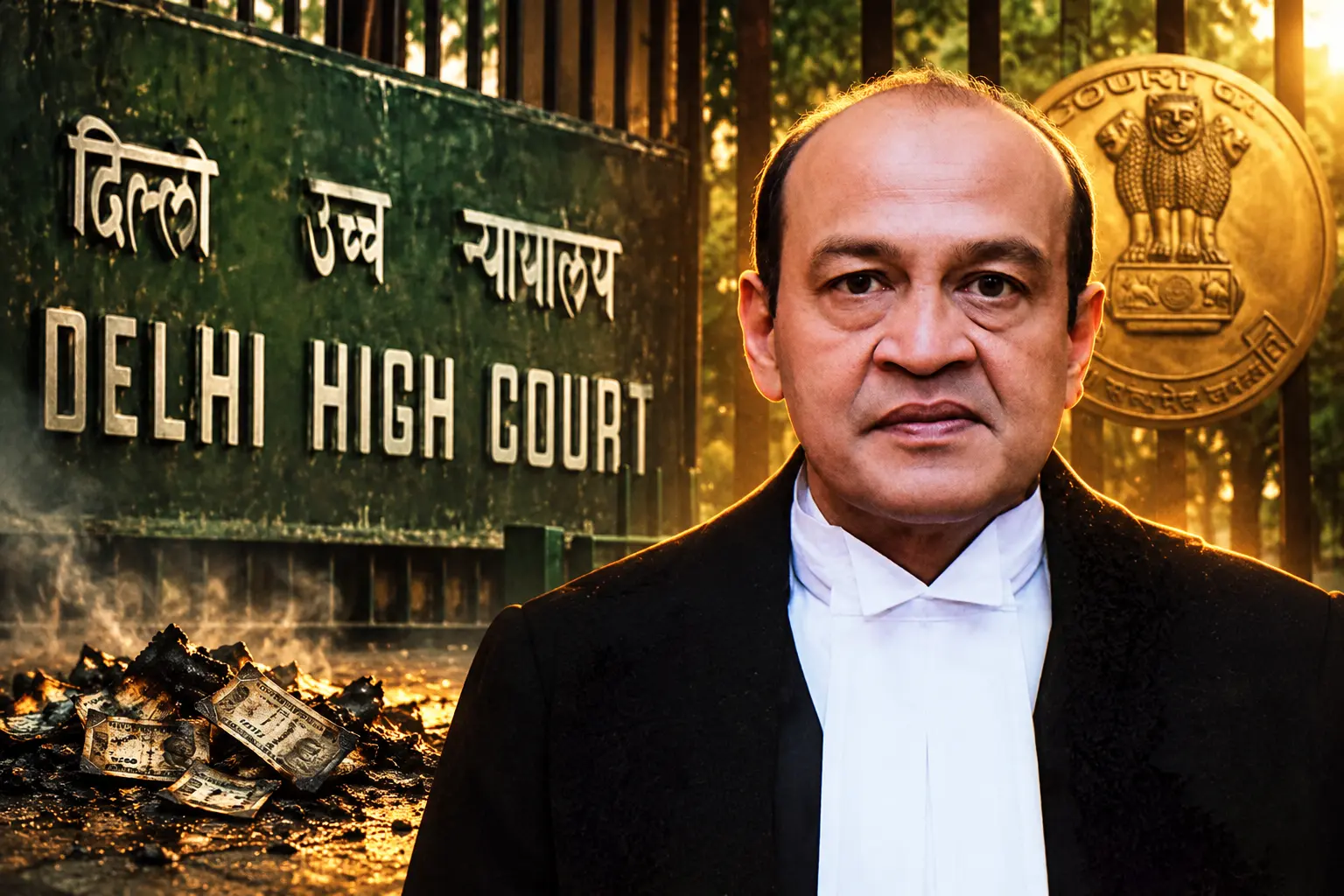
The Delhi High Court on September 21 refused a plea for an FIR over unexplained cash found at former judge Yashwant Varma’s official home. Justice Amit Bansal called the petition a wild witch hunt and told the lawyer he had other remedies in law.
Advocate Ghanshyam Dayalu Upadhyay wanted a police case and a CBI or SIT inquiry. A Lok Sabha panel had already held three charges proved. No FIR is on the record.
A Witch Hunt, the Judge Said
Bansal asked why Upadhyay had not gone to a trial court if he wanted an FIR registered. He also asked what standing the lawyer had to bring the writ at all.
I’m not entertaining this. This is a wild witch hunt. You have nothing better to do?
Justice Amit Bansal, Delhi High Court, September 21, 2026 hearing
Upadhyay said the episode was extraordinary and that a lower court cannot do justice to the matter. He added that this concerned Justice Yashwant Varma, that criminal law can be set in motion by anyone, and that there is no embargo.
After the bench indicated it would throw the petition out, Upadhyay withdrew it so he could look at the remedies still open in law. The High Court therefore did not decide the facts of the cash. It decided the door.
The same lawyer had already been to the Supreme Court. On August 7, a bench of Justices P.S. Narasimha and Alok Aradhe dismissed his writ. Narasimha told him he was an advocate, that this was a misuse of the judicial process, all for cheap publicity, and that the court was not inclined to entertain it.
Upadhyay had argued there that resignation does not wipe out criminal liability, and that he had already put a complaint before the CBI, Delhi Police and the Enforcement Directorate on June 2. He said an earlier petition had failed on the technical ground that no complaint had been filed first. The August bench still sent him away.
Three Charges Already Stand Proved
The hearing sat on top of a report that both Houses of Parliament received on August 12. A three-member committee under the Judges Inquiry Act of 1968 recorded that Articles of Charge I, II and III are proved.
Supreme Court judge Aravind Kumar presided. Bombay High Court Chief Justice Shree Chandrashekhar and senior advocate B.V. Acharya sat with him. Chandrashekhar joined on March 6 after Justice Manindra Mohan Shrivastava retired as Chief Justice of the Madras High Court. The panel put its findings with the Speaker on May 18. The two-volume inquiry report tabled in Parliament runs to a 126-page main report and a 64-page second volume.
Lok Sabha Speaker Om Birla had admitted a removal motion on August 12, 2025, after 146 Lok Sabha members moved it. Notices had been submitted on July 21, 2025. The Articles of Charge were served on November 27, 2025. Nine witnesses deposed and were cross-examined. The record carries 221 exhibits and rulings on 11 applications filed for the judge.
THE THREE ARTICLES OF CHARGE
| Article | What was alleged | What the panel held |
|---|---|---|
| I | Discovery and possession of unexplained Indian currency inside official premises | Proved. Substantial unexplained Rs 500 notes were present in the storeroom. The judge failed to explain presence, source or ownership. The panel said it was not recording direct personal ownership in the criminal sense. |
| II | Failure to preserve material evidence, and interference with it | Proved. The storeroom was disturbed before lawful sealing. The later absence of the notes is unexplained. The finding rests on failure to preserve and on acquiescence through the establishment attached to the premises, not on proof that the judge personally removed the cash. |
| III | Evasive and misleading explanations | Proved. The explanations, including a reply dated March 22, 2025, lacked the candour expected of a judge and stayed evasive when tested against independent official witnesses. |
On Article I the panel wrote that what stands established is that substantial unexplained currency notes were found within the official premises occupied by the judge, that the storeroom formed part of those premises, and that he failed to furnish a satisfactory explanation regarding its presence, source or ownership.
The Notes That Never Entered a Seizure Memo
The fire started at 30, Tughlaq Crescent, then Varma’s official residence in Lutyens’ Delhi, around 11:35 pm on Holi night, March 14, 2025. He was then a Delhi High Court judge. Fire and police officials who went in to douse the blaze said they saw Rs 500 notes in burnt, half-burnt, wet or scattered condition inside a storeroom.
The committee said the evidence pointed to bundles, heaps and stacks rather than a few stray notes. Photographs and electronic material backed the oral testimony. The notes were never seized, inventoried, weighed or sampled, so the panel refused to record any figure. The lapse, it said, goes to quantity, not to the core fact that substantial material was there.
Varma said he was in Bhopal that night and that the cash did not belong to him or his family. He argued the storeroom sat outside his control. The panel rejected that. It held the room formed part of the allotted premises. His own account of a locked liquor cabinet to which he had access, the report said, weakened the plea that the space was beyond him.
A day after the fire, the money was gone. The committee did not find that the judge himself carried it out. It built Article II on three points: nothing was secured, the scene was disturbed through people attached to the house, and the notes later could not be produced. C.G. Rawat of the CRPF, listed as PW-9, placed Rajinder Singh Karki and Mohd. Rahil near the storeroom doing cleaning work. When Rawat offered help, Rahil told him to go and do his duty. The judge admitted he was in touch with both men that night.
The panel also brushed aside planting and conspiracy as unsubstantiated. No person was identified, no entry was proved, and no other owner was named. No FIR alleging a plant was ever filed from the household side. On Article III the explanations shifted from a broad denial to theories of conspiracy, fake notes and removal by officials, none of them backed when the chance came to lead defence evidence.
He Resigned Before Parliament Could Vote
Varma was born on January 6, 1969, enrolled as an advocate on August 8, 1992, and was elevated as an additional judge of the Allahabad High Court on October 13, 2014. His official Allahabad High Court profile lists a Delhi High Court stint from October 11, 2021, a return oath on April 5, 2025, and a retirement date of January 5, 2031.
Then Chief Justice of India Sanjiv Khanna set up an in-house committee on March 22, 2025, with Punjab and Haryana High Court Chief Justice Sheel Nagu, Himachal High Court Chief Justice G.S. Sandhawalia and Karnataka High Court judge Anu Sivaraman. That panel, on May 3, 2025, found misconduct grave enough for removal. On May 8 the Chief Justice wrote to the President and the Prime Minister. Judicial work had already been pulled. The Supreme Court Collegium sent him back to Allahabad on March 28, 2025.
He challenged the parliamentary committee. The Supreme Court dismissed that plea on January 16, 2026. On April 9, 2026, with defence evidence due, he resigned to President Droupadi Murmu and walked out of the inquiry. He was 57. In the letter he said he did not propose to burden her office with the reasons, and that it was with deep anguish that he tendered his resignation from the office of Judge of the High Court of Judicature at Allahabad, with immediate effect.
To the committee he wrote that he would be doing himself and the institution a disservice by legitimising a process that called on him to answer the unanswerable, where the money came from. His lawyers were discharged on April 21. On April 29 the Lok Sabha secretariat told the panel the Speaker wanted the investigation finished and the report submitted under section 4(2) of the Act. The committee held that a statutory inquiry, once seized of definite charges, does not end because the judge resigns or stays away.
FROM THE FIRE TO THE HIGH COURT
- March 14, 2025: Fire at 30, Tughlaq Crescent around 11:35 pm. Fire and police officials see substantial Rs 500 notes in the storeroom.
- March 22, 2025: The Chief Justice of India constitutes the in-house committee.
- May 3 and May 8, 2025: The in-house panel finds misconduct. The Chief Justice writes to the President and the Prime Minister.
- August 12, 2025: The Lok Sabha Speaker admits a removal motion moved by 146 members and sets up the statutory committee.
- April 9, 2026: Varma resigns and withdraws from the inquiry. Removal as a sitting judge becomes infructuous.
- August 7, 2026: The Supreme Court dismisses Upadhyay’s FIR writ as cheap publicity.
- August 12, 2026: Both Houses receive the report holding all three charges proved.
- September 21, 2026: The Delhi High Court refuses to entertain a fresh FIR writ and the petitioner withdraws.
Removal needed a sitting judge. Once the April 9 letter went in, there was no office left from which Parliament could vote him out. The report still exists. The notes still have no seizure memo.
Why No FIR Has Been Registered
Bansal did not say the cash was imaginary. He said a High Court writ is not how this file starts. Upadhyay wanted a CBI or SIT case from the top. The bench pointed him downstairs, to a magistrate and to the ordinary police path.
That is the second-order cost of the year that preceded the hearing. Resignation ended impeachment. The statutory panel still sat, still heard nine witnesses, and still proved three charges. None of that, by itself, opened a criminal case. The government has not put an FIR on the record. Delhi Police have not. The CBI has not. Upadhyay says his June 2 complaint also produced none.
The gap is specific. The notes were seen by officials on duty and then were not preserved. The committee named that failure as a proved charge and still declined to treat the episode as a criminal finding of personal ownership. A police case would have to do the work the misbehaviour inquiry was not built to do: count, seize, trace and charge. No agency has started that work in public.
The argument that keeps returning around the case is that the benches are protecting one of their own. The sharper point is narrower. Nobody in the High Court was asked, or offered, to name who cleaned the storeroom or which matters the cash related to. Those are investigation questions. A writ court that refuses to take them over is not answering them. It is naming the forum that should.
WHERE EXPERTS DISAGREE
- FIR from the report: Senior advocate Rakesh Dwivedi said that once the report was tabled and the judge had resigned, the removal motion had worked itself out, but that on the basis of the report an FIR can certainly be registered.
- No FIR from the report: Senior advocate Gopal Sankaranarayanan said he does not believe that an FIR can be registered against Varma on the basis of the panel’s report.
- Prosecution after resignation: Senior advocate Indira Jaising said the findings could be used to enable a prosecution, because the protections that attach to a sitting judge fell away in April.
Supreme Court Bar Association president Vikas Singh said that if the committee had pointed toward an FIR, then an FIR should be registered, and that impeachment would have cut off pension in a way resignation does not. Allahabad High Court Bar Association president Anil Tiwari said an FIR can be lodged now. The split is not over whether cash was seen. It is over whether a misbehaviour report is a police brief.
After Resignation, Veeraswami’s Gate Falls Away
For a sitting High Court or Supreme Court judge, criminal process still runs through the 1991 1991 ruling on prosecuting judges in K. Veeraswami v. Union of India. The majority held that such a judge is a public servant under corruption law, but that no criminal case should be registered without consulting the Chief Justice of India. The President is the sanctioning authority, acting on that advice.
Varma is no longer on the bench. The consult-the-CJI gate was built for a sitting judge. Upadhyay hung his writs on that change. Both constitutional courts still refused to convert his petitions into a monitored CBI case. They did not revive Veeraswami for a former judge. They refused to let a publicity writ replace a first information report.
The in-house inquiry that Khanna ordered is itself not a criminal court. PRS Legislative Research, mapping the three routes for probing a judge, notes that the in-house procedure cannot lead directly to an FIR, and that no judge of the higher judiciary has been removed through the parliamentary address. The 1968 Act is the removal statute. Section 6 says that if the committee finds the judge guilty of misbehaviour, the pending motion is taken up in the House. It does not register a police case.
In 2019, then Chief Justice Ranjan Gogoi allowed the CBI to register an FIR against Allahabad High Court judge S.N. Shukla, the first use of that power. That was a sitting judge, with the CJI’s nod. Varma’s file is the other shape: a former judge, a proved misbehaviour report, and still no first page in a police station.
Parliament Has Not Closed the Pension File
A High Court judge’s resignation takes effect from the date of the letter to the President. Removal is over. Money after office is not, at least as a political file. A Union minister, speaking after the report was tabled, said the motion remains in force because it started before the resignation, and that Parliament still has to take the conduct into account and decide on perks and pension.
Jurist G. Mohan Gopal, who sat on the parliamentary inquiry into Justice P.D. Dinakaran, has said a motion to remove a man from an office he no longer holds cannot be considered. Dinakaran and Calcutta High Court judge Soumitra Sen also quit while removal was pending. The 1968 Act has no clause that strips pension, bars practice, or forces a criminal case when the subject has already gone.
DOORS THAT REMAIN OPEN
- The magistrate: Bansal’s alternative remedy is a complaint before a trial court seeking an order to register an FIR, the path Upadhyay said a lower court cannot handle.
- The agencies: Delhi Police, the CBI and the Enforcement Directorate can still act on the June 2 complaint or on the parliamentary record. None has put an FIR on the public record.
- The Houses: The report is before both Houses. They cannot vote him out of a job he has left. They can still treat the findings as a record when they deal with pension and post-office benefits.
Upadhyay walked out of Court on September 21 saying he would consider those remedies. That is the forum both the Supreme Court in August and the High Court in September named. The cash that firefighters saw on March 14, 2025, still has no owner in a criminal charge sheet, and still has no count, because it was never taken into a seizure memo.
Disclaimer: This article is news reporting and analysis of court hearings, a parliamentary inquiry and public legal comments. It is for information only and is not legal advice, nor an allegation that any named person has been convicted of a crime. Readers who wish to start or defend a criminal or service-law case should consult a qualified advocate enrolled in India and, where needed, a public prosecutor or the competent investigating agency. Dates, findings and case statuses are those given in the committee report, court remarks and official records cited here and may change if an FIR is registered, a House votes, or a later court order is passed.

A CubeSat Will Age Whisky That Never Comes Home

A Charity Quote Cost Shia LaBeouf the FKA twigs NDA

Looker Turned a Model’s Body Into Ad Inventory

Infinity Ward Bets a Paid DMZ Will Stick This Time

Disney Sidesteps a Kimmel Renewal as Failla Cites Losses

How to Get Pre Boarding on Southwest – Skip the Line with These Tricks

False AI Intel Nearly Put US Crews on a Chinese Ship

Tim Cook’s $4.6 Trillion Apple Still Runs on One Phone

Dunes Air Sues Nora Fatehi Over Its Luxury Jet

OpenAI Posts a Navier-Stokes Proof Clay Has Not Touched
-
 TRAVEL3 years ago
How to Get Pre Boarding on Southwest – Skip the Line with These Tricks
-
 NEWS1 month ago
False AI Intel Nearly Put US Crews on a Chinese Ship
-
 BUSINESS2 months ago
Tim Cook’s $4.6 Trillion Apple Still Runs on One Phone
-
 ENTERTAINMENT2 months ago
Dunes Air Sues Nora Fatehi Over Its Luxury Jet
-
 NEWS2 months ago
OpenAI Posts a Navier-Stokes Proof Clay Has Not Touched
-

 LIFESTYLE3 years ago
How Often Do You Have to Change a Monkey’s Diaper? The Truth About Pet Monkeys
-

 NEWS2 months ago
Australia Treats Cloud Software Payments as Taxable Royalties
-

 LIFESTYLE3 years ago
How Long Does It Take for Armpit Hair to Grow? The Stages of Hair Growth and How to Shave It