
TECHNOLOGY
How to Duplicate Photos on Samsung: Make a Second Copy
Duplicate photos on Samsung by saving a second file, then compare the path in Details so an album label is not the only copy you think you kept.

You want a spare of one photo before you crop it, send it, or file it with a trip. When you duplicate photos on Samsung, Gallery can give you a second file, a second album label on the same file, or a stack of similar shots that were never copies of each other.
Copy to album, Save as copy, and a copy inside My Files are three different jobs, and the Pictures tab can still list a photo after you move it. This page walks through each job, the Details check that shows whether you hold one file or two, and the cleanup that removes extras while the original stays.
What Counts as a Duplicate Photo on a Samsung Phone
For the job in front of you, a duplicate is a second file you can edit, delete, or back up on its own. An album is a way to sort photos. A stack of similar shots is a group the phone made so the Pictures tab stays shorter, and those shots were taken separately.
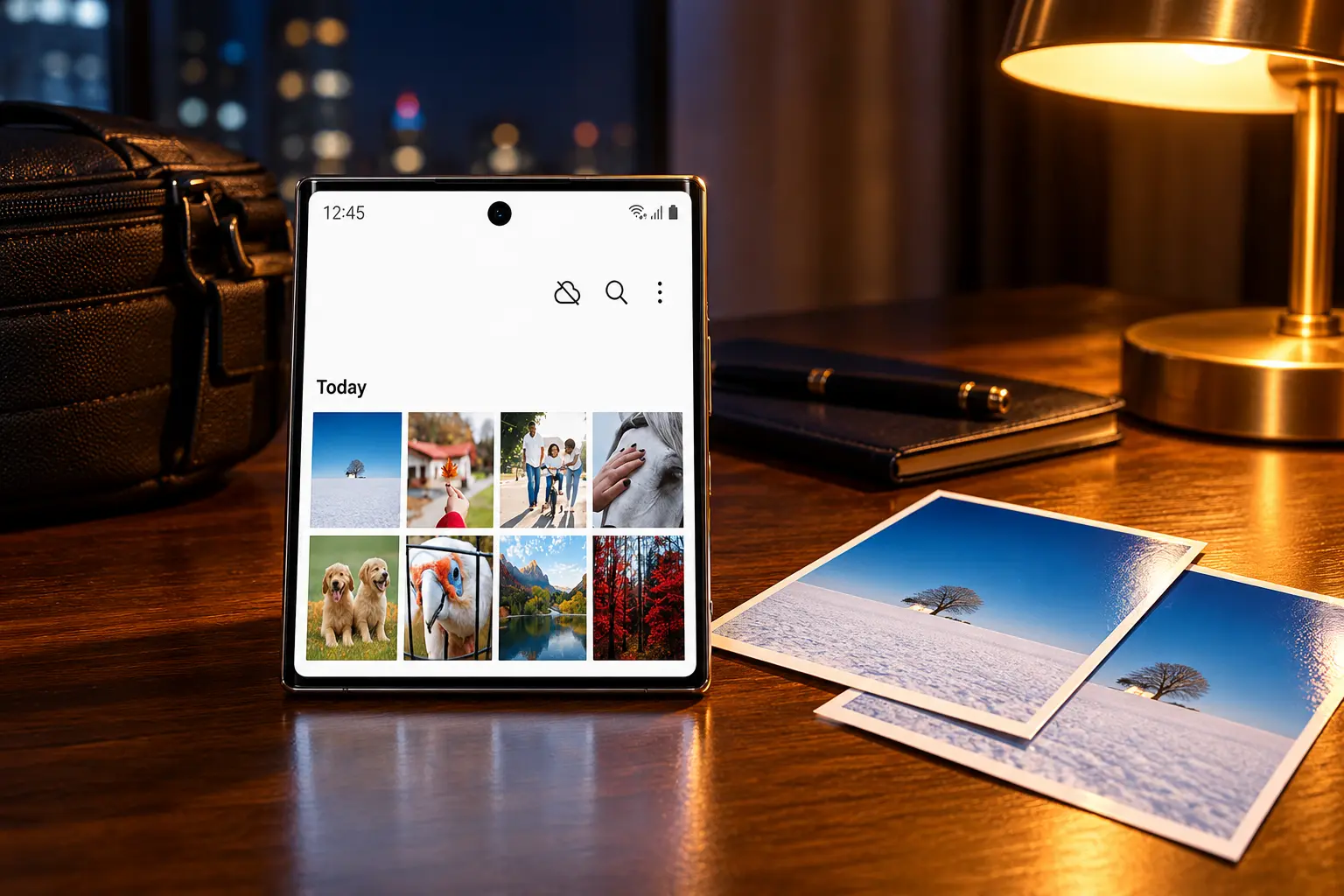
Samsung’s Gallery guide puts a small number such as 2 or 3 on a thumbnail when similar-looking pictures are grouped. Tap that thumbnail to see the group. From the Pictures tab, the three vertical dots include Ungroup similar images, which lists every shot on its own. That switch changes the grid. It does not copy a file.
| What you did | What you see | What you hold |
|---|---|---|
| Copy to album, Save as copy, or Copy in My Files | A second thumbnail | A second file when Details shows another name or another folder |
| Move to album | The photo in the album you chose | One file, which can still show on the Pictures tab |
| Several similar shots | One thumbnail with a small number | Separate photos the phone grouped |
The current US Gallery guide calls Copy to album a copy and Move to album a cut and paste. Samsung’s UK Gallery guide, updated 18 December 2020, says copying saves a second version of the image in the album and moving sends the original file there. Screens and settings vary by carrier, software version, and model, so the file path is the check that still works when the menu wording changes.
How to Copy a Samsung Photo Into Another Album
Album copy is the fast way to file a photo with a set you already browse in Gallery. Use it when you want that photo in a holiday album and you will confirm afterward that a second file exists.
From the Pictures tab, touch and hold the photo until it is selected. Tap more thumbnails if several photos should land in the same album. Tap More at the bottom, then tap Copy to album, and pick the album. Move to album sits on that same menu and relocates the photo instead of copying it. Samsung’s guide to copy a picture to another album uses those two labels.
If the album does not exist yet, open the Albums tab and tap the Create icon, the plus sign. The current US guide lists a standard album you fill yourself, an auto album that adds pictures of people you select (some phones call it an auto-updating album), a group that holds other albums, a shared album other people can open, and a shared family album. Name it, tap Create, select the photos, and tap Next or Done. The next screen asks you to choose Copy or Move.
Some regions and models hide a type, and on older software the plus sign can sit behind a three-dot menu labeled Create album. A shared album is a poor place for a private spare, because anyone you invite can see what you add. Copy the file first if you still want a visible original, then move only one file into a private album.
How to Save a Copy Before the Edit Replaces It
Editing is the moment most people need a duplicate. A crop, a filter, or a flip should leave the camera original alone, and the editor’s plain Save writes the change over the photo you opened.
Save a Copy From the Photo Editor
- Open the photo in Gallery and tap the pencil icon.
- Make the crop, flip, filter, or other change.
- Tap the three dots in the editor. On some phones they sit at the top right, and on others at the bottom right.
- Tap Save as copy or Save Copy.
- Leave the editor and open both the original and the new file before you delete anything.
That three-dot command keeps the original beside the edited photo. A plain Save replaces the photo you opened. If you already tapped Save, the original can still be recovered on phones that offer Revert, which puts it back in the same spot rather than leaving two files side by side.
Revert to the Original on Phones That Offer It
On selected models and software versions, open the edited photo, tap Edit, tap Revert, tap Revert to original, and tap Save. Samsung’s support steps, updated 15 September 2026, list that path and note that it is not on every model. After Revert, Gallery shows the original in the same place. You do not get a spare sitting next to the edit.
QUICK CROP
When you only need a piece of the photo, open it in Gallery, spread two fingers on the area you want, and tap the Quick crop icon. In the Galaxy user guide, quick crop saves a new file of that area. The full photo stays where it was, and the crop is the new file.
Pasting one edit onto other photos is a different command. It changes those other photos, and it does not give you a spare of the first file. Finish Save as copy, or the My Files copy below, before you start a cleanup.
How to Duplicate the Photo File in My Files
My Files copies the file itself into a folder you choose. That is the surest second file when an album button has left you unsure, or when the spare should live on a microSD card, in Google Drive, or in OneDrive.
Open the photo in Gallery, tap the three vertical dots, and tap Details. Read the file name and the folder path, then look for that exact file so you do not copy a lookalike from the same burst. For a shot taken with the camera, the path runs through a DCIM folder named Camera. A screenshot or a download uses a different folder, so follow the line Details printed.
- Open My Files. It is usually in the Samsung folder.
- Tap Images, or open Internal storage and follow the path from Details.
- Touch and hold the file. Tap more files in that folder if you want several copies in one pass.
- Tap Copy. Move is the other button, and it takes the file out of the folder it is in now.
- Open the destination. For a folder on the phone, choose Internal storage. Tap SD card when a microSD card is inserted. Google Drive and OneDrive are on the same list after you sign in.
- To make a new folder, tap the three vertical dots, tap Create folder, name it, and tap Create.
- Tap Copy here.
Samsung’s steps to copy the file in My Files end on Copy here. If that folder already holds a file with the same name, pick the choice that keeps both files. Gallery reads the folders on the phone, so the new file shows up there after the copy finishes. My Files does not paste into the Gallery app as if Gallery were a folder of its own.
A tablet is different on the delete side. Samsung says tablets do not have Trash in My Files, so a file you delete there cannot be restored. Copying still works. Deleting on a tablet does not give you a way back.
How to Tell a Second File From One Photo Listed Twice
The Pictures tab browses what is on the phone. A photo can show there and inside an album while My Files holds one file or two, so two thumbnails are not proof. A move into a new album has left some Galaxy owners looking at the camera folder and the new folder and wondering which button they actually used. The Details screen settles it.
THE PATH CHECK
- Open Details: Open each thumbnail, tap the three vertical dots, and tap Details.
- Read the name: Note the file name shown for each thumbnail.
- Read the path: Note the folder path shown for each thumbnail.
- Compare both: The same file name and the same path means one file. A different name or a different folder means two files.
Try it on a photo you would hate to crop badly. Copy it to an album you name Spare, then open the camera thumbnail and the Spare thumbnail and compare the two Details screens. If both lines match, the album did not give you a file you can ruin safely, so make the spare with Save as copy or with Copy here, and check again. Edit only the file whose path is the new one.
How to Delete Duplicate Photos and Keep the Original
Once a real second file exists, the extra is what you clear later. Gallery and My Files do not treat that job the same way, and selecting every row can remove the original with the extra.
Gallery’s cleaner is built to drop duplicates and keep originals. Open Gallery, tap Menu (the three horizontal lines) at the bottom, tap Clean out, and tap Delete duplicate pictures. If Gallery has no duplicate images, Samsung says this option may not appear. Tap Delete duplicates, then Delete, then Move to Trash. On older Gallery menus the entry is named Suggestions. Open the menu and look for the line that names duplicate pictures.
My Files scans more than photos. Open My Files, tap Analyse Storage (some phones spell it Analyze), tap Duplicate files, select what you want gone, and tap Delete. Samsung’s duplicate-file steps warn that if you delete all the files after checking them, the original files are deleted too. Select the extra, and leave the file you mean to keep unselected.
| Cleanup | Where it sits | What stays |
|---|---|---|
| Gallery | Menu, then Clean out, then Delete duplicate pictures | Samsung says this removes duplicates and saves the originals |
| My Files | Analyse Storage, then Duplicate files | Nothing is spared if you select every file in the set |
A file you delete in My Files on a phone goes to Trash and stays there for 30 days before the phone removes it for good. Confirm with Move to Trash. Gallery has its own Trash: open Gallery, tap Menu, tap Trash, tap Select, choose the photo, and tap Restore. The Gallery user guide says those files are deleted after a certain period and does not print a day count, so restore while the photo is still listed. Empty, under the three dots in Gallery Trash, deletes what is in there now.
Finish the path check and confirm the original’s name before you open either cleaner. A matching path means the album was a label, and a cleanup run in that minute can throw away the only file.
What a Hidden Album or a Backup Does to Your Copy
Hiding and backing up do not make a second file. Each one changes where the file you already have can be seen, which is why a spare should exist before you hide or clear local copies.
A private album is a move. Select the photo, tap the three vertical dots, tap Move to private album, and tap Move. The photo leaves the main gallery and leaves apps that read your media. To open it later, tap Menu, tap Private Album, and pass the security lock. If you still want a visible original, copy the file in My Files first, then move only one of the two files into the private album.
OneDrive sync is a backup, not a duplicate button. In Gallery, tap Menu, tap Settings, and tap Sync with OneDrive. Free up phone space, then Delete all, removes the displayed photos and videos from Gallery on the phone while they stay in OneDrive. After that, the phone no longer holds the local file. Google’s backup switch is separate: Settings, then Accounts and backup, then Back up data, then Photos and videos.
Share sends the photo to another app or another person. Gallery does not gain a new file from that send. A chat can hold what you sent, and that copy is not the file in your camera folder.
Mistakes When You Duplicate Photos on Samsung
Most lost originals come from a button that sounds like a copy and behaves like a move, or from a cleanup that treats every matching row as trash.
COPY MISTAKES
- Plain Save: The editor replaces the photo you opened, so use Save as copy when you need both.
- Move by habit: Move to album and Move to private album relocate the file, and a second thumbnail in Pictures does not prove you have two.
- Select all: In My Files duplicate cleanup, selecting every file in a set deletes the original along with the extra.
- Clean too early: Running Clean out before the path check can throw away the spare you just made, or the only file.
- Free up space: Delete all under OneDrive sync clears the phone copies and leaves the cloud copies.
- Tablet delete: My Files on a tablet has no Trash, so a wrong delete there cannot be restored.
Fix a bad save with Revert when the phone offers it, and fix a bad delete from Trash while the file is still listed. If Trash is already empty, the local file is gone, and the copy that remains is the one you synced before the delete.
Frequently Asked Questions
Can You Duplicate Several Samsung Photos at Once?
Yes. Touch and hold the first photo, tap the others, and then use Copy to album, or select several files in My Files and tap Copy. Each file is copied into the place you choose, and a Details check on one file does not prove the others copied cleanly.
Do the Same Steps Work for a Video?
Copy to album and a My Files copy both work for videos, because Samsung’s Gallery steps copy videos into an album the same way they copy photos. Save as copy is the photo editor’s command, so copy a video in My Files before you trim it when you need the original clip kept.
What if Delete Duplicate Pictures Is Missing?
Gallery leaves that entry off the menu when it finds no duplicate images. Make a real second file, confirm two different paths in Details, and open the menu again. If Clean out itself is missing, look for Suggestions on older software, or open Duplicate files in My Files and leave one file in each set unselected.
Can You Copy a Samsung Photo to a microSD Card?
Yes, in My Files, when the phone has a card in it. Tap Copy, tap SD card, choose the folder, and tap Copy here. Not every Galaxy model takes a microSD card, and the current album steps in Gallery do not ask you to pick a card.
Does Sharing a Photo Leave a Second Copy in Gallery?
Sharing sends the photo to the app you pick and does not add a new file in Gallery. A messaging app can keep what you sent inside the chat, which is separate from the file in your camera folder, so make the spare with Save as copy or My Files before you share.
Open Details on the photo and on the spare before you crop, hide, or clear. Different names or different folders mean the spare is a real file, and you can change one without losing the other. Matching lines mean you still need Save as copy or a My Files copy before you touch the original.

A CubeSat Will Age Whisky That Never Comes Home

A Charity Quote Cost Shia LaBeouf the FKA twigs NDA

Looker Turned a Model’s Body Into Ad Inventory

Infinity Ward Bets a Paid DMZ Will Stick This Time

Disney Sidesteps a Kimmel Renewal as Failla Cites Losses

Southwest Preboarding: Who Qualifies and What to Do

False AI Intel Nearly Put US Crews on a Chinese Ship

How Often Do You Have to Change a Monkey’s Diaper?

Tim Cook’s $4.6 Trillion Apple Still Runs on One Phone

Dunes Air Sues Nora Fatehi Over Its Luxury Jet
-
 TRAVEL3 years ago
Southwest Preboarding: Who Qualifies and What to Do
-
 NEWS2 months ago
False AI Intel Nearly Put US Crews on a Chinese Ship
-
 LIFESTYLE3 years ago
How Often Do You Have to Change a Monkey’s Diaper?
-
 ENTERTAINMENT2 months ago
Dunes Air Sues Nora Fatehi Over Its Luxury Jet
-
 LIFESTYLE3 years ago
How Long Does It Take for Armpit Hair to Grow?
-
 BUSINESS2 months ago
Tim Cook’s $4.6 Trillion Apple Still Runs on One Phone
-

 NEWS2 months ago
OpenAI Posts a Navier-Stokes Proof Clay Has Not Touched
-

 TRAVEL2 years ago
Smallest Airlines in the US: Niche Carriers and Unique Flights