
BUSINESS
V4 Backs India’s UN Seat as New Delhi Builds a Channel
Four Visegrad states backed India’s permanent UNSC seat in New York and locked in yearly talks plus a business forum as U.S. tariff threats rise.

Four Central European states backed India for a permanent UN Security Council seat on September 21, 2026, at their first joint ministerial with New Delhi. Slovakia’s Juraj Blanár said the Visegrad Group wants India “at the table” as a permanent member. External Affairs Minister S. Jaishankar called the New York session a “new historic occasion.”
The line will travel through UN week. What the five ministers can actually deliver is a standing channel: yearly foreign minister meetings and an annual business forum, set as India looks for European markets while a new U.S. law threatens tariffs of up to 100 percent on buyers of Russian oil.
Four Ministers Put India on the Record in New York
The first V4+India foreign ministers’ meeting sat on the sidelines of the 81st UN General Assembly. Jaishankar joined Poland’s deputy prime minister and foreign minister Radek Sikorski, Hungary’s deputy prime minister and foreign minister Anita Orban, Slovakia’s minister of foreign and European affairs Juraj Blanár, and Czech foreign minister Petr Macinka. Slovakia holds the group’s rotating presidency and convened the room.
Blanár spoke after the session and put all four states on the record for a permanent member seat. He framed India as part of the Global South and as an “upcoming superpower in the Indo-Pacific region.” Jaishankar posted the clip the same afternoon.
We all agree as V4 countries that India as a part of the Global South, upcoming superpower in the Indo-Pacific region, must be at the table as the permanent member of the UN Security Council
Juraj Blanár, Slovakia’s minister of foreign and European affairs, after the V4+India meeting
‘We all agree as V4 countries that India as a part of the Global South, upcoming superpower in the Indo-Pacific region, must be at the table as the permanent member of the UN Security Council’
– Foreign Minister Juraj Blanár of Slovakia after the first V4 + India FMM #UNGA81… pic.twitter.com/QwFsjlXWYC
— Dr. S. Jaishankar (@DrSJaishankar) September 21, 2026
Jaishankar told reporters the talks were “very, very productive” and that the group had a “very useful exchange” on the Ukraine war and on the Gulf. He is due to address the General Debate on September 26, 2026. The United States, the United Kingdom, France, and Russia have already backed India for a permanent seat. China has not.
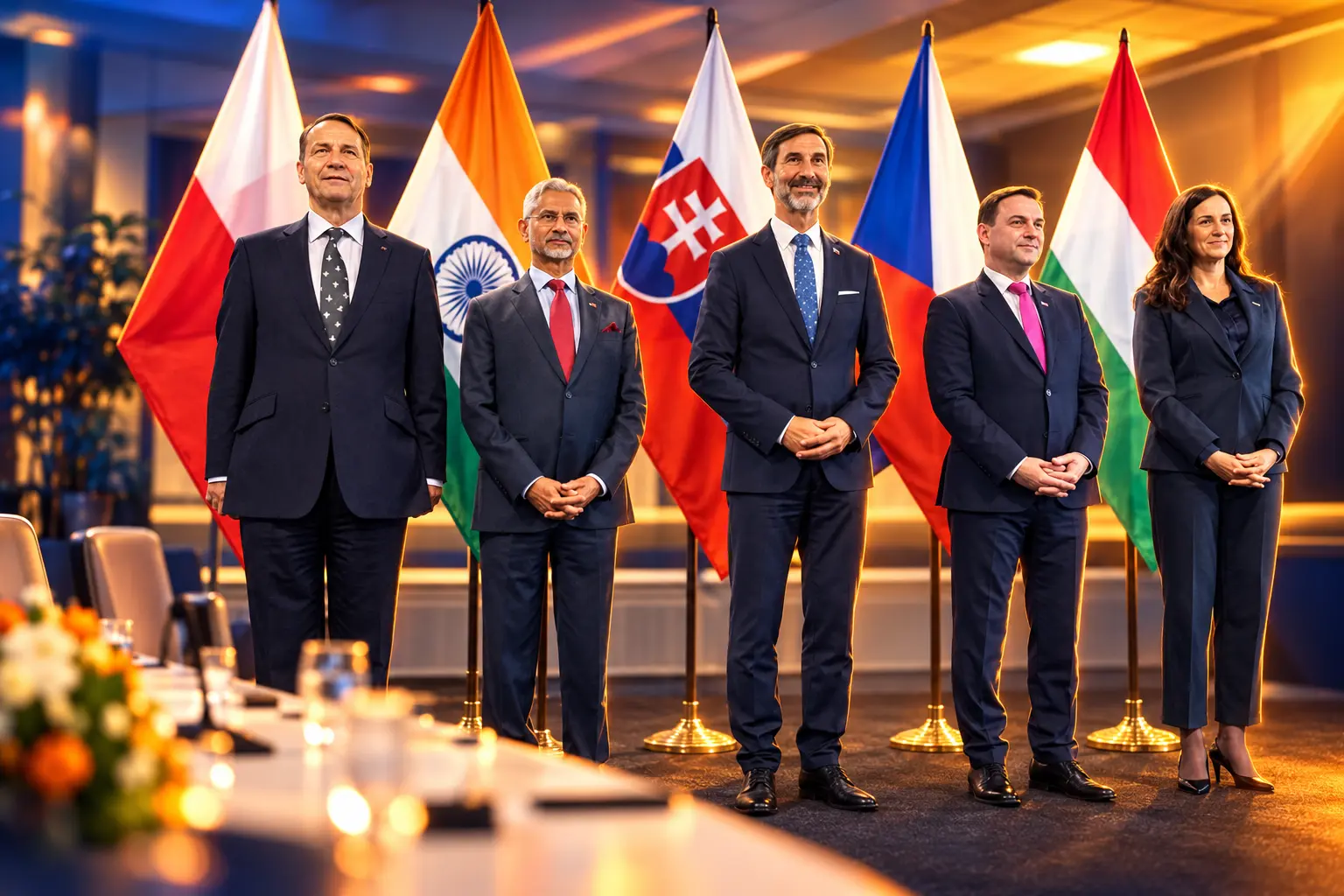
The Meeting Locked in Annual Talks and a Business Forum
Jaishankar did not lead with the Council. He tied the V4 track to a deepening India-EU relationship and said the five had consensus that foreign ministers would meet every year. He also said they would “take some special initiatives to create an annual business forum.” His own readout listed six items.
WHAT THE FIVE MINISTERS AGREED
- Political track: Closer political cooperation, including annual meetings of foreign ministers.
- Business track: Deeper economic cooperation, including an Annual Business Forum.
- Tech and schools: Stronger partnerships in technology, innovation, research, and education.
- Defence: A push to reinvigorate defence cooperation.
- People: Further cultural cooperation and people-to-people ties.
- UN system: A pledge to work together in support of multilateralism.
Delighted to join the Visegrád Group DPM & FM @radeksikorski #Poland DPM & FM @_OrbanAnita #Hungary FM Juraj Blanár #Slovakia and FM @petr_macinka #Czechia on the sidelines of #UNGA81. Our first meeting in the V4+India format agreed to:
✅ Closer political cooperation including… pic.twitter.com/mBqMTkC6QN
— Dr. S. Jaishankar (@DrSJaishankar) September 21, 2026
Space, connectivity, and mobility also came up. On defence, Jaishankar said India already has “a very strong history with all the V4 countries” and wants to “refresh and take forward that record.” He described the four as industrial economies with “great innovation and technology talent,” and said New Delhi welcomes working with them as a group. India’s Ministry of External Affairs called V4+India an extra platform on top of the bilateral ties India already holds with each capital.
Why India Is Building a Central Europe Channel Now
The timing is not only UN week. India spent 2026 opening a European trade door that is still not law, while Washington wrote a new tariff threat into statute days before the ministers sat down. Central Europe is a place where both pressures meet: factories that want Indian orders, and governments that still argue over Russia.
Brussels Has a Deal That Is Not Yet Law
India and the European Union concluded free trade talks in January, the largest such deal either side has closed. The texts still need legal revision, translation, a Council decision, the European Parliament’s consent, and ratification in India. Jaishankar met EU colleagues in New York the same afternoon as the V4 session and discussed India-EU work, the Gulf, Ukraine, and the Indo-Pacific. The V4 forum is a way to run a Central European business track while that larger deal waits on signatures.
THE JANUARY TRADE PACKAGE
- Two-way trade: The EU and India already trade over €180 billion in goods and services a year, supporting close to 800,000 EU jobs.
- Tariff cut: The deal is meant to eliminate or reduce tariffs on 96.6 percent of EU goods exports to India.
- Export aim: Brussels says that should double EU goods exports to India by 2032 and save about €4 billion a year in duties.
- Scale claim: Commission President Ursula von der Leyen said the two sides had created a free trade zone of 2 billion people.
Talks first opened in 2007, froze in 2013, and restarted in 2022. Sensitive farm goods such as beef, rice, and sugar stay outside liberalisation. Until the signatures land, a V4 business forum is a smaller room India can actually book.
A New U.S. Law Targets Russian Oil Buyers
President Donald Trump signed the Lindsey O. Graham Sanctioning Russia and Iran Act on September 19, 2026. The statute gives him authority to impose tariffs of up to 100 percent on countries that keep buying Russian energy. It is more durable than last year’s executive tariffs, because Congress wrote it and a waiver needs a written case. India has already lived with steep U.S. duties linked to Russian oil, including a 50 percent levy in August 2025.
Kpler, a maritime data firm, put Russian crude at roughly half of India’s imports in the summer of 2026. India’s foreign ministry said the country “remains firmly committed to ensuring energy security for its 1.4 billion people” and would keep diversifying suppliers by market conditions. Europe cannot replace the U.S. market. It can, if the January deal is signed and if a V4 forum works, take more Indian goods while that fight runs.
Charter Math Still Gives One Capital a Veto
Blanár’s sentence does not amend the UN Charter. Adding a permanent member means changing the 1945 text. Under Article 108, amendments need every permanent member’s ratification after a two-thirds vote in the General Assembly. One holdout among the five can freeze the map.
THE P5 ON INDIA’S PERMANENT SEAT
| Permanent member | Public position on India’s bid |
|---|---|
| United States | Has backed India for a permanent seat |
| United Kingdom | Has backed India for a permanent seat |
| France | Has backed India for a permanent seat |
| Russia | Has backed India for a permanent seat |
| China | Has not endorsed India’s permanent candidacy |
Four of the five veto powers already say yes in public. That is why another European communique, even a joint one, does not reset the arithmetic. A single capital that withholds ratification outweighs the Visegrad Group, and outweighs the rest of the EU, because the Charter was written that way. China has spoken of a greater voice for developing countries while blocking the G4 path and resisting text-based talks in the Intergovernmental Negotiations. The G4, formed in 2004, groups India with Brazil, Germany, and Japan. Italy’s Uniting for Consensus camp, which includes Pakistan, opposes new permanent seats and prefers a larger elected tier.
The Council itself last grew in 1965, from 11 members to 15. It still has five permanent seats and ten elected two-year seats. India has used the elected track before, most recently in 2021-22, and is running it again for 2028-29. That is a different race from the one Blanár described.
Slovakia Spoke for a Bloc That Only Just Reopened
The Visegrad Group is a political and cultural alliance of Poland, Hungary, Slovakia, and the Czech Republic, built to work on military, economic, cultural, and energy files. It spent years split over Russia and Ukraine. Leaders tried to put it back together at Gödöllő, Hungary, on June 24, 2026.
THE ROAD TO THE NEW YORK MEETING
- January 27, 2026: India and the EU close FTA negotiations in New Delhi; the texts still await signature and ratification.
- June 24, 2026: Hungarian Prime Minister Péter Magyar hosts Poland’s Donald Tusk, Slovakia’s Robert Fico, and Czech Prime Minister Andrej Babiš to relaunch the V4, with a focus on energy prices, industry, and the next EU budget.
- July 1, 2026: Slovakia takes the rotating V4 presidency.
- July 13, 2026: Jaishankar launches India’s campaign for an elected Council seat in 2028-29.
- September 19, 2026: Trump signs the law allowing tariffs of up to 100 percent on major buyers of Russian energy.
- September 21, 2026: The first V4+India foreign ministers’ meeting convenes in New York; Blanár backs a permanent Indian seat; the five agree yearly talks and a business forum.
Magyar’s office has described a bloc of about 65 million people whose combined trade with Germany exceeds France’s. That is a manufacturing belt, not a veto. Poland and the Czech government have taken a harder line on Russia than Hungary and Slovakia, which still lean on Russian energy. The New York session put those four in one room with India and still produced a joint line on the Council. It also produced a schedule India can keep even if the four fall out again.
A Separate Race for the 2028 Council Term
India opened its campaign in July 2026 for a non-permanent seat on the 15-member Security Council in the 2028-29 term. That seat is elected. It lasts two years. It does not come with a veto. Jaishankar has cast the run around Global South interests, counter-terrorism, and maritime security under a SHANTI banner. China, asked about the elected bid, said it had “taken note of relevant reports.”
The elected campaign is the one India can win on votes in the General Assembly. The permanent campaign is the one that still dies in a ratification file in Beijing, unless the P5 change their minds together. Collecting V4 language helps the first race and dresses the second. It does not complete the second.
WHAT WE KNOW
- The format: V4+India now exists at foreign-minister level, with a pledge to meet annually and to convene a business forum.
- The Council line: All four V4 states, speaking through Blanár, backed India as a permanent member on September 21, 2026.
- The P5 split: Four permanent members have backed India; China has not endorsed the bid.
WHAT IS UNCONFIRMED
- FTA timing: No date is set for signature or entry into force of the January EU-India deal.
- Tariff trigger: The new U.S. law authorises tariffs of up to 100 percent; it does not, by itself, impose them.
- Charter talks: There is still no agreed negotiating text in the Intergovernmental Negotiations on Council reform.
Jaishankar will take the permanent-seat case to the General Debate on September 26, 2026. The V4 will not be on the ballot. The forum they promised is the piece of September 21 that does not need a Charter amendment to exist.

A CubeSat Will Age Whisky That Never Comes Home

A Charity Quote Cost Shia LaBeouf the FKA twigs NDA

Looker Turned a Model’s Body Into Ad Inventory

Infinity Ward Bets a Paid DMZ Will Stick This Time

Disney Sidesteps a Kimmel Renewal as Failla Cites Losses

How to Get Pre Boarding on Southwest – Skip the Line with These Tricks

False AI Intel Nearly Put US Crews on a Chinese Ship

Tim Cook’s $4.6 Trillion Apple Still Runs on One Phone

Dunes Air Sues Nora Fatehi Over Its Luxury Jet

OpenAI Posts a Navier-Stokes Proof Clay Has Not Touched
-
 TRAVEL3 years ago
How to Get Pre Boarding on Southwest – Skip the Line with These Tricks
-
 NEWS1 month ago
False AI Intel Nearly Put US Crews on a Chinese Ship
-
 BUSINESS2 months ago
Tim Cook’s $4.6 Trillion Apple Still Runs on One Phone
-
 ENTERTAINMENT2 months ago
Dunes Air Sues Nora Fatehi Over Its Luxury Jet
-
 NEWS2 months ago
OpenAI Posts a Navier-Stokes Proof Clay Has Not Touched
-

 LIFESTYLE3 years ago
How Often Do You Have to Change a Monkey’s Diaper? The Truth About Pet Monkeys
-

 NEWS2 months ago
Australia Treats Cloud Software Payments as Taxable Royalties
-

 LIFESTYLE3 years ago
How Long Does It Take for Armpit Hair to Grow? The Stages of Hair Growth and How to Shave It