
BUSINESS
Iran Bets a Seven-Day Hormuz Clock Against Trump
Iran offered to reopen Hormuz in six days if Washington lifts its blockade, a midterm-oil wager after the June deal collapsed and officials say Trump would wait.

Iran offered on Friday to reopen the Strait of Hormuz in six days and restart nuclear talks on day seven if the United States lifts its blockade. Foreign Minister Abbas Araghchi said the seven-day clock starts only when Washington accepts the plan, which also asks for oil-sanctions relief and a ceasefire covering Lebanon.
US officials familiar with the talks said President Donald Trump has already turned the offer down and expects bombing to resume after the November 3 midterms. The White House has not said that in public.
Iran’s Seven-Day Clock Starts Only If Washington Says Yes
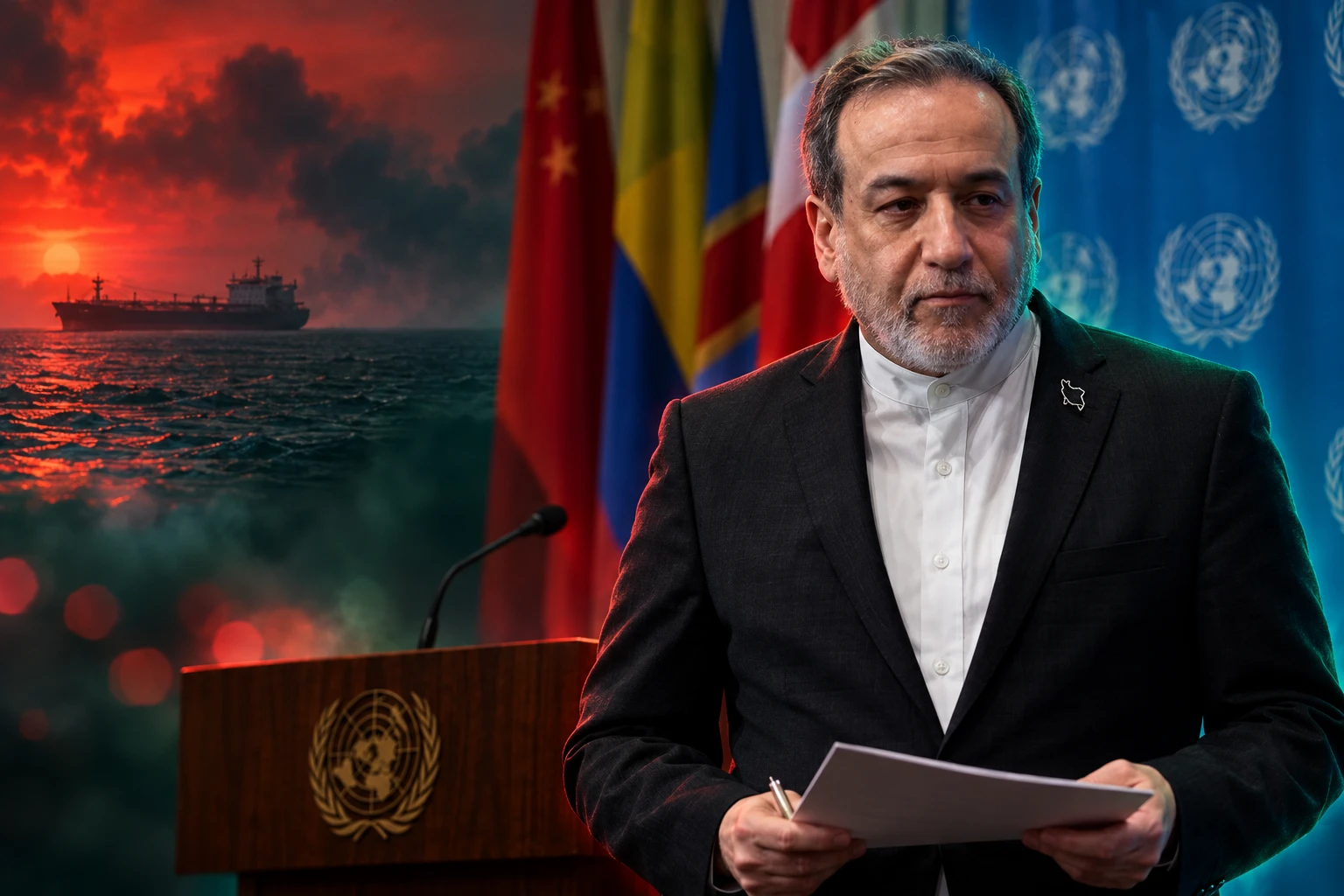
Araghchi spoke to reporters outside the UN Security Council on Friday, September 25, after Qatar passed the plan to the Americans on the sidelines of the General Assembly. He said every step Washington would have to take is already written into the June memorandum of understanding, so Tehran sees no practical barrier if the White House wants a deal.
“The seven-day timeline will start as soon as the United States accepts this plan,” he said. Initial US moves would take about four to five days. The strait would open on day six. “And on day seven, the talks with the US will be started for the final deal on mutually agreed subjects,” he said, meaning the nuclear file.
HOW THE SEVEN DAYS WOULD RUN
- The trigger: The clock starts the day after Washington accepts, not before.
- Days one to five: The United States lifts the port blockade, waives sanctions on Iranian oil sales, and joins a ceasefire that includes Lebanon; the plan as described to reporters also calls for the release of about $12 billion in frozen Iranian assets.
- Day six: Iran reopens the Strait of Hormuz to normal passage.
- Day seven: Nuclear talks begin on mutually agreed subjects.
Araghchi put the choice in one line and refused to dress it up as surrender. He also said a deal “would be better” before the US midterms.
The choice now rests with the United States. Iran does not accept coercion, threats or intimidation, and Iran will not surrender its sovereign rights under pressure. I can tell you if there is seriousness on the US side to come to a deal and reopen the Strait of Hormuz, everything is now prepared.
Abbas Araghchi, Iranian foreign minister, United Nations
Iran’s embassy in Japan posted the same stakeout remarks, including the day-six and day-seven sequence, on Saturday.
BREAKING:
Iran's FM Araghchi’s Stakeout Remarks at the U.N. on a Possible Seven-Day Plan with the U.S.:
"The seven-day timeline will start as soon as the U.S. accepts this plan.
So, if they accept this plan tomorrow, the seven days will start from tomorrow.
There are certain… pic.twitter.com/2MLyw6hGCp
— Iran in Japan/ 駐日イラン大使館 (@IraninJapan) September 26, 2026
He met Trump’s envoy, Steve Witkoff, on Tuesday in a session Witkoff called “lengthy,” saying he hoped it would “prove constructive and promising.” Secretary of State Marco Rubio had said on Wednesday that Washington would exchange ideas “if there’s an opportunity.” President Masoud Pezeshkian hosted Qatari Prime Minister Sheikh Mohammed bin Abdulrahman Al Thani early Friday. “It’s America that must choose whether it wants to end this or not,” Pezeshkian said this week.
What the June Bargain Promised
The new clock is the June deal with the waiting cut out. Trump and Pezeshkian signed a 14-point memorandum of understanding on June 17 that gave both sides 60 days to reopen the strait, sort sanctions, and start nuclear talks. A Congressional Research Service chronology records that the text called for removal of the US naval blockade of Iranian ports on April 13 and for Iranian “arrangements” for commercial ships to pass with no charge for 60 days only, with later management to be set by Iran in consultation with Oman and other Gulf states.
That bargain started coming apart inside nine days. On June 26 the Singapore-flagged container ship Ever Lovely was hit near the Omani coast. The US blamed Iran. Tehran said ships that skipped Iran-designated channels were violating Article 5 of the memorandum, which it read as giving it sole coordination of traffic. US Central Command struck Iranian surveillance, air-defense, drone, and mine-laying sites. Iran then hit targets in Bahrain and Kuwait. Trump threatened to “militarily complete the job.” Both sides later said they would stand down; the pause did not hold.
FROM THE JUNE MEMORANDUM TO FRIDAY’S CLOCK
- February 28, 2026: The United States and Israel open the war with air and maritime strikes that Tehran still dates as the start of the conflict.
- April 13, 2026: After talks in Islamabad fail, Trump orders a blockade of ships going to or from Iranian ports, with a humanitarian exception.
- June 17, 2026: The 14-point memorandum is signed, the blockade is to come off, and the strait is to stay open at no charge for 60 days.
- June 26, 2026: Ever Lovely is struck; tit-for-tat raids follow through the weekend.
- July 2026: Trump declares the deal over; the blockade is reimposed and Hormuz traffic slumps again.
- September 25, 2026: Araghchi puts the same US obligations on a seven-day clock and waits for an answer.
Vague wording on “best efforts” and “arrangements” was the fuse. Iran treated coordination as control. Washington treated any shot at a ship as a breach. Each side still says the other broke the June text first, which is why a faster timetable does not, by itself, settle who polices the waterway.
Gasoline Politics and the November 3 Deadline
Araghchi’s wager is political, not naval. Trita Parsi, executive vice president of the Quincy Institute, sat in a private Thursday gathering where the minister floated the idea that a fast deal would help Trump before the midterms. “If Trump calculates this arrangement is worthwhile and can bring political benefit before the midterms and reduce gas prices, perhaps we’ll see flexibility not seen in previous weeks,” Parsi said. He also flagged “deep suspicion” that Iran mainly wants time to move oil and ease the squeeze at home.
Hamidreza Azizi, a senior Iran analyst at the International Crisis Group, wrote that Tehran already puts the odds of a Trump no higher than a yes. “The Iranians already know that the chances of this not being accepted by Trump are much higher than the opposite,” he wrote. The public offer still has a use in Tehran: it shows Iran was ready for diplomacy if the United States hits during a talks track for a third time.
Brent crude has held above $100 a barrel through much of September. US diesel has been running at records that beat the June 2022 peak, and the Strategic Petroleum Reserve has been drawn down to levels last seen in the early 1980s. Trump has said he is in no rush for a deal even as pump prices feed inflation, and he has said he is in “deciding mode” among wiping Iran out, keeping the economic squeeze, or taking a settlement. The November 3 midterms are the date that makes a six-day reopening look like a campaign instrument rather than a peace process.
The Blockade Has Flipped Who Feels the Squeeze
Hormuz is a narrow gate, 21 nautical miles at its narrowest point, with two-mile inbound and outbound lanes. Before this war it carried about a fifth of the world’s traded oil. The US Energy Information Administration put total oil flows at 20.9 million barrels a day in early 2025, about 20 percent of global petroleum liquids use and a quarter of seaborne oil. About 80 percent of that oil was bound for Asia. Bypass pipes in Saudi Arabia and the United Arab Emirates can take only about 3.5 to 5.5 million barrels a day, and the Saudi East-West line to Yanbu has itself been hit.
Iran closed the strait in the opening days and kept selling its own crude, mostly to China. The US blockade reversed that. Homayoun Falakshahi, an oil analyst at Kpler, found Iranian exports down from 1.85 million barrels a day last spring to around 255,000 in August. Non-Iranian oil moving through Hormuz rose from 300,000 barrels a day at the height of the fighting to 8.4 million in September. Alternative routes took the non-Iranian total to 10.8 million, against about 14 million before the war. Energy Secretary Chris Wright said the United States is “probably two-thirds or more of preconflict flows.”
WHO IS MOVING OIL NOW
| Flow | Earlier mark | Latest mark |
|---|---|---|
| Iranian crude exports (Kpler) | 1.85 million b/d, last spring | Around 255,000 b/d, August |
| Non-Iranian oil through Hormuz | 300,000 b/d at the war’s height | 8.4 million b/d, September |
| Non-Iranian oil plus other routes | About 14 million b/d before the war | 10.8 million b/d, September |
| Hormuz oil, peacetime baseline (EIA) | 20.9 million b/d, first half of 2025 | Far below, and jumpy day to day |
Traffic still does not look like peace. Windward counted 12 transits on September 22, against roughly 130 a day before February 28. A US defense official said about 60 commercial vessels moved through on Wednesday. Saudi Aramco resumed loadings at Ras Tanura on Friday after a halt of nearly four months. Those Gulf barrels are the product of a heavy US escort, not of a settled corridor, which is why Iran’s seven-day plan is also a bid to get its own oil moving again under a sanctions waiver.
Hard-Liners at Home, Saudi Doubts Next Door
Pezeshkian and Araghchi have spent the week looking for an off-ramp that the security services may not want. Firebrand lawmaker Ebrahim Rezaei wrote that merely meeting “the aggressor enemy” showed weakness. Iran’s Assembly of Experts, the clerical panel that appoints the supreme leader, said “there is no path other than resistance.” Parliament speaker Mohammad Bagher Qalibaf, who once led earlier talks with Washington, put the split on the record.
There is a view that speaks of war but offers no prospect or mechanism for bringing it to a powerful conclusion. At the opposite end is a current that makes the error of underestimating national capabilities. The first error keeps the country in a state of permanent crisis, while the second hands national resources and dignity over to the enemy.
Mohammad Bagher Qalibaf, speaker of the Iranian parliament
Araghchi said more than 5,000 people in Iran have been killed in the nearly seven-month US-Israeli war. That body count is the hard-line argument for holding the strait until the terms get bigger, and it is the moderate argument for taking a seven-day deal before another round of strikes.
Riyadh is the other veto. A person familiar with Gulf deliberations said Saudi Arabia is skeptical of this push. Gulf states spent the summer saying they could live with a temporary Iranian role in managing Hormuz. That math changed when Houthi forces seized stretches of Yemen’s Red Sea coast, including Perim Island in the Bab el-Mandeb, and a drone attack shut Saudi Arabia’s East-West pipeline. Pezeshkian has tried to put space between Tehran and those raids, saying “the Houthis are responsible for their own actions.” The seven-day text as Araghchi described it names Lebanon. It does not settle Yemen, which is the front Saudi Arabia now cares about most.
Officials Say Trump Would Rather Wait
The White House, asked about the war, said US officials are having positive and constructive conversations with mediators and that the United States is facilitating significant oil exports through the strait. It offered no public yes or no on the seven-day plan. Officials familiar with the private channel said the president does not intend to lift the maritime blockade, doubts Iran will meet his nuclear terms, and has told aides he expects a new bombing campaign after November 3. A senior Iranian official, speaking separately, said Tehran would show no nuclear flexibility even if Washington took the peace track.
WHAT WE KNOW
- The offer: Qatar has passed a seven-day plan that reopens Hormuz on day six and starts nuclear talks on day seven if the blockade, oil sanctions, frozen funds, and a Lebanon-inclusive ceasefire move first.
- The June precedent: A 60-day version of the same bargain was signed on June 17 and came apart after the Ever Lovely attack and US counter-strikes.
- The oil split: Iranian exports have been crushed by the blockade while US-escorted Gulf barrels have recovered a large share of pre-war non-Iranian flows.
WHAT IS UNCONFIRMED
- A public rejection: Unnamed US officials say Trump has already said no; the White House has not issued that line.
- Yemen’s place in the pause: Lebanon is in the ceasefire Araghchi described; the Houthi war sits outside that public text.
- Who can deliver in Tehran: Hard-liners still call diplomacy weakness, and June showed how a stray shot at a tanker can kill a paper deal.
The seven-day clock does not run until Washington starts it. Officials around Trump say his calendar runs to November 3, then back to bombs. Iran has still put the offer on the record, in six days and a seventh for talks, which is the bet it came to New York to place.

A CubeSat Will Age Whisky That Never Comes Home

A Charity Quote Cost Shia LaBeouf the FKA twigs NDA

Looker Turned a Model’s Body Into Ad Inventory

Infinity Ward Bets a Paid DMZ Will Stick This Time

Disney Sidesteps a Kimmel Renewal as Failla Cites Losses

How to Get Pre Boarding on Southwest – Skip the Line with These Tricks

False AI Intel Nearly Put US Crews on a Chinese Ship

Tim Cook’s $4.6 Trillion Apple Still Runs on One Phone

Dunes Air Sues Nora Fatehi Over Its Luxury Jet

OpenAI Posts a Navier-Stokes Proof Clay Has Not Touched
-
 TRAVEL3 years ago
How to Get Pre Boarding on Southwest – Skip the Line with These Tricks
-
 NEWS1 month ago
False AI Intel Nearly Put US Crews on a Chinese Ship
-
 BUSINESS2 months ago
Tim Cook’s $4.6 Trillion Apple Still Runs on One Phone
-
 ENTERTAINMENT2 months ago
Dunes Air Sues Nora Fatehi Over Its Luxury Jet
-
 NEWS2 months ago
OpenAI Posts a Navier-Stokes Proof Clay Has Not Touched
-

 LIFESTYLE3 years ago
How Often Do You Have to Change a Monkey’s Diaper? The Truth About Pet Monkeys
-

 NEWS2 months ago
Australia Treats Cloud Software Payments as Taxable Royalties
-

 LIFESTYLE3 years ago
How Long Does It Take for Armpit Hair to Grow? The Stages of Hair Growth and How to Shave It