
NEWS
Iran Left Soleimani’s Portrait to Face Netanyahu’s Speech
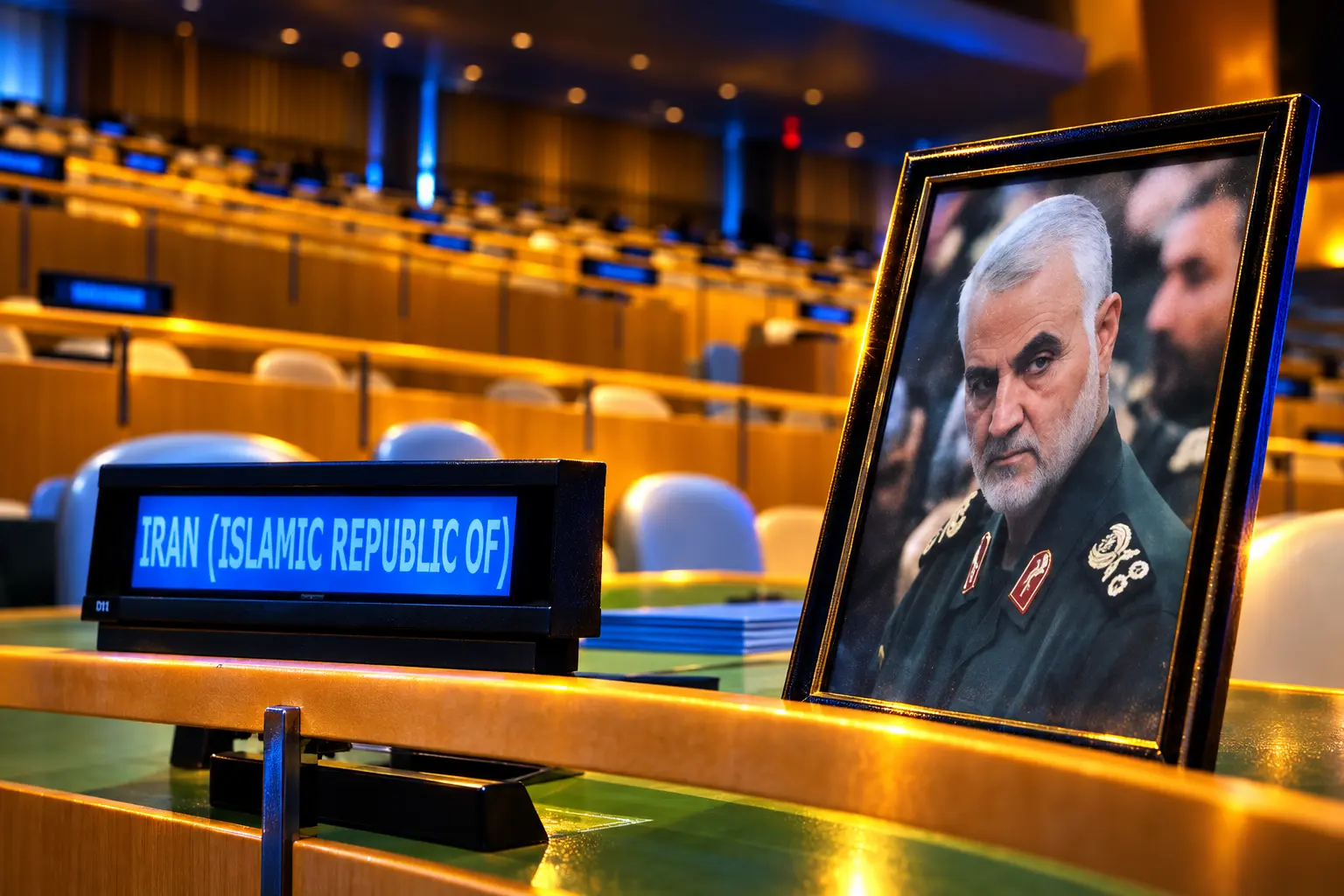
Iran’s delegates walked out of Netanyahu’s UN address, then left Qasem Soleimani’s portrait on the vacant desk, turning absence into the day’s image.

Iran’s delegates walked out of Benjamin Netanyahu’s United Nations speech on September 24, 2026, and left a portrait of Qasem Soleimani on their vacant desk. The Israeli prime minister still spoke for 40 minutes. The photograph stayed in the chair.
Leaving the hall was supposed to starve the podium of an audience. The frame on the desk gave photographers a still the empty chairs could not, and it gave Netanyahu a line about cowards that he used in the first breath of his 40-minute General Assembly address.
A Face Left in the Chair
The Iranian seats sat empty as Netanyahu reached the rostrum of the 81st session. A printed portrait of Soleimani, the late commander of the Quds Force, stood on the desk reserved for the delegation. EPA photographer Sarah Yenesel framed the table as vacant except for that picture, with Netanyahu speaking in the hall beyond it.
WHAT WE KNOW
- The gesture: Iranian diplomats left the General Assembly hall as Netanyahu took the podium and left Soleimani’s portrait on the desk.
- The date: The speech was delivered on September 24, 2026, during the general debate that runs from September 22 to 28.
- The walkout around them: Dozens of delegates from other missions left as he began, and a majority of visible seats sat empty afterward, a count that includes countries that never sat down.
WHAT IS UNCONFIRMED
- A precise headcount: No official UN tally of how many missions walked out has been published, and circulating figures of 50 countries or more than 100 people have not been matched to a public roll.
- Who set the frame down: Hall photographs show the portrait in place; they do not prove which official placed it.
The Palestinian mission had already circulated a memo asking other delegations to pack the hall and then leave together once the Israeli prime minister was announced. General Assembly President Khalilur Rahman had to call for order, repeating, “Order in the hall, please.” Some of those who stayed booed. Members of Netanyahu’s team stood and applauded. Supporters in the gallery chanted in Hebrew that the people of Israel live.
Two days earlier, Iranian diplomats had walked out on President Donald Trump. On September 23, a US diplomat walked out on President Masoud Pezeshkian. The chair game was already in motion before Soleimani’s face appeared.
Why the Portrait Was Soleimani
Soleimani ran the Quds Force, the overseas arm of Iran’s Islamic Revolutionary Guard Corps, until a US drone strike killed him near Baghdad airport on January 3, 2020. Trump ordered the strike in his first term and called Soleimani “the number one terrorist anywhere in the world,” saying the general had been plotting “imminent and sinister attacks” on American diplomats and troops. “We took the action last night to stop a war,” Trump said the next day. “We did not take the action to start a war.”
The Pentagon’s confirmation that night named him as head of the IRGC-Quds Force, a US-designated foreign terrorist organization, and described the strike as defensive action to protect US personnel abroad. The legality of targeting a senior Iranian commander on Iraqi soil, in a war Congress had not declared, was challenged in Washington the same day. Iran has never treated the killing as closed.
Each January, Tehran files another paper in New York. Ambassador Amir Saeid Iravani’s sixth anniversary letter on Soleimani, dated January 3, 2026, calls the strike a “cowardly assassination,” a breach of the UN Charter, and an arbitrary deprivation of life. The portrait on the desk was that argument in a frame: the man Iran still calls a martyr, seated through a speech that named Iran a “murderous dictatorship.”
A flag would have been protocol. A living official’s photograph would have been ordinary. Soleimani is the commander Israel and the United States spent a decade trying to kill, and the face Iranian state media still uses when it wants the “axis of resistance” on camera. Putting him in the chair told the hall, and the feeds at home, that the walkout was not a blank.
Netanyahu Turned the Empty Hall Into a Line
He did not wait for the doors to settle. The first sentences of the speech were aimed at the people already in the aisle.
Mr. President, before I begin, just a quick announcement. If there are any other moral cowards who haven’t yet left this hall, please do so now. Thank you very much.
Benjamin Netanyahu, Prime Minister of Israel, UN General Assembly, September 24, 2026
He then went straight to Iran. Fourteen years earlier, he said, he had drawn a red line at the same podium and vowed to stop Iran’s government from building a nuclear weapon. “That’s exactly what we did.” Devastating Iran’s nuclear facilities “was hard,” he said. “It was very hard to do. But for me, it was one of the easiest decisions I’ve ever had to make as prime minister. Because if we hadn’t done it, we’d all be dead.”
He called that the “ultimate irony”: Israel, in his telling, had also defended “many of the countries whose delegates just left this hall,” and “many of their leaders even thanked us privately for taking out Iran’s nukes.” He called the gap between those private thanks and the public walkout “mind-blowing hypocrisy.”
The rest of the speech was a tour of his enemies list. He described the years since October 7, 2023, as a seven-front war against Hamas, Hezbollah, the Houthis, Iran, militias in Iraq and Syria, and Palestinian fighters in the West Bank, plus an “eighth front” of media and social media. He said Hamas had slaughtered 1,200 Israelis that day, taken 251 hostages, and committed “the worst slaughter of Jews since the Holocaust,” a blow he compared, for a country of 10 million, to 40,000 Americans killed in a day, “16 times 9/11.” UN coverage of the same session noted that Israeli military operations in Gaza have killed over 73,000 Palestinians, according to Gaza health authorities.
He rejected the genocide charge as “the greatest lie of the century” and said, “Israel didn’t commit genocide. Israel prevented genocide.” He asked what genocidal government gives “a million polio vaccinations to the enemy’s population” or moves “two million tons of food into Gaza.” He waved away reports of settler violence in the West Bank as the work of “a handful of young juvenile delinquents, about 150 in number.” Those figures are his. They were written for the cameras in the hall and for the ones at home.
The Props on the Green Marble
Netanyahu has used the UN podium as a stage set for years, with diagrams and red lines. This time he brought hardware. He held up a Hezbollah pager and asked the hall, “Remember the beepers?” then added, “Hezbollah certainly remembers them.” Near the end he held up a Starlink terminal and said he would leave it with the General Assembly president for the Iranian delegation.
THREE OBJECTS IN THE HALL
| Object | Who put it in play | The message attached |
|---|---|---|
| Soleimani portrait | Iranian delegation, on the empty desk | The dead commander is still in the room |
| Hezbollah pager | Netanyahu, at the podium | Israel already hit the network that portrait once ran |
| Starlink terminal | Netanyahu, then Ambassador Danny Danon | Use this when you defect and talk on social media |
The portrait and the pager were relics of the same fight, held up by opposite sides. Soleimani built the Quds Force’s web of allied armed groups, including Hezbollah. The pager pointed back to Israel’s 2024 attack on that network in Lebanon. One object said the commander is immortal. The other said the network can be broken in a pocket.
This is a communications device, Starlink, that allows people to access truth, to exercise choice, to exercise freedom of thought and freedom of speech.
Benjamin Netanyahu, holding the terminal, UN General Assembly, September 24, 2026
He told the president of the Assembly to pass it to the Iranian delegation “so when they inevitably defect, they too will be able to freely tell their story on social media.” He said the “tyrants of Tehran” fear their own people more than they fear Israel. The walkout had given him an empty Iranian desk. He tried to put a satellite dish on it.
Walkouts Have Been UN Ritual for Decades
Walking out of the green marble hall is older than this war and older than Netanyahu’s career. There is no rule against a peaceful exit. Delegations have used it as a vote with their feet since the 1950s.
THE WALKOUT FILE
- May 11, 1949: Six Arab states walk out of the Assembly hall at Flushing Meadow after Israel is admitted as the 59th member.
- 1964: Diplomats from about 40 countries leave as South Africa’s foreign minister defends apartheid.
- 2010: More than 30 delegations, including the United States, walk out on Mahmoud Ahmadinejad after he suggests Washington orchestrated the September 11 attacks.
- 2024 and 2025: Mass exits meet Netanyahu’s Gaza-war speeches; Israeli officials later counted 77 countries absent from or leaving the 2025 address.
- September 22 to 23, 2026: Iran walks out on Trump; a US diplomat walks out on Pezeshkian; Israel’s seats sit empty for the Iranian president.
- September 24, 2026: Dozens of delegates leave as Netanyahu starts; Iran’s desk keeps the Soleimani portrait.
Last year’s walkout was so heavy that diplomats had to form a line for the doors. This year’s version looked the same until the camera found the frame on Iran’s table. The ritual was familiar. The prop was not.
Ahmadinejad used to empty the hall with words. Iran this week used a photograph and an empty chair, which is harder to argue with and easier to share. Netanyahu, who as a younger diplomat once fought Iranian moves to challenge Israel’s credentials, now treats the walkout as content. He needs the empty seats for the coward line the way Iran needs the portrait for the still.
Then the Envoy Offered a Satellite Dish
After the speech, Israel’s UN ambassador, Danny Danon, carried the Starlink terminal across the floor and tried to put it in Iranian hands. The diplomat he approached was Nasser Asadi. Danon told him the device could help Iranians “get their freedom after what you did to them,” asked if he wanted to “take it and deliver it back to Tehran,” and said, “We love the Iranian people, and we pray for regime change in Iran. The day will come.”
Asadi did not take it. He turned away and did not answer. Danon later posted the exchange and wrote that the Iranian representative had refused the terminal.
That refusal closed the loop the portrait opened. Iran’s desk had offered a dead commander as a witness. Israel’s ambassador offered a consumer satellite kit as a defection prop. Neither object belongs in ordinary UN debate. Both were built for a clip that would outlive the 40 minutes 7 seconds of audio on the UN’s own player.
The people arguing over those clips already know what they think of Soleimani. To Iranian state media he is a martyr who fought ISIS and never left the field. To the Pentagon in 2020 he was a designated terrorist plotting the next attack on Americans. The portrait does not settle that fight. It just keeps it on the furniture.
Abbas on Tape, Mamdani in the Speech
Mahmoud Abbas, 90, addressed the same hall by prerecorded video from Ramallah after the United States denied him a visa for the second year in a row. Washington has accused the Palestinian Authority and the Palestine Liberation Organization of “glorifying terrorism” and of trying to internationalize the conflict. Abbas called the refusal “unlawful and punitive.” “We will not leave our homeland,” he said. “We will not accept displacement.” His message ran hours before Netanyahu walked in. Of the 193 members, one leader was kept off the floor by the host country, and another spoke to a hall his critics had already emptied.
Netanyahu used part of the remaining time on New York. He called Mayor Zohran Mamdani an antisemite, said “many Jews no longer feel safe in New York” since the mayor took office, and accused him of trying to stop the visit. “Mr. Mamdani, you tried to stop me from coming here. You tried to silence me. Well, you can’t silence me. You can’t silence the truth.” Mamdani, who has called Netanyahu a war criminal, issued a statement accusing him of “baseless lies meant to sanitize his genocide of Palestinians.” Netanyahu is the subject of an International Criminal Court arrest warrant over the Gaza war. The mayor has said New York cannot execute that warrant.
He called Turkish President Recep Tayyip Erdogan a “tyrant,” accused him of hosting Hamas leaders, occupying northern Cyprus, and saying he would be “the ruler of Jerusalem.” “No, sir, you won’t,” Netanyahu said. “It is our city.” He accused Qatar of using Al Jazeera and university money to “brainwash young minds.” Outside, several hundred protesters gathered near headquarters with banners against the war in Gaza. Netanyahu, who faces Israel’s parliamentary elections on October 27, is due back in Israel after the short New York trip. Trump had already left the city and did not meet him.
WHO THE SPEECH WAS FOR
- Israeli voters: The coward line, the Iran strike as the easy hard decision, and the promise “we’re going to win, we have no other choice,” recycled from his brother Yoni before the 1967 war and Entebbe, where Yoni died after the rescue of 103 hostages on July 4, 1976.
- American cameras: Praise for Trump as Israel’s “greatest partner,” the Mamdani attack in the host city, and the genocide denial aimed at a US audience that has fractured.
- Iranians, as he imagines them: The Starlink taunt, the prediction of defection, and the claim that Tehran fears its public more than it fears Israel.
The portrait was for a fourth audience Iran did not name: the one that never sat in the hall. A walkout without an image is a gap in the footage. A walkout with Soleimani in the chair is a poster. Netanyahu understood that as well as anyone in the building, which is why he answered a photograph with a pager and a satellite dish, then sent his ambassador to force the dish into the shot.
When the session moved on, the Iranian desk was still a desk. The frame was still a frame. The speech was already cut for October. So was the empty chair.
Frequently Asked Questions
Who Was Qasem Soleimani and What Was the Quds Force?
Soleimani commanded the Quds Force, the IRGC branch that runs operations outside Iran, from the late 1990s until his death. The United States designated the IRGC, including the Quds Force, a foreign terrorist organization in 2019, a step that put the commander in a legal category Washington uses for armed groups, not for ordinary generals. Iran’s own letters to the Security Council still describe him as a senior official on an official visit to Iraq who helped fight ISIS, which is why the portrait on the desk was treated in Tehran as a state symbol rather than a freelance stunt.
Are Walkouts Allowed at the UN General Assembly?
Yes. The Assembly has no rule that forces a delegation to remain in its seats for another member’s speech, so long as the exit is peaceful. French diplomats used the tactic over Algeria in the 1950s, Hungary’s delegation used it after the 1956 Soviet invasion, and the same tool has been turned on speakers from Iran, Russia, and Israel. The chair can call for order, as Khalilur Rahman did, but it cannot compel a diplomat to listen.
Why Did the United States Deny Mahmoud Abbas a Visa?
The State Department extended visa sanctions on Palestinian officials and accused the Palestinian Authority and the PLO of glorifying terrorism and of trying to move the conflict into international forums. Abbas was kept out for a second straight General Assembly and spoke from Ramallah on tape. UN members can still hear a leader the host will not let into the building; they cannot vote him a chair in the room.
What Did the Pentagon Say When Soleimani Was Killed?
The US military’s first public statement was a short release, 163 words, issued the night of the strike. It said that at the president’s direction the military had “taken decisive defensive action to protect U.S. personnel abroad by killing Qasem Soleimani,” named him as head of the IRGC-Quds Force, and repeated the foreign-terrorist-organization designation. Joint Chiefs Chairman Gen. Mark Milley later said the United States had “compelling, clear, unambiguous intelligence” of plots still in motion. Iran’s annual letters reject every one of those claims.

A CubeSat Will Age Whisky That Never Comes Home

A Charity Quote Cost Shia LaBeouf the FKA twigs NDA

Looker Turned a Model’s Body Into Ad Inventory

Infinity Ward Bets a Paid DMZ Will Stick This Time

Disney Sidesteps a Kimmel Renewal as Failla Cites Losses

How to Get Pre Boarding on Southwest – Skip the Line with These Tricks

False AI Intel Nearly Put US Crews on a Chinese Ship

Tim Cook’s $4.6 Trillion Apple Still Runs on One Phone

Dunes Air Sues Nora Fatehi Over Its Luxury Jet

OpenAI Posts a Navier-Stokes Proof Clay Has Not Touched
-
 TRAVEL3 years ago
How to Get Pre Boarding on Southwest – Skip the Line with These Tricks
-
 NEWS1 month ago
False AI Intel Nearly Put US Crews on a Chinese Ship
-
 BUSINESS2 months ago
Tim Cook’s $4.6 Trillion Apple Still Runs on One Phone
-
 ENTERTAINMENT2 months ago
Dunes Air Sues Nora Fatehi Over Its Luxury Jet
-
 NEWS2 months ago
OpenAI Posts a Navier-Stokes Proof Clay Has Not Touched
-

 LIFESTYLE3 years ago
How Often Do You Have to Change a Monkey’s Diaper? The Truth About Pet Monkeys
-

 NEWS2 months ago
Australia Treats Cloud Software Payments as Taxable Royalties
-

 LIFESTYLE3 years ago
How Long Does It Take for Armpit Hair to Grow? The Stages of Hair Growth and How to Shave It