
NEWS
A J&K Statehood Resolution Splits the Parties That Claim It
The Jammu and Kashmir Assembly passed Omar Abdullah’s statehood resolution after the BJP walked out over 2000 and 2024 autonomy citations, not the demand itself.

The Jammu and Kashmir Assembly on September 28, 2026, passed a resolution asking Delhi to restore full statehood at once. The BJP walked out because the text still carried two older House votes on autonomy and special status.
Chief Minister Omar Abdullah had kept Articles 370 and 35A out of the operative clause so the opposition would have no pretext. His own MLAs tried to write those articles back in. Four MLAs were marshalled out before the voice vote, and a removal motion against Speaker Abdul Rahim Rather was parked for 14 days.
The Resolution Cited June 2000 and November 2024
Abdullah tabled the text on September 25, the third sitting of the autumn session in Srinagar. The operative ask was narrow: immediate restoration of full statehood, with the paper to be sent to the Government of India. The fight lived in the opening clause.
In addition to the resolutions passed by this House on 26 June 2000 and 6 November 2024, the House calls upon the Government of India for the immediate and urgent restoration of full statehood to Jammu and Kashmir and resolves that this resolution be forwarded to the Government of India.
Omar Abdullah, Chief Minister, resolution tabled in the J&K Assembly
The 2000 vote, passed under Farooq Abdullah, sought greater autonomy as it existed before August 9, 1953. The Union Cabinet under Atal Bihari Vajpayee rejected it. On November 6, 2024, weeks after this House first met as a Union Territory legislature, it voted for restoration of special status.
Those two dates are why a sentence both parties say they support could not be read aloud in peace. Statehood is a change of status, from a Union Territory under a Lieutenant Governor to a full state. Autonomy, in the National Conference’s long usage, is the older package: a pre-1953 constitutional position, and later Articles 370 and 35A. Abdullah said the demand on the floor was the status J&K held before it became a Union Territory, and that he had left 370 and 35A out of this text on purpose.
Leader of Opposition Sunil Sharma called the language unacceptable and the pre-1953 position unconstitutional. He said the BJP wants statehood restored, that it is the party’s agenda, and that this wording was an insult to the Constitution in a sensitive region. The walkout was not a walkout from the word statehood. It was a walkout from the envelope.
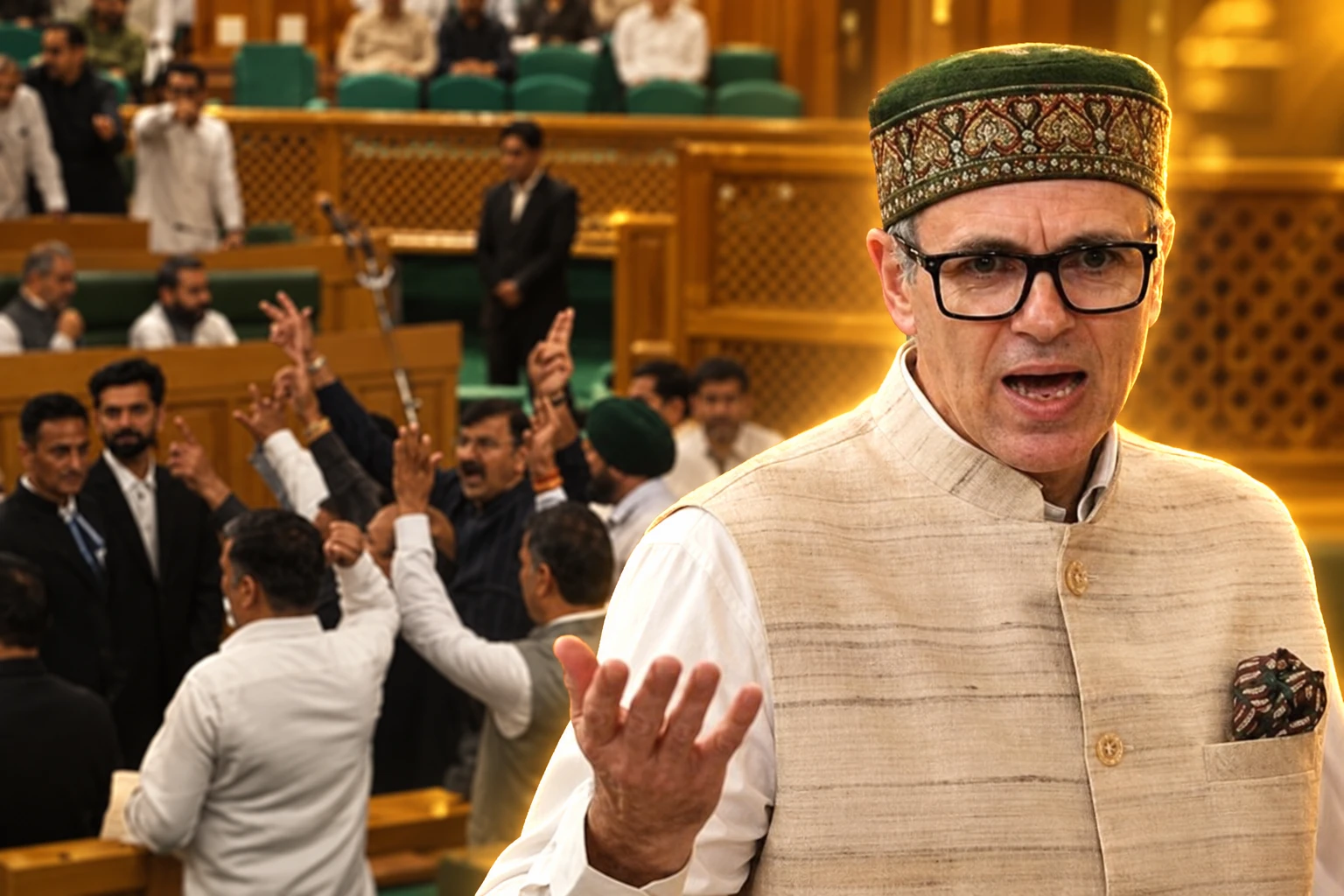
Eight of Omar’s Own MLAs Tried to Rewrite It
Before Monday’s debate, Pulwama MLA Waheed Para of the People’s Democratic Party had already called the floor the real test. He said eight National Conference MLAs had filed eight separate amendments to their own chief minister’s text, a Sunday count of the treasury-side rewrite. By the sitting, ten amendments were on the paper: five from NC members, two from the PDP, two from independents, and one from Congress MLA Nizam ud Din Bhat.
THE AMENDMENTS THAT CAME BACK IN
- Tanvir Sadiq, NC: Reaffirm the constitutional guarantees in Articles 370 and 35A as they stood before August 5, 2019.
- Waheed Para, PDP: Restore Articles 370 and 35A in their original form.
- Aga Syed Muntazir Mehdi: Record anguish at the unilateral measures taken from August 5, 2019, and tie autonomy to the same ask.
- Nizam ud Din Bhat, Congress: Remind the Centre of commitments already made to the people of J&K.
NC members Javid Hassan Baig, Ajaz Jan, Altaf Ahmad Wani and Hilal Akbar Lone were among those who also moved changes. The National Conference manifesto still pledges to strive for 370, 35A and statehood as they existed before August 5, 2019, and to implement the 2000 autonomy vote. Dropping that line on the floor has a cost inside the party. Keeping it has a cost with the BJP and with Delhi.
Abdullah told colleagues they had walked into a BJP trap and asked them to drop the amendments, arguing the 2000 citation already sat in the preamble. The Speaker treated the amendments as withdrawn. None was pressed to a vote. The middle sentence survived. The peace did not.
Tomorrow’s J&K Assembly business will be worth watching. CM @OmarAbdullah’s own resolution is being met with 8 separate amendments from 8 of his own NC MLAs, exposing serious differences over its language, intent and scope.
When a government’s own legislators seek to rewrite its…
— Waheed Ur Rehman Para (@parawahid) September 27, 2026
Why the BJP Walked Out of a Statehood Vote
Sharma said before the sitting that the BJP would not let Article 370 or a dual flag and dual constitution be smuggled in under a statehood heading. He claimed Union Home Minister Amit Shah had already made clear that talk of 370 or a pre-1953 status no longer has a place in J&K politics. After the vote he went further, offering the whole BJP legislative party if Abdullah brought a text that named statehood alone and closed the door on 370 and the pre-1953 position.
If Omar Abdullah has any moral ground left, then come forward, bring a resolution for statehood in the Jammu and Kashmir Assembly. But only for statehood. State clearly in it that there is no scope left for Article 370 or the pre-1953 status anymore. The entire legislative party of the Bharatiya Janata Party will stand with you.
Sunil Sharma, Leader of Opposition, press conference in Jammu
That offer is the trap in reverse. A clean statehood line would let the BJP vote for a demand it already claims, and it would strand Abdullah with his own benches and with the PDP, which used the amendments to argue he had already watered the manifesto down. He chose the chained preamble instead. The BJP then got to walk out of a statehood vote without walking out of statehood.
Handwara MLA Sajad Lone of the People’s Conference backed the resolution and then moved the starting line again, telling the House the claim was not a favour from 2023 or 2019 but the promise of 1947. He said unelected officers now run a “UT lottery” in which they do not even take calls from elected members. The argument on the floor was never only yes or no to a state. It was which year the House is allowed to remember.
Mock Proceedings in the Well of the House
The sitting opened with the BJP’s other motion. MLA R. S. Pathania, citing Rule 215(2), said 23 MLAs of the BJP legislative party had stood for Rather’s removal because the Speaker had allowed Friday’s resolution against the rules. Rather said that even if the motion entered the list of business, it could be taken up only 14 days after it was moved, and he went on with Question Hour.
BJP members then entered the well, tore business papers, raised slogans, and sat on the floor. Sham Lal Sharma began mock proceedings from the well after warnings that action would follow. Four MLAs were marshalled out. Minister Sakina Ittoo said the opposition was “only doing drama for galleries.” Deputy Chief Minister Surinder Chaudhary asked why the House should wait 14 days to vote on the Speaker, and he asked what had become of the Centre’s promise, made in Parliament and before the Supreme Court, to restore statehood.
Abdullah used the same sitting to describe the daily cost of remaining a Union Territory. He said the Law Department had sent the Speaker an opinion that Monday’s debate was sub judice, that he believed the chief secretary had written as well, and that he had not seen the opinion even though he is the law minister. He asked whether any other state’s chief minister would move a resolution and find the law secretary writing against it.
WHAT THE UT STILL HOLDS BACK
- Revenue: Abdullah asked why the revenue department sits outside the elected government’s reach when the Reorganisation Act, as he read it, leaves the Lieutenant Governor security and law and order.
- Campuses and culture: He named control of the Islamic University of Sciences and Technology, Baba Ghulam Shah Badshah University, and the cultural academy as files that do not run through the elected side.
- Rules and law officers: He said Transaction of Business Rules sent to the Centre remain unapproved after nearly two years, and that the Union Territory still has no Advocate General.
- Daily wagers: A committee on regularisation, he said, has not submitted its report, which he tied to the UT structure rather than to the committee’s own pace.
He then put the delay in the language Delhi has used since 2019. “We’ve been waiting two years for the central government to keep its word,” he said. “The SC had said that after the UT elections, J&K’s statehood should be restored at the earliest.” He asked in what language “at the earliest” means two years, and what “uchit samay,” the opportune moment, is supposed to mean.
Is ‘uchit samay’ linked to militancy? Are you saying that till the guns fall silent in J&K, statehood will not be restored? You are directly saying that the decision on statehood will not be taken in New Delhi but in Islamabad.
Omar Abdullah, Chief Minister, Jammu and Kashmir Assembly, September 28, 2026
After nearly four hours of that argument, the House adopted the resolution by voice vote as the BJP walked out. Slogans continued until adjournment at 2 pm, with the next sitting listed for September 29.
Statehood Still Needs an Act of Parliament
Nothing that happened in Srinagar alters the 2019 statute. The Jammu and Kashmir Reorganisation Act, Act 34 of 2019, received presidential assent on August 9, 2019. A Union Home Ministry order fixed the appointed day of 31 October 2019, when the old state split into a Union Territory of Jammu and Kashmir with a legislature and a Union Territory of Ladakh without one. Turning that back is a job for Parliament, not for a resolution forwarded up the hill.
The Supreme Court’s December 11, 2023, Article 370 judgment is why every party in this House can say it wants statehood and still mean different things. The court upheld the 2019 changes and said steps must be taken to restore statehood at the earliest and as soon as possible. It also gave the Election Commission a hard date, September 30, 2024, to hold Assembly elections. The elections were held. Statehood was not given a calendar.
The 2024 Jammu and Kashmir Assembly results produced a 90-seat House in which the National Conference won 42 seats and the BJP 29, all in the Jammu division. Congress won 6. The PDP won 3. Majority is 46. The NC-Congress pairing on 48, with the CPI(M)’s one seat taking an NC-led group to 49, is why Abdullah can pass a voice vote after a walkout and still not move the one file that matters in Delhi.
HOW THE 2024 HOUSE LINED UP ON MONDAY
| Party | Seats won, 2024 | Monday in the House |
|---|---|---|
| National Conference | 42 | Moved the resolution; five MLAs filed 370-era amendments, then stood down |
| Bharatiya Janata Party | 29 | 23 signed a Speaker-removal motion; walked out before the voice vote |
| Congress | 6 | One amendment reminding the Centre of old commitments |
| People’s Democratic Party | 3 | Amendments to restore 370 and 35A in original form |
Rather, a seven-time NC MLA from Charar-e-Sharief, was unanimously elected as first Speaker of this Union Territory Assembly on November 4, 2024, after the opposition chose not to contest. On Monday the same opposition said he had broken the rules by admitting Abdullah’s text. The 14-day clock is now the only new date the sitting produced.
Five Meetings With Amit Shah Brought No Date
Abdullah was sworn in on October 16, 2024. In the 712 days between that oath and this vote he has taken the statehood ask to the Home Minister five times in Delhi, and once to Prime Minister Narendra Modi, without coming home with a day on the calendar.
THE STATEHOOD CALLS IN DELHI
- October 2024: First meeting with Shah, about a week after the oath, half an hour long; Abdullah handed over a council-of-ministers resolution seeking restoration.
- December 19, 2024: Second meeting, framed around the limits of UT administration.
- February 10, 2025: Third meeting, during Parliament’s budget session, with statehood, security and governance on the table.
- May 11, 2026: Fourth meeting, pending files and the working of the administration; no restoration announced.
- June 11 and September 4, 2026: Abdullah met Modi on June 11 and pressed for an early return of statehood; the NC protested in Delhi on July 20; the fifth Shah meeting, on September 4, listed statehood, Business Rules and reservation among the subjects and again named no date.
Shah’s public line has stayed the same phrase. On October 18, 2025, he said statehood would be restored at an appropriate time, and that it would be done after discussions with Abdullah, whom he described as speaking from political compulsion. Union Law Minister Arjun Ram Meghwal said in Srinagar on February 17, 2026, that the grant would go through a rightful process and that people would hear a decision very soon. The Assembly has now added its own paper to that pile.
The paper does not bind the Centre. It does bind the local parties to a record of what they would and would not say in the same sentence. Abdullah can tell voters the elected House asked for full statehood and the BJP walked out. Sharma can tell Delhi his members refused to re-open 2000 and 2019. Lone can tell the Valley the clock should start in 1947. None of those statements restores a state.
Frequently Asked Questions
Can the Jammu and Kashmir Assembly restore statehood by itself?
No. The House can only ask. Full statehood would require Parliament to change the Jammu and Kashmir Reorganisation Act, 2019, which created the Union Territory with a legislature. Monday’s text ends by resolving that the resolution be forwarded to the Government of India, which is a political request, not a change in law.
What did the Supreme Court set a date for, and what did it leave open?
In the December 11, 2023, Article 370 judgment the court directed the Election Commission to complete Assembly elections by September 30, 2024, a date that was met. Restoration of statehood was ordered “at the earliest and as soon as possible,” with no month or year attached, which is why the two promises have travelled together and only one has been cashed.
What was the June 26, 2000, resolution the new text cites?
It was an autonomy resolution passed by the National Conference government headed by Farooq Abdullah, seeking restoration of the constitutional position as it existed before August 9, 1953. The Union Cabinet under Atal Bihari Vajpayee rejected it, which is the precedent the BJP now cites when it says the pre-1953 demand has already been closed.
When did Abdul Rahim Rather become Speaker of this Assembly?
On November 4, 2024, the first day the new House sat, Rather was elected by voice vote after other parties decided not to field a candidate. He is a seven-time MLA from Charar-e-Sharief and had earlier served as Speaker of the erstwhile state Assembly; the BJP’s Sunil Sharma escorted him to the chair that day along with Abdullah.
Speaker Rather told the House the removal motion cannot come up for 14 days. The Assembly was adjourned at 2 pm until September 29, with the resolution on its way to the Government of India and still no date for the statehood the text demands.

A CubeSat Will Age Whisky That Never Comes Home

A Charity Quote Cost Shia LaBeouf the FKA twigs NDA

Looker Turned a Model’s Body Into Ad Inventory

Infinity Ward Bets a Paid DMZ Will Stick This Time

Disney Sidesteps a Kimmel Renewal as Failla Cites Losses

How to Get Pre Boarding on Southwest – Skip the Line with These Tricks

False AI Intel Nearly Put US Crews on a Chinese Ship

Tim Cook’s $4.6 Trillion Apple Still Runs on One Phone

Dunes Air Sues Nora Fatehi Over Its Luxury Jet

OpenAI Posts a Navier-Stokes Proof Clay Has Not Touched
-
 TRAVEL3 years ago
How to Get Pre Boarding on Southwest – Skip the Line with These Tricks
-
 NEWS1 month ago
False AI Intel Nearly Put US Crews on a Chinese Ship
-
 BUSINESS2 months ago
Tim Cook’s $4.6 Trillion Apple Still Runs on One Phone
-
 ENTERTAINMENT2 months ago
Dunes Air Sues Nora Fatehi Over Its Luxury Jet
-
 NEWS2 months ago
OpenAI Posts a Navier-Stokes Proof Clay Has Not Touched
-

 LIFESTYLE3 years ago
How Often Do You Have to Change a Monkey’s Diaper? The Truth About Pet Monkeys
-

 NEWS2 months ago
Australia Treats Cloud Software Payments as Taxable Royalties
-

 LIFESTYLE3 years ago
How Long Does It Take for Armpit Hair to Grow? The Stages of Hair Growth and How to Shave It