
NEWS
Kohat Attack Repeats a Year of Raids on Police Compounds
A suicide truck and gunmen hit Kohat Police Lines during Friday prayers, killing 31 and holding Special Branch overnight in a now-familiar raid on KP police.

At least 31 people, 16 of them police, died after a suicide truck and gunmen hit Kohat’s police headquarters on September 18, 2026. A senior police official gave that toll on Saturday, September 19, with more than 100 wounded and fire still coming from inside the compound.
The target was not a roadside post. It was the Old Police Lines in Kohat, a town of about 220,000 in Khyber Pakhtunkhwa, whose district headquarters houses the Counter-Terrorism Department, Special Branch and other units. Attackers used a truck bomb at Friday prayers, then walked toward those offices, the same sequence southern KP police have been fighting for more than a year.
A Suicide Truck Hit the Mosque at 1:20 p.m.
Worshippers were in the mosque inside the lines when an explosives-laden vehicle struck the gate around 1:20 p.m. on Friday. Khyber Pakhtunkhwa Inspector General Zulfiqar Hameed said the blast opened the compound. A second suicide bomber then blew himself up near the Special Branch building as gunmen tried to get in behind the smoke.
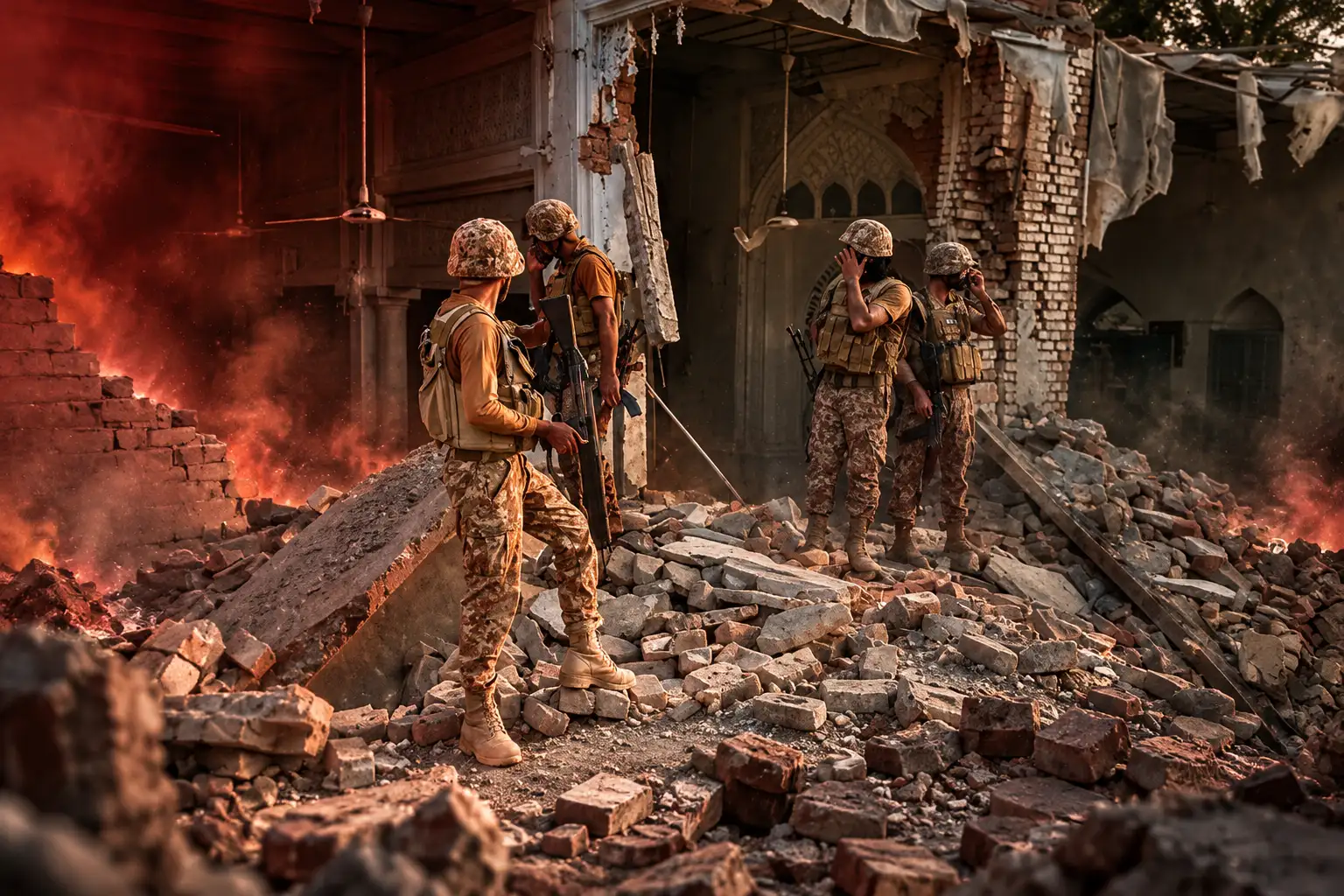
Photographs from the scene showed soldiers among piles of brick, rubble and blown-out walls, with ambulances lined on the street outside. Rescue 1122 spokesperson Bilal Faizi said 20 ambulances and more than 60 rescue officials worked the site. Authorities closed the Kohat-Hangu Road.
Kohat District Health Officer Dr Nasir Hassan Afridi said Friday night that more than 100 people were hurt and three were in critical condition. Among the dead were SP Traffic Akbar Shinwari and Dr Israel Orakzai, head of the paediatric department at the district headquarters hospital. Funeral prayers for 15 police officers were held in Kohat that evening, after which Rescue 1122 took the bodies to Kohat, Karak, Lakki Marwat, Bannu and Mardan.
THE HOURS AFTER THE TRUCK BOMB
- September 18, 2026, about 1:20 p.m.: An explosives-laden vehicle strikes the gate of Old Police Lines during Friday prayers at the mosque inside the compound.
- Friday afternoon: A second suicide blast goes off near Special Branch. Seven gunmen try to enter. Several head for the CTD building; three move toward Special Branch.
- Friday evening: Police say six of the seven attackers, including a suicide bomber, are dead. Additional IG CTD Javad Qamar is inside the compound leading the fight. One attacker is still hiding.
- September 19, 2026, Saturday morning: A senior police official says at least 31 are dead, 16 of them police, and that several militants remain in the Special Branch wing, with fire continuing since late Friday night.
That overnight hold is the part Friday’s first statements missed. Police had said six of seven attackers were already dead and that the complex was all but clear. By Saturday a named official was still describing an active fight inside Special Branch, which is the district’s intelligence wing, not a leftover room.
Gunmen Then Walked Toward the CTD Offices
Hameed said the truck bomb hit the gate, after which several attackers went for the CTD building, where police said they were stopped, while three others tried to reach Special Branch. The Central Police Office had already said a suicide bomber detonated near that building. The raid was aimed at the two units that hunt and watch militants in the district, not at a generic police desk.
Kohat is a garrison town, and army units later joined a fight that began as a police and CTD operation inside their own headquarters. Additional IG Qamar entered the site himself. Elite Force and, later, army commandos were described at the scene as the firefight stretched through the night. The first hours still belonged to the people who work in those buildings.
Friday police figures on the wounded show how widely the blast cut through the compound’s units, even before Saturday’s higher death toll.
POLICE WOUNDED IN THE FRIDAY TALLY
| Unit | Officers wounded |
|---|---|
| District police | 29 |
| Frontier Reserve Police | 13 |
| Counter-Terrorism Department | 10 |
| Special Branch | 8 |
| Elite Police Force | 3 |
| Telecommunications | 2 |
| Total in this police count | 65 |
Those 65 were the police share of Friday’s hospital intake, not the Saturday death list. The DHO still put the overall wounded above 100, most of them police. Special Branch and CTD appear in that wounded list because the gunmen walked toward their doors after the mosque wall came down.
The Death Toll Rose to 31 by Saturday
The Saturday figure from the senior official, 31 dead including 16 police, is the working count. He also said more than 100 were injured and that the number of militants still inside Special Branch was not clear. That is a harder picture than Friday night, when police said six attackers were dead and one was hiding.
Hameed had said the operation would go on. Scene accounts on Saturday morning later described the buildings as cleared and the remaining attackers as dead, some of them after army commandos joined at first light. Those later notes did not come from a signed police communique, and they do not change the Saturday official toll of 31.
WHAT WE KNOW
- The method: A vehicle bomb at the mosque gate during Friday prayers, a second suicide blast near Special Branch, then gunmen moving on CTD and Special Branch.
- The Saturday toll: A senior police official put the dead at 31, including 16 police, with more than 100 wounded.
- The claim: Ittehad-ul-Mujahideen Pakistan, led by Afghanistan-based Hafiz Gul Bahadur, said it carried out the raid.
WHAT IS UNCONFIRMED
- How many stayed inside: Police said seven gunmen tried to enter on Friday; the Saturday official still would not give a number for those in Special Branch overnight.
- Whether the compound was fully clear: Friday night statements said it was almost clear; Saturday morning official comment still described live fire; later scene accounts said the last attackers were dead.
- A second claim: A smaller group using the name Inqilabi Islami Pakistan also put out a claim on Telegram that has not been independently tied to the raid.
What is not in dispute is the shape of the raid. A truck opened the wall at prayer time, and armed men then tried to occupy the offices that run counter-terror work in Kohat.
Who Claimed the Kohat Police Lines Attack?
Ittehad-ul-Mujahideen Pakistan, often shortened to IMP, claimed the bombing and the gun raid. Pakistani officials describe the group as a front for the banned Tehreek-e-Taliban Pakistan, the Pakistani Taliban. The TTP, in a separate statement, denied a role and said mosques, seminaries and medical sites are not its targets. That denial left IMP holding the claim while Islamabad still treats the alliance as part of the same war.
IMP was formed in April 2025 as a joint banner for three already active networks. The Pakistan Institute for Conflict and Security Studies, in its 2025 roundup, listed the alliance among the groups that kept hitting security forces through the year.
THE THREE GROUPS UNDER THE IMP BANNER
- Hafiz Gul Bahadur Group: A North Waziristan network whose leader Pakistani officials say lives in Afghanistan and directs raids into KP.
- Lashkar-e-Islam: A Khyber-rooted faction that has fought Pakistani forces for years in the old tribal belt.
- Harakat-e-Inqilab-e-Islami: The third partner in the 2025 merger, named by PICSS as Inqilab-e-Islami in its year-end list of active outfits.
The same alliance claimed a May 9, 2026 suicide raid on the Fatah Khel police checkpost in Bannu, where Pakistani police and the Foreign Office said 15 KP officers were killed. Gunmen and armed quadcopters followed a huge vehicle bomb into that compound. Kohat is the same script at a larger address: a district headquarters instead of a checkpost, a mosque full of officers at Jumma, and a fight that lasted into the next day.
The operation will continue until the complete elimination of Fitna al Khawarij.
Zulfiqar Hameed, Inspector General of Police, Khyber Pakhtunkhwa, in a statement from his office
Fitna al Khawarij is the term the Pakistani state uses for the TTP and groups it treats as the same fight. Hameed also said police morale remained high. KP Chief Minister Sohail Afridi called the targeting of civilians “deeply regrettable and unacceptable” and asked for a detailed report.
Khyber Pakhtunkhwa Logged 413 Terror Attacks in 2025
Kohat sits on the southern KP belt that has taken the weight of this campaign, next to Hangu, Karak, Bannu, Lakki Marwat, Tank and Dera Ismail Khan. The Pak Institute for Peace Studies, in its Pakistan Security Report 2025, counted 413 terrorist attacks in Khyber Pakhtunkhwa that year, with 581 people killed and 698 injured, the highest provincial total in the country. Nationwide it recorded 174 policemen killed in 2025 attacks among 437 security and law-enforcement dead from terrorism.
PICSS, using a wider combat ledger that includes force-on-force fighting as well as terrorist strikes, found a steeper national climb. It said combat deaths in 2025 rose 74% to 3,413 from 1,950 in 2024, including 667 security personnel, the worst year for the forces since 2011.
PICSS COMBAT TOLL, 2024 AND 2025
| Measure | 2024 | 2025 |
|---|---|---|
| Combat-related deaths | 1,950 | 3,413 |
| Security personnel killed | 528 | 667 |
| Militant attacks | 908 | 1,066 |
| Suicide attacks | 17 | 26 |
PICSS also logged 26 suicide attacks in 2025, up 53 percent from 17 the year before, and 33 small-drone incidents. IMP has advertised quadcopter strikes. The Bannu checkpost raid in May used that mix, a truck bomb plus gunmen plus drones, against a police post. Kohat used the truck and the gunmen against a headquarters that also holds CTD and Special Branch.
Bannu’s own police command has already put numbers on what that looks like at district level. DIG Sajjad Khan said his district saw 134 terrorist attacks on stations, posts, checkpoints, mobiles and parties in 2025, with 27 officers killed and 79 wounded. Kohat is one district over on the same road network. A headquarters mosque at Jumma is a larger version of the same hunt.
Zardari Blamed Terrorists Operating With Foreign Backing
President Asif Ali Zardari and Prime Minister Shehbaz Sharif issued separate messages on Friday condemning the blast at Old Police Lines. They asked that the injured receive the best possible medical care immediately. Sharif also asked for a report on the nature and causes of the blast and told officials to speed up relief.
Zardari tied the raid to a foreign hand, the line Islamabad has used throughout the latest TTP wave. “The complete elimination of Fitna-al-Khawarij and terrorists operating with foreign backing is inevitable for national security,” he said. KP Governor Faisal Karim Kundi issued his own condemnation.
Pakistan has blamed the rise in attacks in KP and Balochistan on militants who, it says, plan from Afghanistan. The Taliban government in Kabul denies that. The row has already produced airstrikes, border fire and closed crossings. After the May 9 Bannu police-post raid, the Foreign Office summoned the Afghan chargé d’affaires and handed over a demarche after the Bannu police attack. In June, Pakistan again struck what it called militant targets in eastern Afghanistan; Kabul and the United Nations said dozens of civilians were killed.
Hafiz Gul Bahadur, the name on the Kohat claim, is the same commander Pakistani security officials have repeatedly placed on Afghan soil. PICSS noted that Ittihadul Mujahideen, the Bahadur group and the TTP all stayed active through 2025 while Islamabad’s air campaign and Kabul’s denials ran in parallel. Kohat does not settle that argument. It does show that a faction Pakistan says is run from across the border can still put a truck against a district police mosque and then occupy part of the headquarters overnight.
This Compound Was Bombed Once Before, in 2010
The Old Police Lines have been hit on this ground before. In 2010, a remote-controlled bomb exploded inside a police colony just behind the lines during Ramazan iftar, killing 20 people, most of them relatives of policemen, and wounding more than 90. Friday’s truck bomb found a mosque at prayer time in the same cluster of buildings, then sent gunmen after CTD and Special Branch.
Sixteen years apart, both attacks treated the Kohat lines as a place where police families and officers gather, not as a hardened fort. The 2026 raid added a second stage the 2010 bombing did not: armed men inside the intelligence offices until Saturday. For a province that recorded 413 terror attacks in 2025, and for a police force that has been the chosen target from Bannu’s checkposts to this headquarters, that is the campaign, not a one-day massacre.
On Saturday the official count stood at 31 dead, the Special Branch wing had been a battlefield overnight, and IMP had put its name on another police compound in southern Khyber Pakhtunkhwa.

A CubeSat Will Age Whisky That Never Comes Home

A Charity Quote Cost Shia LaBeouf the FKA twigs NDA

Looker Turned a Model’s Body Into Ad Inventory

Infinity Ward Bets a Paid DMZ Will Stick This Time

Disney Sidesteps a Kimmel Renewal as Failla Cites Losses

How to Get Pre Boarding on Southwest – Skip the Line with These Tricks

False AI Intel Nearly Put US Crews on a Chinese Ship

Tim Cook’s $4.6 Trillion Apple Still Runs on One Phone

OpenAI Posts a Navier-Stokes Proof Clay Has Not Touched

Dunes Air Sues Nora Fatehi Over Its Luxury Jet
-
 TRAVEL3 years ago
How to Get Pre Boarding on Southwest – Skip the Line with These Tricks
-
 NEWS1 month ago
False AI Intel Nearly Put US Crews on a Chinese Ship
-
 BUSINESS2 months ago
Tim Cook’s $4.6 Trillion Apple Still Runs on One Phone
-
 NEWS2 months ago
OpenAI Posts a Navier-Stokes Proof Clay Has Not Touched
-
 ENTERTAINMENT2 months ago
Dunes Air Sues Nora Fatehi Over Its Luxury Jet
-

 LIFESTYLE3 years ago
How Often Do You Have to Change a Monkey’s Diaper? The Truth About Pet Monkeys
-

 NEWS2 months ago
Australia Treats Cloud Software Payments as Taxable Royalties
-

 BUSINESS2 months ago
Samsung India Cuts TV Jobs as Its Chip Unit Booms