
BUSINESS
ONGC’s Mahanadi Gas Find Hinges on Shared Facilities
ONGC’s MDW-28 well off Konark flowed gas for three days, but 2025 sharing rules and common hubs, not a solo field, will decide if it produces.

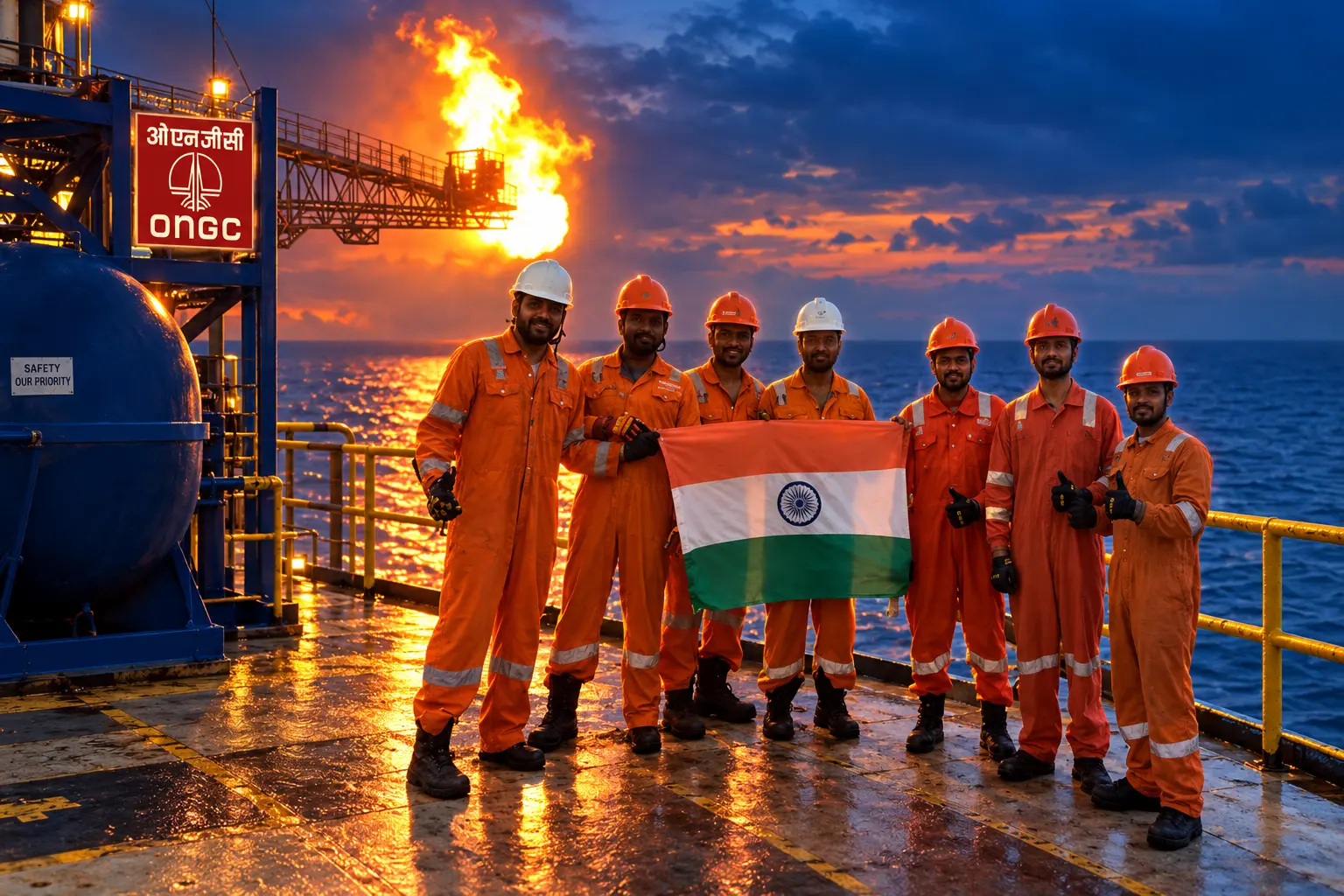
Oil and Natural Gas Corporation struck gas at well MN-DW18-1-H-D on 18 September 2026, 43 km off Konark in Odisha. The state explorer, in a 21 September filing, said MDW-28, the first well of its current Mahanadi Basin deepwater campaign, had been flowing for three days with “encouraging flow and reservoir pressure.”
It did not publish a rate, a test duration in hours, or a recoverable volume. In the same note it already treated the strike as a cluster candidate under the Petroleum and Natural Gas Rules, 2025, to be developed with other finds in the area through shared facilities.
Gas Flowed From 1,441 Metres for Three Days
The well, also tagged MDW-28, was drilled to a target depth of 1,623 metres and hit gas in the 1,441 to 1,452 metre interval, an 11-metre pay. ONGC said the short hop to the Odisha coast offers a shot at early sales if appraisal and a commercial test hold up. Hardeep Singh Puri, India’s Minister of Petroleum and Natural Gas, spudded it on 25 July 2026, tying the hole to the government’s Samudra Manthan offshore drive.
THE WELL ON PAPER
- Where: Mahanadi Offshore Basin, about 43 km off Konark.
- How deep: Drilled to 1,623 metres; gas in the 1,441 to 1,452 metre interval.
- What it did: Flowed gas for three days as of the 21 September filing, with pressure holding.
- What is missing: No flow rate, no reserve size, no commercial sign-off.
Arun Kumar Singh, ONGC’s Chairman and CEO, went out to the Platinum Explorer drillship on 27 August 2026 with Vikram Saxena, Director of Technology and Field Services, and O. P. Sinha, Director of Exploration. The crew perforated the well on 18 September after reading the subsurface data, and gas moved soon after. ONGC put the result on its own account the morning of 21 September.
#ONGC strikes gas in the deep waters of Mahanadi Basin.
MDW-28, the maiden well of ONGC’s current deepwater campaign in the Mahanadi Basin is flowing gas with encouraging rates and sustained reservoir pressure.
The campaign was launched on 25 July 2026 by Hon'ble Minister of… pic.twitter.com/whAV8TubIK
— Oil and Natural Gas Corporation Limited (ONGC) (@ONGC_) September 21, 2026
THE PATH FROM SPUD TO FLOW
- 25 July 2026: Puri spuds MDW-28 in the deep offshore Mahanadi Basin.
- 27 August 2026: Singh, Saxena and Sinha visit Platinum Explorer and meet the drilling crew.
- 18 September 2026: The well is perforated and records the gas strike in the 1,441 to 1,452 metre interval.
- 21 September 2026: ONGC files that the well has been flowing for the last three days and flags shared facilities under the 2025 rules.
A single deepwater wildcat of this kind costs about $125 million to $150 million, the Cabinet’s own Samudra Manthan note says. That is why a three-day flow, with the metreage unpublished, is still only a ticket to appraisal, not a field.
Mahanadi Has Found Gas Before Without a Hub
The Directorate General of Hydrocarbons describes the Mahanadi Basin as a 55,000 sq km rifted margin on the east coast, of which about 14,000 sq km is shallow offshore. It assigns 45 million tonnes of onshore resources and about 100 million tonnes in shallow water. It does not put a number on the much larger deepwater belt, which it only calls additional potential.
Onshore and shallow holes have already shown gas. DGH’s basin note records hydrocarbon shows in several of the early Mahanadi wells, gas recovered from Miocene sandstones and Eocene limestones in MND-2, and six later wells in block NEC-OSN-97/2 that proved gas-bearing in Upper Miocene to Pliocene rock. Those are young, often small accumulations, sitting a long way from a processing plant.
ONGC has already named other discoveries in this same fairway, including Utkal and Konark, in materials around the campaign. It has not published reserves or a development plan for those either. The 21 September filing’s phrase “other discoveries in the area” is doing real work: one well 43 km from the temple town does not carry a deepwater pipeline on its own books.
East-coast deepwater gas has a habit of arriving as a press note and then waiting on iron. Krishna-Godavari had a different fate because it built a hub. Mahanadi, on the DGH numbers, still does not have a published deepwater resource figure, let alone a shared riser or a shore plant sized for several small finds.
Operators Must Now List Spare Pipelines and Plants
The Petroleum and Natural Gas Rules, 2025, notified on 9 December 2025, replaced the 1949 concession rules and the 1959 PNG rules. They sit under the Oilfields (Regulation and Development) Amendment Act, 2025. The piece ONGC is leaning on is not a royalty holiday. It is a duty to put spare kit on the record, and a backstop if neighbours will not deal.
WHAT THE 2025 SHARING RULES REQUIRE
- Annual capacity file: Each lessee must tell the Centre the installed, used and excess capacity of the infrastructure it owns.
- Deals first: Lessees may jointly develop or share plants, lines and other facilities by mutual agreement.
- Tariff backstop: If they cannot agree, the Centre may fix how much spare capacity exists and set the terms and tariff after a hearing.
- One lease: A single petroleum lease now covers exploration, development and production, with grants due in 180 days and terms of up to 30 years, extendable through the field’s economic life.
That is the legal path ONGC pointed at when it said the find, along with other discoveries in the area, can be a candidate for development through shared facilities. Puri used the same cluster language the same day, from the ministry side rather than the company side.
The discovery, along with other finds in the area, opens up the potential for cluster development through shared facilities under the PNG Rules, 2025, providing a pathway to bring deepwater resources into production more efficiently.
Hardeep Singh Puri, Minister of Petroleum and Natural Gas, on X
Sharing only helps if there is something to share. A rule that forces an annual spare-capacity declaration does not lay a pipe. It stops the first lessee from sitting on a plant that a second, smaller find needs. For Mahanadi, where several modest biogenic-style pools are more likely than one giant, that is the difference between a development and a stranded wellhead.
₹10,000 Crore Goes to Common Offshore Hubs
The Union Cabinet, chaired by Prime Minister Narendra Modi, approved Samudra Manthan, the National Offshore Exploration Scheme, on 31 July 2026, six days after MDW-28 was already in the hole. The Central Sector scheme of the Ministry of Petroleum and Natural Gas has an outlay of ₹84,084 crore through 31 March 2031. Puri had launched the well as part of that mission before the Cabinet locked the rupees.
The Cabinet note is blunt about the maths the well now has to beat. Existing oil and gas fields decline around 6% to 7% a year. A block still typically takes 5 to 10 years from award to commercial production. India opened more than 99% of former “No-Go” offshore acreage, putting over one million square kilometres of the exclusive economic zone on the map. Deepwater and ultra-deepwater basins, including Mahanadi, Krishna-Godavari, Cauvery and the Andaman, are where the government says the next barrels have to come from.
SAMUDRA MANTHAN PHASE I OUTLAY
| Component | Amount (₹ crore) |
|---|---|
| Offshore data (2D, 3D, NDR and AI tools) | 28,534 |
| 60 deepwater exploration wells, with support of 50% of eligible cost or ₹675 crore per well, whichever is lower | 43,200 |
| Common offshore production and evacuation hubs | 10,000 |
| Oil and gas manufacturing and services zones | 2,000 |
| Monitoring, digital tools, people and outreach | 350 |
| Total through 31 March 2031 | 84,084 |
The line that maps onto MDW-28 is the ₹10,000 crore for common offshore hubs. That pot is meant to commercialise discoveries that cannot carry their own pipeline and plant. The well-support line is separate: the state will pick up up to half the eligible drilling cost, capped at ₹675 crore a hole, across 60 deepwater wells.
Subject to exploration success, the scheme aims to lift domestic oil and gas output from around 62 million tonnes of oil equivalent a year to 80, and the resource base from 1.6 billion tonnes of oil equivalent to 2.2 billion. Extra production, the Cabinet said, has the potential to cut crude imports by nearly ₹1 lakh crore a year against a bill of nearly ₹13 lakh crore. Those are national targets, not a forecast for one 11-metre interval off Konark.
LNG Supplied 51.7% of India’s Gas From April to July
The reason a Mahanadi cluster is even on the table is that domestic gas is not covering demand. The Petroleum Planning and Analysis Cell’s monthly series for April to July 2026 shows net production of 11,091 million standard cubic metres and 11,867 million standard cubic metres of LNG. Total consumption in those four months was 22,958 million standard cubic metres. Imports were 51.7% of that tally. July’s LNG line is still provisional, based on prorated trade data.
INDIA’S GAS BALANCE, APRIL TO JULY 2026
- Net production: 11,091 million standard cubic metres after flare and loss.
- LNG imports: 11,867 million standard cubic metres, with July still provisional.
- Share from ships: 51.7% of the 22,958 million standard cubic metres used in the four months.
That split is the working reality a new east-coast pool would enter, not a 2030 slogan. City gas, fertiliser plants and industry still bid for whatever domestic molecules ONGC and others can land. A Mahanadi hub that actually flows would show up in that PPAC table as production, not as another cargo. A discovery that stays as a press release will not.
Public reading of the ONGC post ran ahead of that table. Replies treated the strike as if it were crude, and as if three days of flow had already dented the import bill. It has not. Gas and oil are different fuels, and the Cabinet’s own 5 to 10 year lag still applies. The sharper point on the thread was quieter: O. P. Sinha wrote that ONGC’s Open Acreage Licensing Policy campaign in the Mahanadi Basin “continues to deliver success.” That is a drilling claim, which is true. It is not a production claim.
Why Appraisal Still Decides Whether This Pays
ONGC’s filing is careful where the political posts are not. Early monetisation is “subject to further appraisal, and commercial evaluation.” The company will keep pushing into deep and ultra-deepwater, it said, “towards India’s goal of energy security,” and added, “Hopefully, a new chapter in India’s energy frontier.” Hope is not a development plan.
Appraisal here means more wells, a longer test, a map of how far the 11-metre interval actually goes, and a cost for the tieback into whatever shared plant the 2025 rules and the ₹10,000 crore hub fund can support. If Utkal, Konark and MDW-28 are three modest pools, a shared line can make all three pay. If MDW-28 is a thin lens with no neighbours worth tying in, the Platinum Explorer’s three-day flow stays a geological data point.
Sinha’s own note after the company post stayed inside that box. He called it another milestone in ONGC’s deepwater journey in Mahanadi and said the OALP campaign there continues to deliver success. He did not give a rate either. Until someone does, the well is what the filing says it is: gas on a test, 43 km off Konark, waiting on a hub the new rules now make it legal, and the new scheme now makes it possible, to build.

A CubeSat Will Age Whisky That Never Comes Home

A Charity Quote Cost Shia LaBeouf the FKA twigs NDA

Looker Turned a Model’s Body Into Ad Inventory

Infinity Ward Bets a Paid DMZ Will Stick This Time

Disney Sidesteps a Kimmel Renewal as Failla Cites Losses

How to Get Pre Boarding on Southwest – Skip the Line with These Tricks

False AI Intel Nearly Put US Crews on a Chinese Ship

Tim Cook’s $4.6 Trillion Apple Still Runs on One Phone

Dunes Air Sues Nora Fatehi Over Its Luxury Jet

OpenAI Posts a Navier-Stokes Proof Clay Has Not Touched
-
 TRAVEL3 years ago
How to Get Pre Boarding on Southwest – Skip the Line with These Tricks
-
 NEWS1 month ago
False AI Intel Nearly Put US Crews on a Chinese Ship
-
 BUSINESS2 months ago
Tim Cook’s $4.6 Trillion Apple Still Runs on One Phone
-
 ENTERTAINMENT2 months ago
Dunes Air Sues Nora Fatehi Over Its Luxury Jet
-
 NEWS2 months ago
OpenAI Posts a Navier-Stokes Proof Clay Has Not Touched
-

 LIFESTYLE3 years ago
How Often Do You Have to Change a Monkey’s Diaper? The Truth About Pet Monkeys
-

 NEWS2 months ago
Australia Treats Cloud Software Payments as Taxable Royalties
-

 LIFESTYLE3 years ago
How Long Does It Take for Armpit Hair to Grow? The Stages of Hair Growth and How to Shave It