
NEWS
Pakistan Says It Killed Taliban Fighters After Mediators Left Kabul
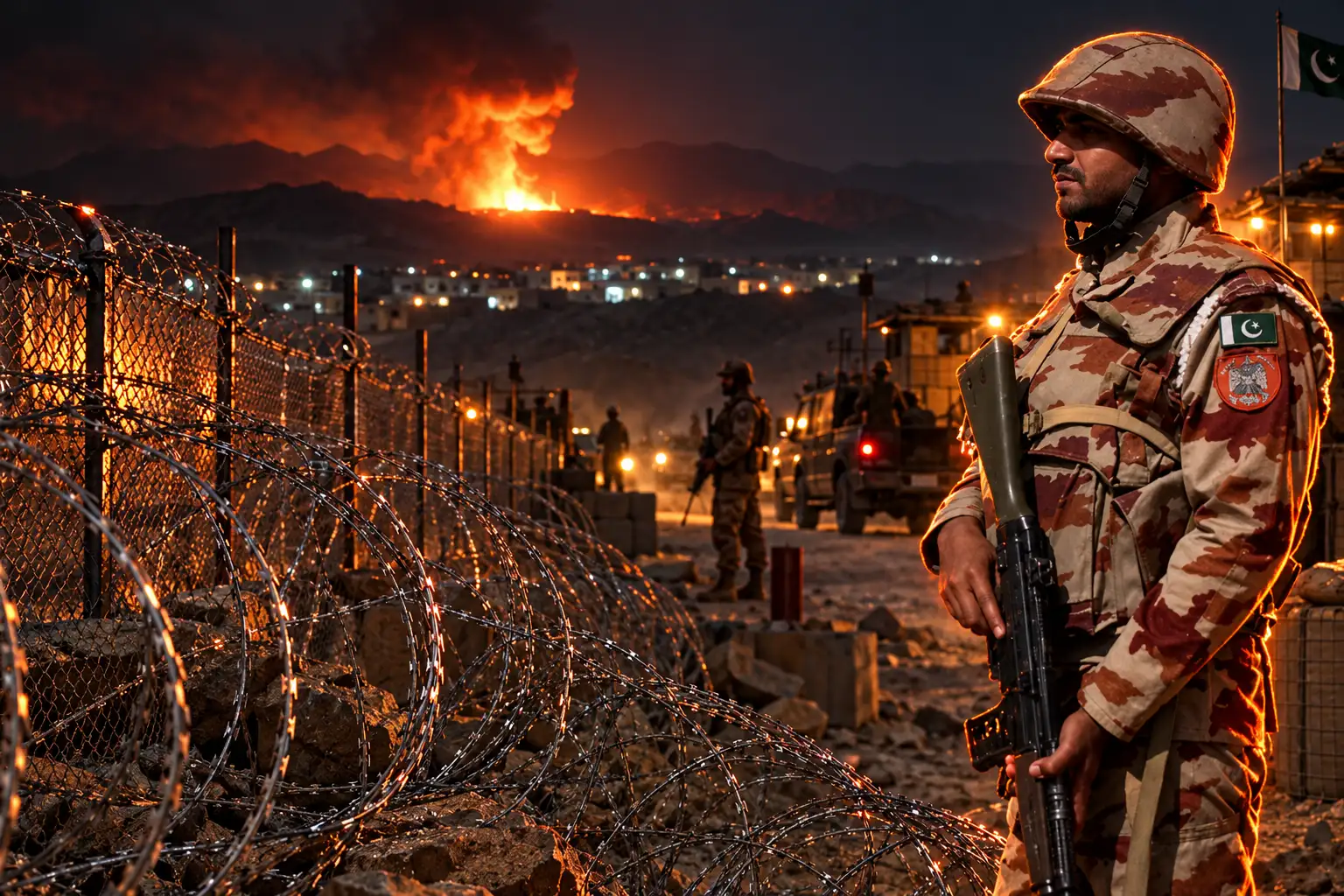
Pakistani sources say several Afghan Taliban fighters were killed at Gulistan after Turkey and Qatar’s security chiefs left Kabul without a militant handover deal.

Pakistani security sources said several Afghan Taliban fighters were killed in a Gulistan border firefight on Friday, with shooting still underway. Neither government has confirmed the clash. It came hours after Kabul promised an “appropriate response” to Pakistani raids on 10 Afghan sites, and a week after Turkish and Qatari security chiefs left Kabul without a deal on the militants Islamabad wants handed over.
The sources described the shooting as a foiled “attempted Afghan aggression” in the Gulistan sector of Balochistan. Intermittent fire was still moving along the frontier after midnight.
Fire Still Moving Through the Gulistan Sector
State-run Associated Press of Pakistan, citing security sources, said Afghan Taliban fighters tried to enter Pakistani territory in the Gulistan sector and were met with return fire. Several of those fighters were killed, the sources said, and Pakistani troops stayed on alert for another crossing.
No military spokesman in Islamabad has put a number on the dead. Kabul has not answered the charge. That gap matters, because the same 24 hours already produced rival tallies for air raids further east, and because Pakistani commentary quickly treated the ground fight as Kabul’s promised reply arriving as a probe on the Balochistan line.
WHAT WE KNOW
- The place: Pakistani sources locate the clash in the Gulistan sector of Balochistan, a border stretch that feeds toward Kandahar.
- The claim: Security sources said several Afghan Taliban fighters were killed and that fire continued after midnight into Friday, September 25.
- The prelude: Information Minister Attaullah Tarar said Pakistan had struck 10 Afghan sites at dawn on Thursday, September 24, after drones entered Pakistani airspace on Wednesday.
WHAT IS UNCONFIRMED
- The death toll: “Several” is the only figure on offer, and it comes from unnamed Pakistani sources, not from ISPR or the Afghan government.
- Who started it: Islamabad calls the shooting an Afghan raid. Kabul has not confirmed a fight at Gulistan at all.
- The drones at the sector: Some Pakistani accounts say four small drones were also flown at Gulistan and shot down; that detail has not been put on the record by Tarar or the army.
Until one of the two governments speaks, the Gulistan file is a source claim sitting on top of a week that is already documented in public statements from both capitals.
Pakistan Hit 10 Sites Before Dawn on Thursday
Tarar said Pakistan’s air defence had detected drones launched from Afghan territory on Wednesday, September 23, tracked them, and destroyed them before they reached their targets. In a statement on X he called the incursion “deliberate and unlawful,” then said Pakistan had used “precision aerial and drone strikes” against 10 locations used to launch and store those drones.
He called the raids “deliberate, precise, calibrated and proportionate” and limited to military aims tied to the attempted attacks. “Any further provocative act by Afghan Taliban will be responded with firm and resolute response,” he wrote. A second post, labelled Update-Ghazab lil Haq, the same name Pakistan used for an earlier cross-border round, said hideouts and drone gear at the 10 sites “were comprehensively destroyed,” and carried video of the strikes.
Update-Ghazab lil Haq
Islamabad, 24 September 2026;
Through precise aerial and drone strikes as seen in attached clip, terrorist hideouts and support infrastructure including drone launching and storage sites across 10 locations in areas under the control of Afghan Taliban… pic.twitter.com/6CrgV4SzSw
— Attaullah Tarar (@TararAttaullah) September 24, 2026
Pakistani security sources, speaking separately, put the Wednesday drone count at 8, with four brought down near the Torkham crossing and four in the hills near Kohat. Tarar’s own posts confirmed an interception. They did not repeat that eight-and-four split on the record.
Zabihullah Mujahid, the Afghan government’s spokesperson, said the Thursday raids hit Kandahar, Paktia and Khost and killed 4 civilians. He denied that his government had flown drones at Pakistan the day before, and he treated the drone story as a cover for strikes he said were aimed at Afghanistan’s own soil.
The Islamic Emirate of Afghanistan assures the people that these shameless acts of aggression and attacks by the Pakistani military regime will be met with an appropriate response through a decisive stance.
Zabihullah Mujahid, Afghan government spokesperson, on X
He added that “reckless, careless, and hostile actions will undoubtedly provoke the anger of the Afghan people and will have adverse consequences for the Pakistani military.” Local officials did not all match his death toll. Mustaghfir Gurbaz, spokesman for the Taliban governor in Khost, said strikes around 3:30 a.m. hit Gurbaz, Ismail Khel, Mandozai and areas near the provincial capital, and he reported no casualties there. In Paktia, governor’s spokesman Mohammad Rasool Ahmadi said jets bombed the Afghan army’s 203rd Mansouri Corps in Gardez. In Kandahar, local accounts described a strike on a weapons depot in the city’s ninth district, and a resident told of a jet, a heavy blast, and fire toward the centre of the city that is home to Taliban supreme leader Hibatullah Akhundzada.
THE WEEK’S COMPETING CLAIMS
| Date | What Pakistan says | What Kabul says |
|---|---|---|
| Sept 18 | Kohat police compound attacked; at least 31 dead | Not a party to the claim |
| Sept 21 | Border air raids killed 28 militants | 3 civilians killed (UN also recorded at least 3) |
| Sept 23 | 8 drones from Afghan soil shot down | Denies launching drones |
| Sept 24 | 10 military and drone sites struck | 4 civilians killed; promises a response |
| Sept 24-25 | Gulistan raid foiled; several Taliban killed | No confirmation |
Those rows are the ladder. Each side calls its own step defence and the other side’s step a crime, which is how a drone intercept on Wednesday became an air war on Thursday and a ground fight by Friday.
What Restarted the Fighting After Three Quiet Months
The border had been quieter for nearly three months before a suicide car and gunmen hit the Old Police Lines compound in Kohat, a Khyber Pakhtunkhwa town of about 220,000, on the afternoon of September 18. Attackers rammed the gate while officers and their families were in a mosque, then fought inside a complex that houses the Counter Terrorism Department and Special Branch.
THE KOHAT TOLL
- The dead: A senior police official said at least 31 people were killed, including 16 police officers.
- The wounded: More than 100 people were injured, most of them police, according to the same official and the district health officer.
- The claim of responsibility: Ittehad-ul-Mujahideen Pakistan, a faction linked to Tehreek-e-Taliban Pakistan, said it carried out the attack.
Islamabad has, for years, said TTP leaders and fighters sit on Afghan soil and that some Baloch separatist groups use the same rear area. Kabul says it does not let anyone use Afghan territory against Pakistan and calls the violence Pakistan’s internal problem. That is the same argument that sat under the TTP sanctuary fight from last winter, when the two former partners fought their worst battles in years.
On September 21, Pakistan said it had hit hideouts in the border region and killed 28 militants. Afghan officials said those raids killed three civilians, a figure the United Nations also recorded as at least three civilian deaths in eastern Afghanistan. Two days later came the drones. One day after that came the 10-site raids. Gulistan followed in the night.
Empty-Handed Mediators, Then a Bomb in Kohat
The fighting did not restart in a diplomatic vacuum. Ibrahim Kalin, head of Turkey’s National Intelligence Organization, was in Kabul and Kandahar on September 16. Turkish security sources said he talked about security cooperation, counterterrorism, drug trafficking and the region, then flew to Islamabad to see Prime Minister Shehbaz Sharif, army chief Field Marshal Asim Munir and ISI Director-General Asim Malik.
Hamad bin Khamis Al-Kubaisi, deputy secretary of Qatar’s National Security Council, was in Kabul at the same time. A Taliban official said Pakistan had asked for the visit, and that the Pakistan file sat at the centre of the meetings. The two officials saw deputy chief minister Abdul Ghani Baradar, interior minister Sirajuddin Haqqani, intelligence chief Abdul Haq Wasiq and defence minister Mohammad Yaqoob Mujahid. Kalin also saw Kandahar governor Mullah Shirin Akhund and people close to Akhundzada. It is not clear whether he met the supreme leader.
Taliban statements about those sessions spoke of bilateral ties and cooperation, not of a Pakistan request. Pakistan’s foreign ministry has already said earlier work by China, Turkey and Qatar did not produce results. On September 17, ministry spokesman Sajjad Haider Khan said Islamabad was ready to restore trade and transit if its security concerns were addressed. The Kohat compound was hit the next afternoon.
THE FOUR MEDIATORS
- Turkey and Qatar: They hosted the October ceasefire that was quickly broken in Doha on October 19, 2025, and sent Kalin and Al-Kubaisi back this month.
- Saudi Arabia: Riyadh helped lock an Eid pause after the winter fighting and, on August 7, signed the Mecca Joint Defense Agreement with Turkey and Pakistan, under which an armed attack on one is treated as an attack on all three.
- China: Beijing brought both sides to Urumqi talks without a ceasefire in April, and a promise only to “explore a comprehensive solution.”
- The missing seat: TTP and the Kohat attackers are the parties Islamabad says matter, and they are not in the room.
Turkey’s dual role is the strain inside that list. Ankara is one of the few capitals that can sit with both the Taliban leadership and Pakistan’s army chief, and it is now also bound to Islamabad by the August defence pact. That does not put Turkish jets over Kandahar. It does mean the mediator who walked through Kabul on September 16 is no longer a bystander in a fight that, by Friday, was again killing people on the line.
Why Drones Now Set the Pace Along the Border
Wednesday’s intercept, Thursday’s loitering munitions and Friday’s small-arms fight are a faster ladder than the artillery-and-warplane nights of February. Cheap drones let each side claim a “proportionate” hit without rolling columns to the fence, and they give the other side a reason to answer within hours. Tarar’s own language, “calibrated and proportionate,” is the same register Pakistan used for earlier rounds. Mujahid’s “appropriate response” is the matching phrase from Kabul. Gulistan is where those two phrases met on the ground.
SEVEN DAYS ON THE BORDER
- September 16: Kalin is in Kabul and Kandahar; Al-Kubaisi meets Taliban security chiefs. Kalin then sees Sharif, Munir and Malik in Islamabad.
- September 17: Sajjad Haider Khan says trade can reopen if Pakistan’s security file is met.
- September 18: A suicide car and gunmen hit Kohat’s Old Police Lines; at least 31 people are killed.
- September 21: Pakistan says border air raids killed 28 militants; Kabul and the UN report three civilian deaths.
- September 23: Pakistan says it shot down drones from Afghan territory near Torkham and Kohat.
- September 24: Pakistan strikes 10 sites in Kandahar, Paktia and Khost; Mujahid reports four civilians killed and promises a response.
- September 24-25: Pakistani sources say several Afghan Taliban fighters are killed at Gulistan, and that fire is still going.
March showed how far this ladder can run. The Taliban said a Pakistani strike on a Kabul drug rehabilitation centre killed more than 400 people. Islamabad denied that account and said it had hit military sites and militant support gear. Saudi Arabia, Turkey and Qatar then pushed through a short Eid pause. The pause did not become a settlement, and by April the Urumqi session could not even produce a joint ceasefire statement.
Islamabad Still Wants TTP Fighters Handed Over
Every mediation round since last October has stumbled on the same demand. Pakistan wants verifiable action against TTP, including people it says are directed from Afghan districts. The Taliban government says those attacks are Pakistan’s problem and that Kabul is not a sanctuary. Until that gap closes, a shuttle by Kalin or a Qatari security official can cool a night of fire. It cannot stop the next police-compound raid from putting aircraft back over Khost.
Gulistan is still an unsigned report. The sources who described it have not been backed by a named Pakistani officer, and Kabul has not said its men were there. What is signed is the week around it: eight drones on Wednesday by Pakistani count, 10 sites on Thursday by Tarar’s count, four civilians on Thursday by Mujahid’s count, and a promised Afghan reply that, if the Gulistan sources are right, arrived as rifle fire on the Balochistan line.
The mediators who were in Kabul on September 16 are, by Friday, watching the same file they could not close. The TTP-linked faction that hit Kohat is still not at that table, and the border they all came to quiet is again exchanging fire.

A CubeSat Will Age Whisky That Never Comes Home

A Charity Quote Cost Shia LaBeouf the FKA twigs NDA

Looker Turned a Model’s Body Into Ad Inventory

Infinity Ward Bets a Paid DMZ Will Stick This Time

Disney Sidesteps a Kimmel Renewal as Failla Cites Losses

How to Get Pre Boarding on Southwest – Skip the Line with These Tricks

False AI Intel Nearly Put US Crews on a Chinese Ship

Tim Cook’s $4.6 Trillion Apple Still Runs on One Phone

Dunes Air Sues Nora Fatehi Over Its Luxury Jet

OpenAI Posts a Navier-Stokes Proof Clay Has Not Touched
-
 TRAVEL3 years ago
How to Get Pre Boarding on Southwest – Skip the Line with These Tricks
-
 NEWS1 month ago
False AI Intel Nearly Put US Crews on a Chinese Ship
-
 BUSINESS2 months ago
Tim Cook’s $4.6 Trillion Apple Still Runs on One Phone
-
 ENTERTAINMENT2 months ago
Dunes Air Sues Nora Fatehi Over Its Luxury Jet
-
 NEWS2 months ago
OpenAI Posts a Navier-Stokes Proof Clay Has Not Touched
-

 LIFESTYLE3 years ago
How Often Do You Have to Change a Monkey’s Diaper? The Truth About Pet Monkeys
-

 NEWS2 months ago
Australia Treats Cloud Software Payments as Taxable Royalties
-

 LIFESTYLE3 years ago
How Long Does It Take for Armpit Hair to Grow? The Stages of Hair Growth and How to Shave It