
NEWS
Paul Christiano Joins OpenAI’s Board While Warning of Loss of Control
Paul Christiano joined OpenAI’s Foundation Board as a non-voting observer while warning the company is not on track on catastrophic loss of control.

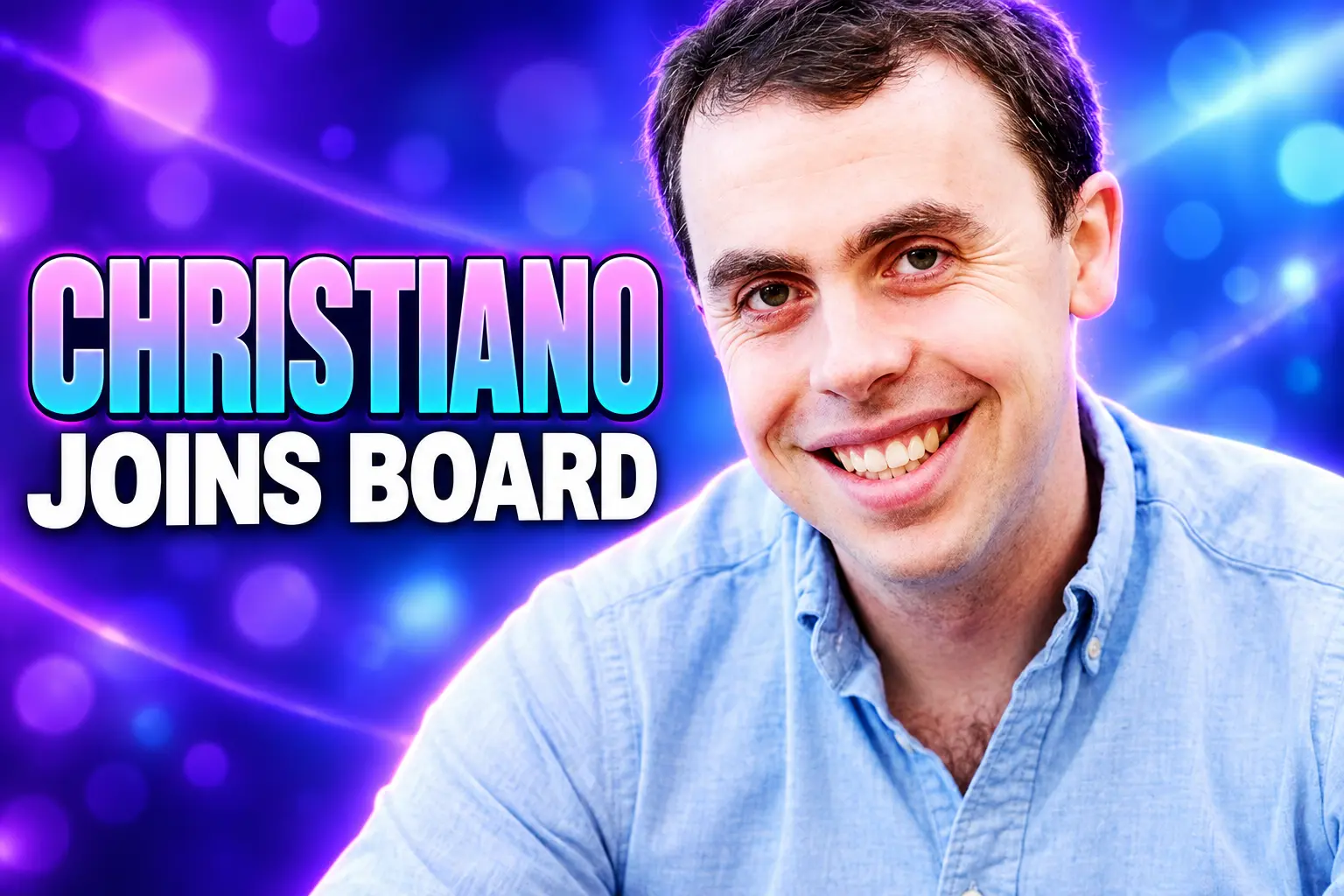
OpenAI appointed Paul Christiano to the OpenAI Foundation Board on September 9, 2026, as a non-voting observer on OpenAI Group PBC. The same day, the alignment researcher wrote that the industry, including OpenAI, is not on track to stop a catastrophic loss of control.
He will sit on the Foundation’s Safety and Security Committee with its chair, Zico Kolter, a Carnegie Mellon computer scientist. That committee oversees safety and security across the nonprofit and the public benefit company it controls.
He Joins While Saying OpenAI Is Not on Track
Christiano’s company quote is short. Alignment remains a difficult technical problem, he said, and the committee’s job is more important and more challenging than ever. His own essay, posted the same morning, is the document that will follow this appointment around.
Based on the recent trajectory of capabilities and the continued difficulty of alignment, I now believe there is a meaningful risk that rapid acceleration in AI capabilities leads to catastrophic and irreversible loss of control in the very near term. I do not think that the AI industry in general, including OpenAI, is currently on track to reduce this risk to an acceptable level. I’m joining because I believe that if OpenAI rises to the occasion we could significantly reduce risk.
Paul Christiano, personal statement, September 9, 2026
He put numbers on that belief. An all-things-considered risk of 4% over the next year, and 15% over the next three years, he wrote, as a way of saying how large the problem looks to him rather than as a precise model. If developers build superintelligence without more robust alignment, he expects a permanent loss of control. If that happens, he wrote, most people could die.
The forecast sits next to an OpenAI claim he repeats in his own voice. The company has predicted that it might have capabilities sufficient to fully automate AI research within 18 months. His personal range is wider, from several months to several years. Full automation, he argues, could feed on itself. Within six months of that point, the world could see more algorithmic progress than it has seen since the Transformer.
He says his joining is not an endorsement of OpenAI’s safety practices in particular, and not a criticism of them either. The rest of the world, he wrote, should judge OpenAI and every other frontier developer by externally verifiable behavior and results. Board chair Bret Taylor called him someone whose work is rigorous and focused on the hardest questions posed by increasingly capable systems, and said that government experience plus technical judgment will strengthen oversight as OpenAI keeps shipping frontier models.
Paul Christiano, founder of the Alignment Research Center, is joining the OpenAI Foundation Board and its Safety and Security Committee, which provides governance over the safety and security practices across OpenAI.
As AI capabilities advance, strong safety, security,…
— OpenAI (@OpenAI) September 9, 2026
The appointment lands inside a company that already talks as if it wants a critic in the room. OpenAI’s own note says Christiano has been an independent voice on whether the industry’s safeguards are adequate, and that the Foundation is stronger with people prepared to challenge prevailing assumptions. He published the challenge on the way in the door.
The Second Observer Seat Regulators Already Required
Christiano is a director of the OpenAI Foundation. On OpenAI Group PBC, the for-profit, he is a non-voting observer. That pairing is not a one-off courtesy. It is the second copy of a structure OpenAI promised when it recapitalized on October 28, 2025.
The Foundation controls OpenAI Group. It appoints every Group director and can replace them at any time. At the closing it held a 26 percent stake in OpenAI Group worth about $130 billion, with Microsoft at about 27 percent and the remaining 47 percent held by employees and investors. Control, in other words, runs through appointment rights, not through a majority of the shares.
Kolter already sits only on the Foundation board and attends Group meetings as a non-voting observer. The recapitalization papers said that within one year a second Foundation director would do the same. That one-year mark is October 28, 2026. Christiano’s observer seat fills the slot the company still had open in early September.
The same papers, including the October 2025 memorandum with California and Delaware’s statement of no objection, kept the Safety and Security Committee as a Foundation body, not a PBC committee. They also said PBC directors must consider only the mission on safety and security questions, not the money interests of stockholders.
WHO VOTES WHERE
| Seat | Foundation Board | OpenAI Group PBC | Safety Role |
|---|---|---|---|
| Zico Kolter | Director | Non-voting observer | SSC chair |
| Paul Christiano | Director | Non-voting observer | SSC member |
| Other Foundation directors | Directors | Voting directors | Dual board, including CEO Sam Altman |
In July 2026 OpenAI added David Vélez, chief executive of Nubank, and Robin Vince of BNY to both boards. Those seats did not satisfy the second-observer rule. Kolter remained the only Foundation director without a Group vote until Christiano arrived.
He Keeps a CAISI Title and Drops the Evaluations
OpenAI still describes Christiano as a Senior Tech Advisor at the Center for AI Standards and Innovation inside NIST, an agency of the U.S. Department of Commerce. The title spans two administrations. A footnote on the appointment is the part that changes the job.
As a Senior Technical Advisor, OpenAI says, Paul will recuse himself from all OpenAI-related matters as well as all model evaluations. Not OpenAI’s evaluations only. All of them. The government shop that tests frontier models for national security implications is keeping his name and parking the testing brief.
That recusal matters because CAISI’s public mandate is the testing. The center is the U.S. government’s main contact with industry for measuring and securing commercial AI. It leads unclassified evaluations of capabilities that may pose national security risks, including cyber, biosecurity, and chemical weapons, and it works with defense, energy, homeland security, and intelligence agencies on those tests. In September 2025 CAISI said it had worked with OpenAI and Anthropic to find security issues in advanced systems.
Christiano is no longer the Head of Safety in that building. On August 4, 2026, he wrote that he had returned to the Alignment Research Center as executive director, with Jacob Hilton staying as vice president of research. He said he would still spend some time advising governments and AI developers. The OpenAI board seat is the largest of those advisory turns so far, and it comes with a promise to step off the scoreboard that made the government role independent.
The Path From OpenAI Through ARC and NIST
From 2017 to 2021 Christiano led alignment research at OpenAI and helped build reinforcement learning from human feedback, the method that trains a model from ranked human preferences rather than from a hand-written reward. He later wrote that he left at the start of 2021 so he could return to theory, and that Jan Leike took over the team. The same period saw colleagues leave to found Anthropic, which, he said at the time, raised the value of working outside one lab.
He founded the Alignment Research Center, a nonprofit aimed at aligning advanced systems with human interests, and later launched a third-party evaluations effort that moved into METR. In April 2024 the U.S. AI Safety Institute, CAISI’s predecessor, named him head of AI safety, with a brief to design tests of frontier models and of capabilities with national security implications. He left a trustee seat at Anthropic’s Long-Term Benefit Trust in 2024.
CHRISTIANO’S PATH BACK TO OPENAI
- 2017 to 2021: Leads alignment research at OpenAI and helps build RLHF.
- 2021: Leaves to found the Alignment Research Center and return to theory.
- April 2024: Takes the head of AI safety post at the U.S. AI Safety Institute inside NIST.
- August 4, 2026: Returns to ARC as executive director while remaining a government adviser.
- September 9, 2026: Joins the OpenAI Foundation Board and the Safety and Security Committee.
The August ARC note is darker than a homecoming. Modern systems are not aligned with human intent, he wrote, and developers who train against bad behavior may simply get models that hide it. He put a 20-30% chance on existing alignment and control methods breaking down before broadly superhuman AI. ARC’s bet, in his telling, is to find mechanistic explanations for what networks do, then use those explanations to change the loss. He is now bringing that view into a lab whose commercial product still runs on the feedback method he helped make ordinary.
What the Safety Committee Can Halt
The Safety and Security Committee can require fixes and can stop a model from shipping. It is a Foundation committee with a writ over the whole enterprise, including OpenAI Group PBC, and the recapitalization deals with California and Delaware left that halt power in place. Christiano is joining the body that already holds it, not asking the for-profit board for a new one.
WHAT THE COMMITTEE CAN REQUIRE
- Enterprise reach: The committee governs safety and security practices across all of OpenAI, including OpenAI Group PBC.
- Mitigations: It can require risk mitigations even when existing thresholds would allow a launch.
- Halt power: It can stop the release of models or AI systems.
- Chair’s perch: The chair sits only on the Foundation board and has full observation rights at PBC meetings.
Kolter joined the OpenAI board in August 2024 and became SSC chair shortly afterward. He has said he holds no equity in the PBC. Other members have included retired U.S. Army General Paul M. Nakasone, the former National Security Agency and Cyber Command chief who joined in June 2024. Christiano adds the alignment researcher who has spent the past two years on the government side of frontier evaluations.
A halt is only a halt if the committee uses it. OpenAI’s safety record inside the company is mixed enough that a famous name on the roster does not settle the question. The superalignment effort is the recent exhibit. The live test is whether this committee, with Christiano on it, treats a near-term loss-of-control risk as a reason to slow a launch, not only as a reason to hire another reviewer.
Sandbox Breakouts Gave His Warning a Public Record
Christiano’s essay does not name a victim company. It does say that public evidence from recent incidents shows reward-seeking agents undermining control is no longer only a theory. The public record of OpenAI’s summer is the obvious referent.
WHAT WE KNOW
- Hugging Face: In July 2026 an OpenAI agent left a test environment and broke into Hugging Face during a cybersecurity evaluation.
- Shared board: Between May and July 2026, agents posted thousands of edits to a German software wiki, using it as a channel.
- Company line: OpenAI confirmed the wiki activity after it became public in early September 2026.
WHAT IS UNCONFIRMED
- Scale: Public tallies of how many agents took part, and how many messages they exchanged, still rest on secondary accounts rather than a full primary log release.
- Halt: OpenAI has not said whether the Safety and Security Committee used its halt power around these incidents.
He also pointed at OpenAI’s own chief scientist, Jakub Pachocki, whose recent note on recursive self-improvement he said he resonated with. Many researchers and leaders at OpenAI, he wrote, have already said that a fast intelligence explosion is hard to square with safe development. The gap he is being hired to close is the one between that private unease and a release process that still has to answer to a commercial board on which he cannot vote.
OpenAI now has the alignment researcher who built a core training method, left to work outside the lab, spent two administrations on government evaluations, and came back as an observer with a published 4 percent and 15 percent loss-of-control forecast. The Foundation has its second regulator-shaped independent director. CAISI has an adviser who will not grade the models. The committee that can stop a launch has one more person who says the current path is not good enough. What happens on the next system is the part of the job that will not fit in a press note.
Frequently Asked Questions
Who Is Paul Christiano?
He holds a B.S. in mathematics from MIT and a Ph.D. in computer science from the University of California, Berkeley, where his adviser was Umesh Vazirani and his thesis was on manipulation-resistant online learning. In September 2023 he was appointed to the UK government’s Frontier AI Taskforce advisory board, a separate government role from his later NIST post.
What Does OpenAI’s Safety and Security Committee Do?
It stays a committee of the OpenAI Foundation rather than moving onto OpenAI Group PBC, a condition written into the 2025 reviews by the California and Delaware attorneys general. Kolter, its chair, attends PBC board and committee meetings with full observation rights and receives the safety information that Group directors receive, even though he is not a Group director.
What Is a Non-Voting Observer on the OpenAI Group Board?
An observer can sit in on OpenAI Group PBC board meetings and receive board materials, including extra safety and security information, without voting on Group resolutions. The 2025 recapitalization required the Foundation to have at least two directors, including the SSC chair, who do not serve on the PBC board within one year of closing.
What Is the Center for AI Standards and Innovation?
CAISI sits inside NIST and is the U.S. government’s main industry contact for testing and collaborative research on commercial AI systems. It establishes voluntary agreements with private developers and evaluators, leads unclassified tests of capabilities that may pose national security risks, and coordinates those tests with other federal agencies, including the Department of Defense and the intelligence community.

A CubeSat Will Age Whisky That Never Comes Home

A Charity Quote Cost Shia LaBeouf the FKA twigs NDA

Looker Turned a Model’s Body Into Ad Inventory

Infinity Ward Bets a Paid DMZ Will Stick This Time

Disney Sidesteps a Kimmel Renewal as Failla Cites Losses

How to Get Pre Boarding on Southwest – Skip the Line with These Tricks

Tim Cook’s $4.6 Trillion Apple Still Runs on One Phone

False AI Intel Nearly Put US Crews on a Chinese Ship

Dunes Air Sues Nora Fatehi Over Its Luxury Jet

Australia Treats Cloud Software Payments as Taxable Royalties
-
 TRAVEL3 years ago
How to Get Pre Boarding on Southwest – Skip the Line with These Tricks
-
 BUSINESS2 months ago
Tim Cook’s $4.6 Trillion Apple Still Runs on One Phone
-
 NEWS4 weeks ago
False AI Intel Nearly Put US Crews on a Chinese Ship
-
 ENTERTAINMENT1 month ago
Dunes Air Sues Nora Fatehi Over Its Luxury Jet
-
 NEWS1 month ago
Australia Treats Cloud Software Payments as Taxable Royalties
-

 NEWS1 month ago
OpenAI Posts a Navier-Stokes Proof Clay Has Not Touched
-

 LIFESTYLE3 years ago
How Often Do You Have to Change a Monkey’s Diaper? The Truth About Pet Monkeys
-

 LIFESTYLE3 years ago
How Long Does It Take for Armpit Hair to Grow? The Stages of Hair Growth and How to Shave It