
NEWS
Supreme Court Clocks the TMC Symbol Fight After the Freeze
The Supreme Court gave the Election Commission three months to settle the TMC symbol dispute, but Flowers and Grass stay off the October 6 ballot.

The Supreme Court on September 28 directed the Election Commission of India to decide the Trinamool Congress name and symbol dispute in three months after both factions finish their papers. A three-judge Bench led by Chief Justice of India Surya Kant, with Justice Joymalya Bagchi and Justice V. Mohana, gave the camps four weeks to file remaining affidavits and then three months for the poll body to “decide the controversy.”
The order does not put Flowers and Grass back on the ballot. Nandigram and Rejinagar still vote on October 6 under substitute names, and the petitioner herself had already stopped asking for a stay.
Four Weeks, Then Three Months
Mamata Banerjee, the former West Bengal chief minister and party founder, had moved the court against the Commission’s September 17 freeze. The writ, Diary No. 58005/2026, named the poll body and Ritabrata Banerjee, Leader of the Opposition in the Assembly, as respondents. It was filed on September 18, the day after the freeze.
On September 24, senior advocate Kapil Sibal, for Mamata, told the Bench the interim freeze was no longer under challenge and that the ask was speed. The court then told senior advocate D.S. Naidu, for the Commission, to put a realistic clock on the table. Naidu brought a chart of older symbol cases and asked for five or six months, saying affidavits would arrive in “lakhs” and that elections in five states had already stretched the staff. “Some of these are big,” he said.
We are inclined to rely upon the timeline within which the disputes at Serial Nos. 3 and 4 of that chart were finally decided in the past. We find in the instant case that the dispute is already pending where pursuant to a notice issued by the Election Commission, the petitioner has already filed their response, whereas the response from the opposite group is still awaited. In such circumstances, we grant four weeks’ time to the contesting respondents as well as the petitioner to place on record their additional documents/affidavits/counter-affidavits, etc. In other words, the pleadings shall be completed in all respects within four weeks; thereafter, the Election Commission of India shall take three months’ more time to decide the dispute.
Chief Justice Surya Kant, Justice Joymalya Bagchi and Justice V. Mohana, Supreme Court of India, September 28, 2026
Four weeks from September 28 runs to October 26. Three months from that date runs to January 26, 2027. The combined window is about four months, which is what Naidu had wanted to start from the filing of affidavits, not from the court’s own calendar.
Justice Bagchi told Naidu the Commission could use machine-learning tools to sort the paper, and that three months had already passed since the dispute reached Nirvachan Sadan. When Naidu pressed for more time, Bagchi said, “In case of extreme exigencies, come before us.” Naidu said the Commission would make “every endeavour” to finish inside the window. Senior advocate Neeraj Kishan Kaul, with Mukul Rohatgi for the Ritabrata camp, asked for six weeks to file. The Bench said no. Sibal told the court the other side was “yet to file, and delaying.” Kalyan Banerjee appeared with Sibal for Mamata. The court said it was expressing no view on the merits and that both sides’ cooperation would be “extremely important.”
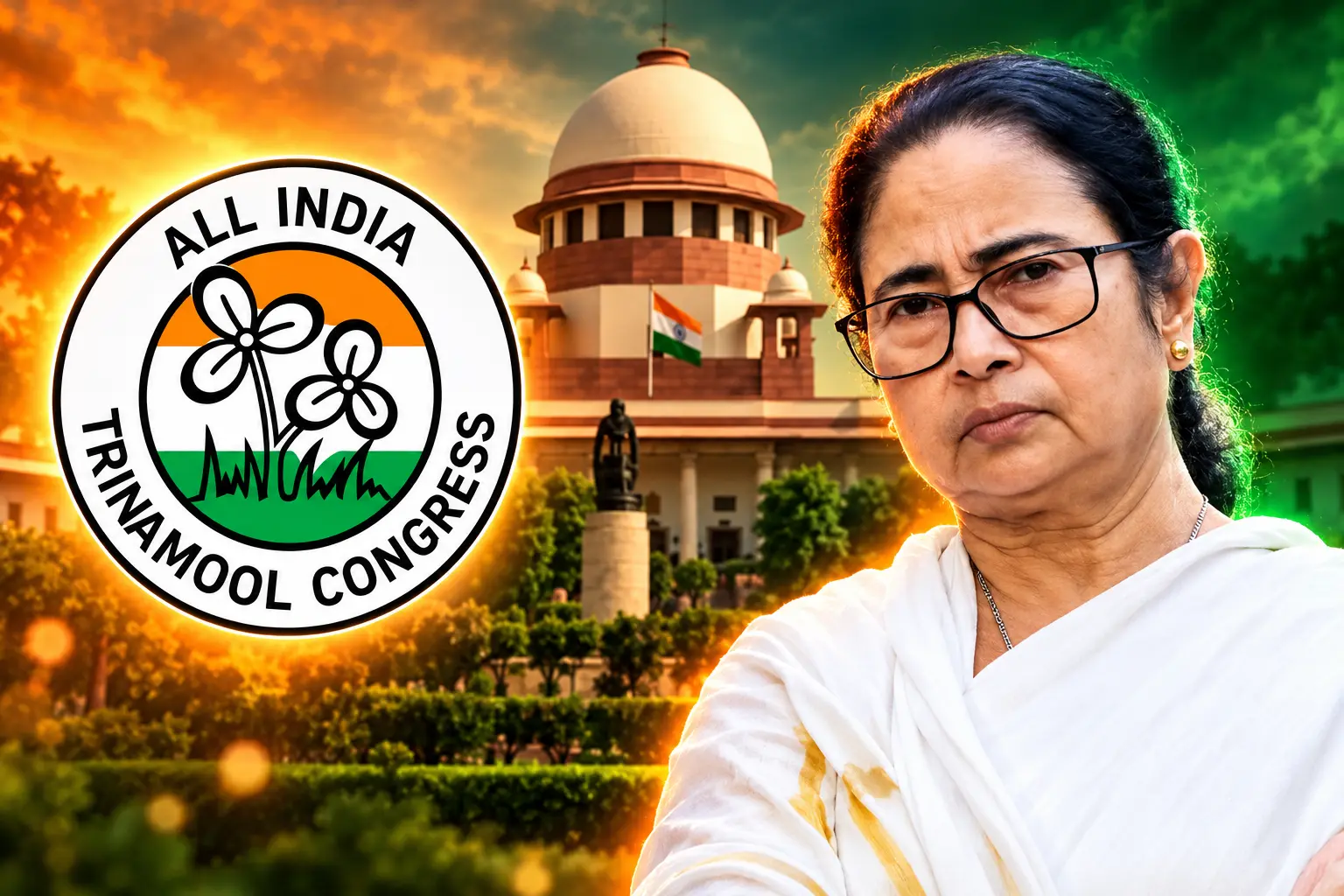
The Freeze Still Covers October 6
Chief Election Commissioner Gyanesh Kumar sat with Election Commissioners Vivek Joshi and Sukhbir Singh Sandhu on September 17 and issued a 14-page order in Dispute Case No. 01 of 2026. The Commission held that two groups each claimed to be the All India Trinamool Congress, a recognised state party in West Bengal, Meghalaya and Tripura, and that there was not enough time to finish a full hearing under Paragraph 15 of the Symbols Order before the bypolls. Paragraph 39 said the freeze was needed to place both groups “on even keel” and to protect their rights. The Order itself is the live rule for these fights; a March amendment to the Symbols Order shows the Commission was still rewriting the same instrument this year.
WHAT THE SEPTEMBER 17 ORDER BARS
- The name: Neither group may use “All India Trinamool Congress” on its own.
- The mark: Neither group may use Flowers and Grass, the reserved symbol, known in Bengal as Joda Ghas Phool.
- The substitutes: Each camp may pick a name that still nods to the parent party, and a free symbol from the notified list.
- The term: The arrangement covers the current by-elections and runs until a final decision under Paragraph 15.
Both sides had until 11 a.m. on September 18 to send three name choices and three free-symbol choices. India Today’s account of that night put the window at 11 hours, with Mamata’s reply time-stamped 11.36 p.m. on September 17, filed under protest. On September 18 the Commission allotted the temporary identities.
THE INTERIM NAMES AND MARKS
| Camp | Interim name | Symbol | Who fronts it |
|---|---|---|---|
| Mamata Banerjee | Mamata All India Trinamool Congress | Football Player | Mamata Banerjee, founder |
| Ritabrata Banerjee | Democratic Trinamool Congress | Envelope | Ritabrata Banerjee, LoP; Arup Roy, NWC chair |
The allotment is not a finding on who owns the party. National spokesperson Nilanjan Das posted the new name and the Football Player the same morning, and the replies turned the figurine into a joke within hours. That is the cost of a freeze that lasts through polling day: the 28-year mark leaves the machine, and the replacements read as props.
Our party led by Smt. @MamataOfficial has been allotted the name ‘Mamata All India Trinamool Congress’ along with the ‘Football Player’ symbol. pic.twitter.com/aI2SiJzLGV
— Nilanjan Das (@NilanjanDasAITC) September 18, 2026
Lok Sabha Leader of the Opposition Rahul Gandhi called the freeze part of a run that had already hit Shiv Sena and the Nationalist Congress Party, saying a party can be “stolen” the way votes can. Congress general secretary K.C. Venugopal called the late-night order Chief Election Commissioner Gyanesh Kumar’s “late night birthday gift” to Prime Minister Narendra Modi and demanded the original mark back for Mamata’s camp. The Commission’s own papers treat the two groups as rival claimants, not as a hijack file.
Who Contests Nandigram and Rejinagar?
Voting is on October 6. Counting is on October 9. The process is to close by October 11. Nandigram in Purba Medinipur fell vacant after Chief Minister Suvendu Adhikari, who won both Nandigram and Bhabanipur in the May 2026 Assembly election, kept Bhabanipur, the seat where he beat Mamata. Rejinagar in Murshidabad fell vacant after Aam Janata Unnayan Party chief Humayun Kabir, a former Trinamool leader who won Rejinagar and Naoda, kept Naoda. Kabir had publicly offered to vacate Rejinagar for Mamata after her Bhabanipur loss; he then fielded his son, Ghulam Nabi Azad, known as Robin.
Nomination scrutiny ran on September 17, the freeze day, and on September 18. Withdrawals closed on September 19. Both Trinamool camps had filed on Flowers and Grass before the Commission locked the mark.
THE BYPOLL FIELD AFTER THE FREEZE
- Nandigram, BJP: Hasirani Rath, mother of Adhikari’s former aide Chandranath Rath.
- Nandigram, Ritabrata camp: Ehteshmul Haque, on the Envelope.
- Nandigram, Mamata camp: Sanchita Pradhan withdrew after photographs of a meeting with Adhikari circulated; Mamata then backed Congress candidate Milan Pradhan, who was arrested the same day on 19-year-old warrants tied to the 2007 land agitation.
- Nandigram, others: CPI’s Shanti Gopal Giri; Indian Secular Front’s Mohammad Sabe Miraj Ali Khan.
- Rejinagar, Mamata camp: Rabiul Alam Chowdhury, on the Football Player, announced a withdrawal and reversed it the same day on Mamata’s instruction.
- Rejinagar, Ritabrata camp: Sheikh Saifuddin, on the Envelope.
- Rejinagar, others: Robin for AJUP; Shankharav Sarkar for the BJP; Sayeed Asad Ali for the CPI(M); Mohammad Abdullahil Kafi for Congress.
The Envelope itself had a second fight attached. The Indian Secular Front had used it and was contesting both seats. After the Commission gave the same mark to Democratic Trinamool Congress, the Calcutta High Court on September 25 told the poll body it “should act fairly.” ISF was moved to the almirah. Voters in two Assembly seats will now sort Football Player, Envelope, almirah, and the rest without the two flowers they have seen since 1998.
Mamata’s camp also said it would not contest the Nagaon Lok Sabha bypoll in Assam, another October 6 contest, and would back Congress there. The October 6 round also includes Madurantakam and Dharapuram in Tamil Nadu and Thattanchavady in Puducherry. None of those other races turns on Flowers and Grass. Nandigram and Rejinagar do, and they will be over before the four-week pleading clock even runs out on October 26.
Fifty-Eight MLAs and a Founder Without Them
The party that will argue over the original name is not the party that won Bengal for 15 years. In the 2026 Assembly election the BJP took 207 seats. Trinamool was left with 80. On June 3, 58 of those 80 MLAs backed expelled legislator Ritabrata Banerjee for Leader of the Opposition, crossing the two-thirds line of 54 that the Tenth Schedule uses for a split inside the House. Speaker Rathindra Bose recognised him that day. The rebels’ letter still called Mamata chairperson, then added the Bengali tag for principal adviser.
THE SPLIT ON PAPER
- Assembly: 80 Trinamool MLAs after May 2026; 58 recognised with Ritabrata on June 3; he later claimed 64, and by mid-September the Mamata camp’s own bypoll note put “more than 65” on his side.
- Lok Sabha: Trinamool had 28 members; 20 were described as moving toward the Nationalist Citizens Party of India and the NDA.
- Organisation: On June 22 a special session at the Novotel in Kolkata elected Howrah Central MLA Arup Roy as National Working Committee chair. Ritabrata, Javed Khan and Sandipan Saha were named general secretaries.
Ritabrata, 47, is a former CPI(M) cadre who joined Trinamool in 2020 and was expelled on June 1 with Sandipan Saha. The Commission’s caption on the dispute names Arup Roy as the petitioner and Mamata as the respondent, which is why some orders speak of an Arup Roy group even when the public fight is Ritabrata versus Mamata. Abhishek Banerjee, the national general secretary and Mamata’s nephew, is the person the rebels keep naming as the reason they walked.
Mamata’s answering NWC, sent to the Commission as of June 20, kept her as chairperson, Abhishek as general secretary, Subrata Bakshi as vice chair, and Rajya Sabha MPs Derek O’Brien and Dola Sen as joint secretaries. That is the organisational pile the Commission must now weigh against the legislative pile. In the last two big splits, the legislative pile won.
The Test That Awarded the Bow and Arrow
Paragraph 15 says that when rival sections of a recognised party each claim to be that party, the Commission may, after looking at all the facts and hearing the groups, decide that one of them, or none of them, is the party. In practice the test has two legs, the organisation and the legislature, and when the organisation is a mess the legislature has decided the file.
HOW THE LAST THREE BIG SPLITS ENDED
| Party | Interim freeze | Final order | Who kept the original mark |
|---|---|---|---|
| Shiv Sena | October 2022, Andheri East bypoll | February 17, 2023 | Eknath Shinde, majority of MLAs; Uddhav Thackeray, the founder’s son, got a flaming torch |
| NCP | None; direct final award | February 6, 2024 | Ajit Pawar, majority of MLAs; Sharad Pawar, the founder, got a man blowing a trumpet |
| AIADMK | March 2017, before an April bypoll | November 2017 | O. Panneerselvam’s camp over V.K. Sasikala and T.T.V. Dhinakaran |
| Trinamool Congress | September 17, 2026 | Clocked for January 2027 | Pending |
Shiv Sena’s freeze lasted from October 2022 to mid-February 2023, about four months, and then the founder line lost. NCP’s split began in July 2023 and ended in February 2024, again with the founder on the outside. Sibal and Venugopal have already put Trinamool on that list in public. The list cuts both ways. A three-month decision after a four-week paper round is faster than those files, and speed is what Mamata asked the court for. It is also speed toward a numbers test her camp does not lead in the Assembly.
The 2017 Samajwadi Party fight, decided in 14 days before the Uttar Pradesh election, is the outlier the court did not copy. Naidu told the Bench that older files had taken six months to over ten months. Serial Nos. 3 and 4 on his chart, the ones the judges said they would follow, were not named in open court. The Shiv Sena gap from freeze to final order is the closest public match to the window now fixed for Trinamool.
Naidu Asked for Six Months
The Commission’s own docket, set out in the September 17 order, is why Sibal could call the other side late. Both camps wrote to Nirvachan Sadan on June 23. Ritabrata’s letter said the National Working Committee’s tenure had expired on February 11, 2025, and that the June 22 Novotel session had filled the vacuum. Mamata’s letter sent a fresh office-bearer list from a June 20 meeting. The Commission exchanged the papers on July 2 and asked for replies by July 6.
THE COMMISSION FILE BEFORE THE FREEZE
- June 23, 2026: Both camps file competing NWC claims.
- July 2, 2026: A ten-member Arup Roy delegation meets the Commission; papers are exchanged; replies are due July 6.
- July 6, 2026: Mamata files. Ritabrata asks for a week, then 15 days to July 25, then 10 days to August 4.
- July 12 and 29, 2026: Mamata writes again, asking the Commission to stop granting time and to treat her points as admitted.
- September 11, 2026: Ritabrata files his reply, more than two months after the first deadline.
- September 12, 2026: Separate meetings with both camps. The rebel side also lodges Alipore civil court orders in Title Suit No. 965 of 2026, Jui Biswas versus Mamata Banerjee, including an ad-interim injunction.
- September 17, 2026: Freeze, on the last day of nomination scrutiny.
- September 28, 2026: Supreme Court clock.
That gap is the reason four weeks, not six, is now the paper round. It is also why a January 2027 decision lands on top of the next big Assembly cycle. Assembly terms end on March 13, 2027 in Manipur, March 14 in Goa, March 16 in Punjab, March 28 in Uttarakhand, and May 22 in Uttar Pradesh. The working plan around the Census is a February-March 2027 poll in those five states, the cluster Naidu was pointing at when he said some of the coming elections are big. A Trinamool verdict in late January would arrive as that machine is already moving.
West Bengal minister Tapas Roy, asked about the September 28 order, said that if the apex court had spoken there was little left for him to add. BJP MP Naresh Bansal said whatever the Commission does inside the four-month combined window will come back to the Supreme Court. Neither comment restores a flower to an EVM. The bypolls will be fought as Mamata All India Trinamool Congress and Democratic Trinamool Congress, and the original name stays in the freezer until the Commission, on the court’s clock, says which camp is the party, or that neither is.

A CubeSat Will Age Whisky That Never Comes Home

A Charity Quote Cost Shia LaBeouf the FKA twigs NDA

Looker Turned a Model’s Body Into Ad Inventory

Infinity Ward Bets a Paid DMZ Will Stick This Time

Disney Sidesteps a Kimmel Renewal as Failla Cites Losses

How to Get Pre Boarding on Southwest – Skip the Line with These Tricks

False AI Intel Nearly Put US Crews on a Chinese Ship

Tim Cook’s $4.6 Trillion Apple Still Runs on One Phone

Dunes Air Sues Nora Fatehi Over Its Luxury Jet

OpenAI Posts a Navier-Stokes Proof Clay Has Not Touched
-
 TRAVEL3 years ago
How to Get Pre Boarding on Southwest – Skip the Line with These Tricks
-
 NEWS1 month ago
False AI Intel Nearly Put US Crews on a Chinese Ship
-
 BUSINESS2 months ago
Tim Cook’s $4.6 Trillion Apple Still Runs on One Phone
-
 ENTERTAINMENT2 months ago
Dunes Air Sues Nora Fatehi Over Its Luxury Jet
-
 NEWS2 months ago
OpenAI Posts a Navier-Stokes Proof Clay Has Not Touched
-

 LIFESTYLE3 years ago
How Often Do You Have to Change a Monkey’s Diaper? The Truth About Pet Monkeys
-

 NEWS2 months ago
Australia Treats Cloud Software Payments as Taxable Royalties
-

 LIFESTYLE3 years ago
How Long Does It Take for Armpit Hair to Grow? The Stages of Hair Growth and How to Shave It