
NEWS
The U.S. Reopens Two Greenland Bases Without the Island
Washington is set to reopen Narsarsuaq and Mestersvig under a pact Denmark says keeps Greenland Danish and puts Arctic security under NATO.

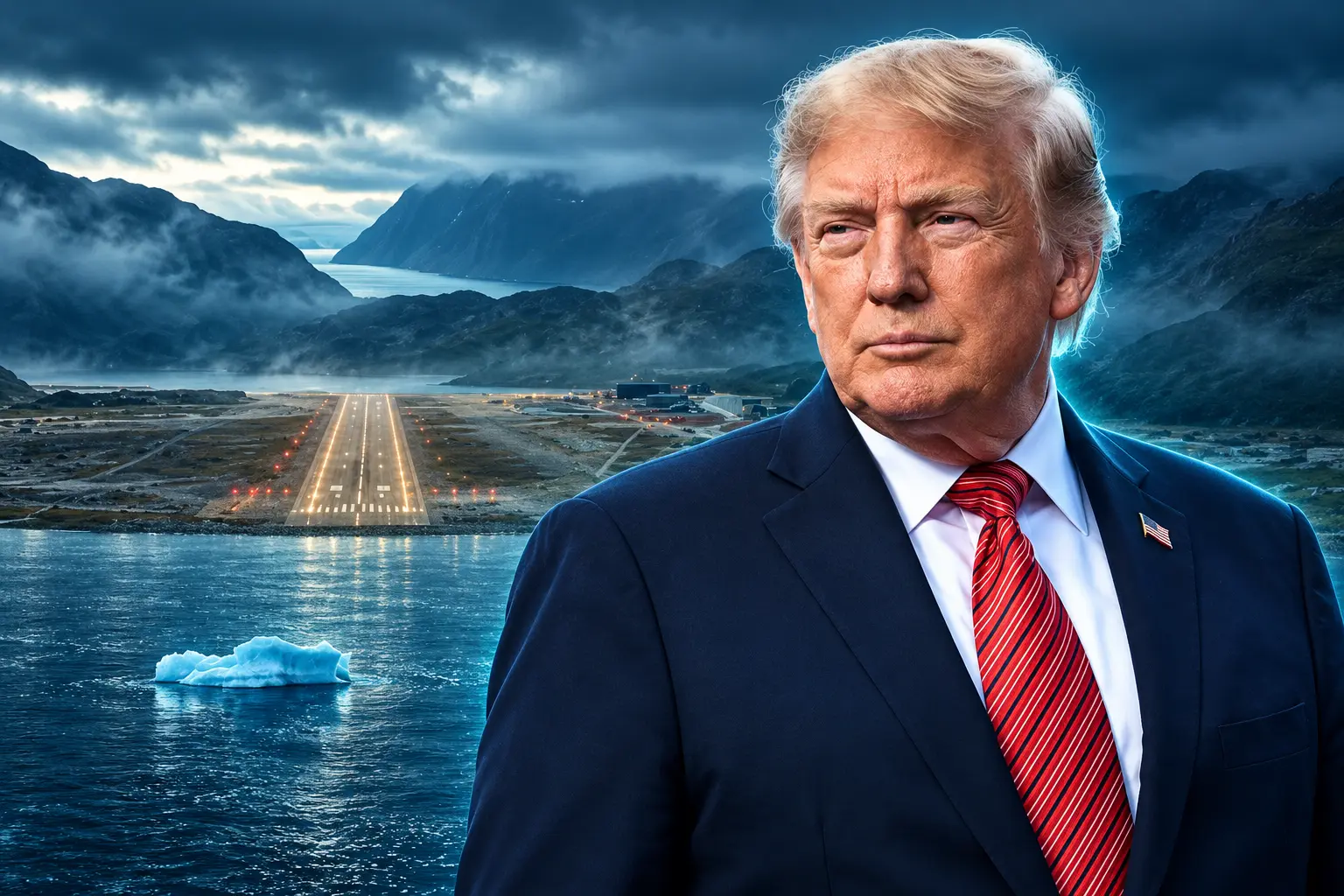
The United States is scheduled on September 22 to reopen a Cold War airfield in southern Greenland and stand up a presence at an east-coast dog-sled outpost. President Donald Trump, Danish Prime Minister Mette Frederiksen, and Greenland Prime Minister Jens-Frederik Nielsen are due to sign at 10:30 a.m. ET (1430 GMT) at United Nations headquarters in New York.
People familiar with the talks named the sites as Narsarsuaq, a settlement of a few dozen people, and Mestersvig, used by Denmark’s Sirius Dog Sled Patrol. Trump has called the pact “permanent control over security.” Denmark says it keeps the island Danish and puts Arctic security under NATO.
Narsarsuaq Closed Its Runway in April
Narsarsuaq is the easier political postcard, because America already built it. Construction on the field the Army coded Bluie West One began in July 1941, on a glacial plain at the head of a fjord, after Britain asked for help against U-boats on the North Atlantic ferry route. About 4,000 troops were stationed there at the wartime peak, and about 10,000 aircraft used it as a fuel stop on the way to Europe.
A hospital went up in 1943. Jets later needed a longer paved strip, and a 6,000-foot runway replaced the original steel-mat field. Aerial refueling and the big base at Thule, now Pituffik, made the southern stop redundant. The U.S. Air Force left in 1958, 68 years before this signing, and Denmark reopened the field for civilian flights.
Greenland then spent years moving that traffic. Officials decided to close the airport to airplanes and keep only helicopters, shifting fixed-wing service about 37 nautical miles south. A new airport has opened in Qaqortoq on April 16, 2026, with a 1,500-meter runway built for turboprops. Narsarsuaq dropped to heliport status. The settlement that once lived off the field now has a few dozen residents, according to people familiar with the new deal.
Danish Chief of Defence Michael Hyldgaard has called Narsarsuaq an obvious candidate because it sits on transatlantic routes and the Denmark Strait. Washington would be walking back onto a runway the island’s own government just emptied.
NARSARSUAQ FROM FERRY STOP TO HELIPORT
- July 1941: U.S. Army construction begins on Bluie West One.
- 1943: An Army hospital opens beside the field.
- 1958: The U.S. Air Force leaves and hands the site to Danish authorities.
- April 16, 2026: Qaqortoq Airport opens and takes South Greenland’s fixed-wing traffic.
- September 22, 2026: Trump, Frederiksen, and Nielsen are scheduled to sign a pact that people familiar with the talks say includes a U.S. return to the field.
The 1951 technical schedule that accompanied the original Defense of Greenland Agreement already listed Narsarsuaq among the selected defense areas, so the “new” southern base is a return to a map Washington used when the Cold War was young.
Sirius Still Holds the East Coast
Mestersvig is a different kind of leftover. It sits on Greenland’s east coast as a military outpost with a gravel strip, inside the huge Northeast Greenland National Park, and it is already a Danish sovereignty tool. Sirius, formed in 1950 as a secret naval sled unit after the war, trains there in winter and uses it as a way station.
The patrol enforces Danish sovereignty in Northeast Greenland by covering 15,000 to 20,000 kilometers a year by dog sled. Headquarters are at Daneborg. Teams deploy for 26 months at a stretch. Sirius is one of Denmark’s three special forces, beside the Jaegercorps and the Frogman Corps, and its job is presence: showing that the empty coast is watched.
WHAT SIRIUS ALREADY DOES OUT EAST
- The route: Two-person teams and a dozen sled dogs work the uninhabited north and northeast coasts.
- The point: The unit exists to show the Kingdom of Denmark is on the ground in country too empty for a garrison.
- The strip: Mestersvig is a training ground and outpost, not a town, and a U.S. presence would sit on top of that Danish patrol.
- The politics: Putting American forces on a sled-patrol hut is how a “new base” can be announced without opening a city.
Polling has shown an overwhelming majority of Greenlanders reject the idea of U.S. control of the island. Sharing a gravel strip with Sirius is easier to sell in Nuuk than a flag change.
What Washington Says the Pact Contains
The text has not been published. People familiar with the deal, speaking before the ceremony, said the details will not be final until it is signed, and Danish officials have said it would then need parliamentary steps in Copenhagen and Nuuk before it enters into force. What has been said in public is two sales pitches.
On September 18, Trump wrote that the United States would “FOREVER have the complete ability to do what is necessary in Greenland,” that the pact had no expiry date, and that “There will be NO COST to the United States.” He said no U.S. adversary could have a base, a military presence, or make sensitive investments without express written American approval, and that Washington would “immediately begin the process of developing a large Military presence.” Secretary of State Marco Rubio said the deal “permanently and completely addresses our national security concerns in Greenland.”
It is a good agreement from a Danish point of view.
Mette Frederiksen, Danish prime minister, on Danish radio from New York
Frederiksen said the unpublished text “recognises” the sovereignty and territorial integrity of the Kingdom of Denmark and the Greenlandic people’s right to self-determination. Foreign Minister Lars Lokke Rasmussen told Danish television the pact “will be in a form where responsibility for security in the Arctic is not only Danish or American,” and that NATO would largely look after the Arctic. A NATO spokesperson said the alliance welcomed an agreement that would “help advance security, stability and cooperation in this vital region.” French President Emmanuel Macron said it helps reaffirm Danish sovereignty.
A State Department official, speaking on condition of anonymity about terms, said the deal bars non-NATO countries from building a base, keeps China and Russia from sending troops, and sets screening so sensitive investments need U.S. written approval. The same briefing said Washington would hold permanent access, basing, and overflight rights, and that those rights would continue to apply even if Greenland later became independent. No land changes hands.
THREE SITES ON THE MAP
| Site | Coast | Past U.S. role | Status now |
|---|---|---|---|
| Pituffik Space Base | Northwest | Thule Air Base, the surviving post | About 150 U.S. troops, missile warning and space surveillance |
| Narsarsuaq | South | Bluie West One, closed in 1958 | Heliport after the April 2026 airport shift |
| Mestersvig | East | Not a U.S. base | Sirius Dog Sled Patrol outpost |
If both additions open, the American footprint would go from one site to three. During the Cold War the United States kept 17 installations and more than 10,000 personnel in Greenland. Pituffik is what remains of that system, with some 150 U.S. troops. The two named additions are not a return to that scale. They are a southern ghost field and an eastern patrol hut.
The 1951 Treaty Never Left
A large share of the military language in the new pact restates rights Washington already holds. The Defense of Greenland Agreement signed on April 27, 1951, let the United States, on the basis of NATO plans, establish and operate defense areas Denmark could not run alone, without prejudice to Danish sovereignty. Flags of both countries were to fly. U.S. rights inside those areas included construction, movement, and logistics without compensation to Copenhagen.
The 2004 update signed at Igaliku on August 6, 2004, by Secretary of State Colin Powell, Danish Foreign Minister Per Stig Moller, and Greenland Home Rule Deputy Premier Josef Motzfeldt, cut that map to a single named post. Article 1 of that amendment said Thule Air Base is the only defense area in Greenland, and that Article II of the 1951 treaty would still govern any new ones. NATO’s Status of Forces Agreement, the parties noted, had applied in Greenland since 1955. The United States also agreed to consult Denmark and Greenland’s home-rule government before significant changes to operations or facilities.
Thule Air Base is the only defense area in Greenland. The provisions of Article II of the Defense Agreement shall apply to the establishment of new defense areas.
Article 1, Agreement amending the 1951 Defense of Greenland Agreement, Igaliku, August 6, 2004
Reopening Narsarsuaq and adding Mestersvig is, on that paper, the first named expansion of “defense areas” in 22 years. Greenland Prime Minister Nielsen has suggested the new text may largely restate rights the United States already holds through NATO and the 1951 treaty. The legal fight is less about inventing access than about who frames it, who can veto a Chinese mine, and whose flags stay on the pole.
January’s Annexation Threat Ends in a Signing Room
The ceremony is the end of a year that began with Trump refusing to rule out military or economic force to acquire the semi-autonomous Danish territory. Those threats peaked in January and opened a rift inside NATO, because the target was a founding ally’s land. Denmark and Greenland went into talks to take the pressure down. A working group on a framework was set up in mid-January.
Trump had said the United States needed Greenland so Russia or China could not have it. A State official later argued that under the old status quo any country, adversaries included, could in principle have been allowed a base or troops. Denmark spent the winter saying there had been little Chinese or Russian military activity around Greenland. The bar on adversary bases and on sensitive investment, in that light, writes down a fear more than it reverses a build-out already under way.
A White House official said the three leaders “will formalize their new agreement that will secure and defend the security of Greenland and the United States.” Nielsen, posting from New York the day before the ceremony, called it “an important moment after a difficult period, during which many people back home have followed developments closely and with concern,” and wrote, “When I sign the agreement tomorrow, I will do so with all of you in mind.” Lithuanian President Gitanas Nauseda welcomed the pact as a step toward stronger security in the Arctic and the North Atlantic.
The split in public argument is the same split as the two speeches. One side hears a locked Arctic and a U.S. return. The other hears a lease dressed as a win, and waits for pages nobody has released. Until those pages are public, “permanent control” and “self-determination” travel as slogans, not as clauses a court could read.
The Overlay That Would Outlive Independence
Greenland has had the right, since the 2009 Self-Government Act, to vote itself independent. The State Department briefing that the new security rights would survive that vote is the piece Nuuk will have to live with longest. Copenhagen keeps the Kingdom’s title today. Nuuk keeps a path to a referendum. Washington, if that briefing holds, keeps basing and overflight on the other side of any yes vote.
That is the part of the deal that is not a ghost town and not a sled hut. An investment screen with American written approval would sit on minerals and infrastructure the island needs if it ever wants an economy that can fund a state. Nielsen has said the deal “recognises Greenland’s interests” and is “to the benefit of us all.” The unread clause about independence will test that sentence for years.
WHAT WE KNOW
- The ceremony: Trump, Frederiksen, and Nielsen are scheduled to sign at the United Nations on September 22 at 10:30 a.m. ET.
- The sites: People familiar with the talks named Narsarsuaq and Mestersvig as the two additional U.S. locations, on top of Pituffik.
- The deed: Denmark and Greenland say the pact recognizes Danish sovereignty, territorial integrity, and Greenlandic self-determination, and transfers no land.
WHAT IS UNCONFIRMED
- The text: The agreement has not been published, and people familiar with it said details are not final until signature.
- The scale: Trump promised a large military presence at no cost to the United States; no public troop number, budget, or construction timetable has been attached to Narsarsuaq or Mestersvig.
- The independence clause: A State Department official said U.S. access would survive a future Greenlandic state; that language is not yet on paper the public can read.
On the ice, the first American problem is simpler than the speeches. Narsarsuaq’s jet runway is a heliport. Mestersvig is a patrol hut on gravel. Pituffik still does the missile warning. The flags Denmark wants on the document are the same flags that flew over Thule in 2004. The unread pages have to do the rest.

A CubeSat Will Age Whisky That Never Comes Home

A Charity Quote Cost Shia LaBeouf the FKA twigs NDA

Looker Turned a Model’s Body Into Ad Inventory

Infinity Ward Bets a Paid DMZ Will Stick This Time

Disney Sidesteps a Kimmel Renewal as Failla Cites Losses

How to Get Pre Boarding on Southwest – Skip the Line with These Tricks

False AI Intel Nearly Put US Crews on a Chinese Ship

Tim Cook’s $4.6 Trillion Apple Still Runs on One Phone

Dunes Air Sues Nora Fatehi Over Its Luxury Jet

OpenAI Posts a Navier-Stokes Proof Clay Has Not Touched
-
 TRAVEL3 years ago
How to Get Pre Boarding on Southwest – Skip the Line with These Tricks
-
 NEWS1 month ago
False AI Intel Nearly Put US Crews on a Chinese Ship
-
 BUSINESS2 months ago
Tim Cook’s $4.6 Trillion Apple Still Runs on One Phone
-
 ENTERTAINMENT2 months ago
Dunes Air Sues Nora Fatehi Over Its Luxury Jet
-
 NEWS2 months ago
OpenAI Posts a Navier-Stokes Proof Clay Has Not Touched
-

 LIFESTYLE3 years ago
How Often Do You Have to Change a Monkey’s Diaper? The Truth About Pet Monkeys
-

 NEWS2 months ago
Australia Treats Cloud Software Payments as Taxable Royalties
-

 LIFESTYLE3 years ago
How Long Does It Take for Armpit Hair to Grow? The Stages of Hair Growth and How to Shave It