
BUSINESS
The FCRA Bill Traps Assets After Certificates Lapse
The FCRA Amendment Bill’s vesting clause hits any lapsed certificate, while MHA data show social and education groups took 87% of 2024-25 inflows.

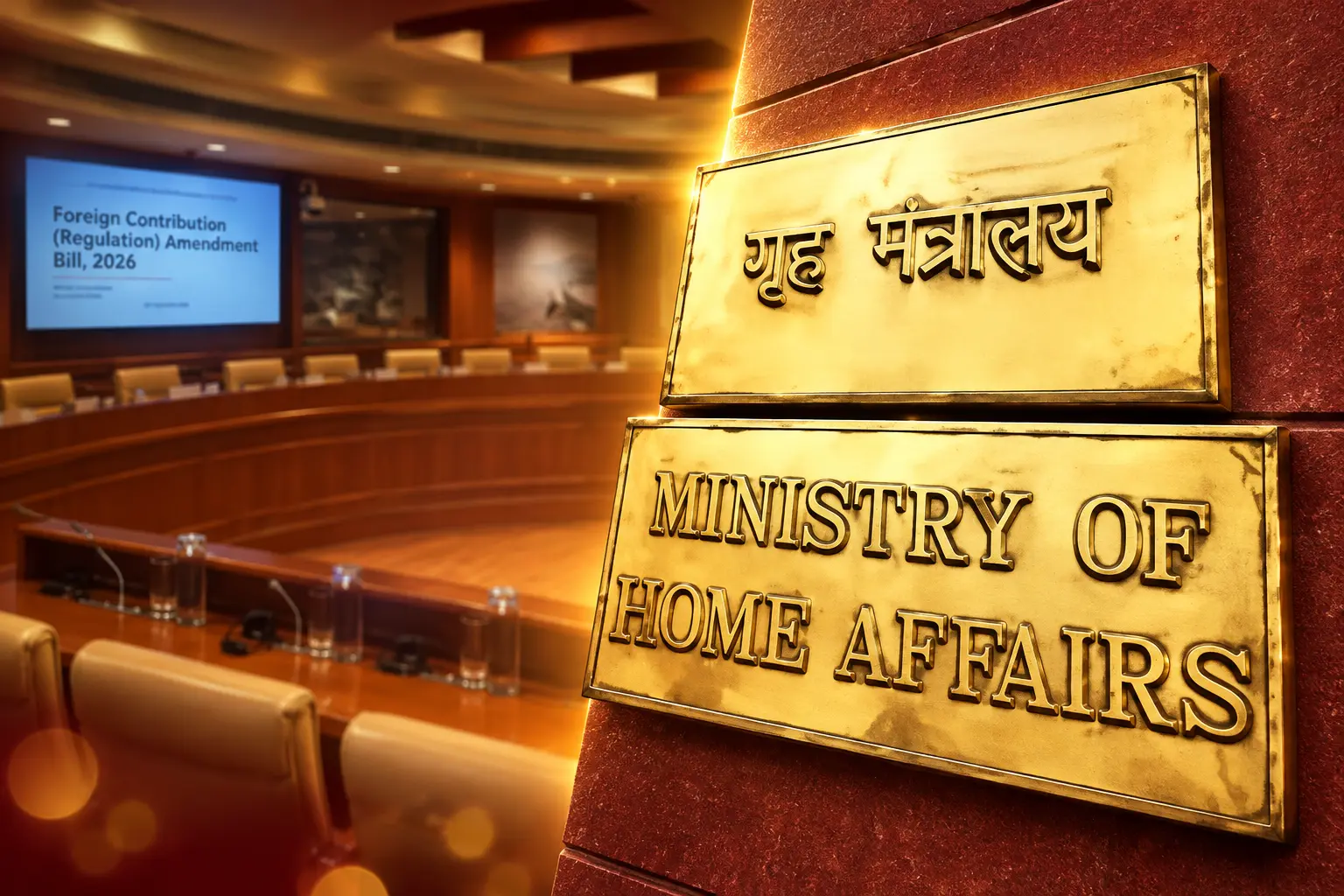
Union Home Secretary Govind Mohan told a parliamentary panel on 18 September 2026 that the FCRA Amendment Bill polices foreign money entering a sovereign space. The Ministry of Home Affairs said the law is, at its core, national-security legislation, and that it does not regulate charity.
The tables the ministry laid on the same day point somewhere else. Religious purpose took 8% of ₹22,974 crore received in 2024-25. Social and education work took 87%. A new Designated Authority would still take foreign-funded assets when a five-year certificate is cancelled, surrendered, or simply allowed to run out.
Mohan Told the Panel It Is a Security Law
Mohan led the first sitting of the 31-member joint committee examining the Foreign Contribution (Regulation) Amendment Bill, 2026, chaired by BJP MP Sanjay Jaiswal. The session ran more than three hours. MHA officials said concerns over national interest, internal security and law and order were the drivers, and that the bill was not aimed at any community.
The bill was introduced in the Lok Sabha on 25 March 2026 by Minister of State for Home Nityanand Rai and sent to the joint committee on 12 August 2026 after opposition protests. Christian groups had already met Home Minister Amit Shah. Rai told the House the bill was “indeed dangerous” for those who use foreign money for “forced religious conversion” and for people who abuse foreign funding for personal gain.
BJP MP Nishikant Dubey told the panel India had a history of foreign money being used to influence national questions. He asked why the Ford Foundation was allotted prime property in Lodhi Estate when more than 1,400 NGOs linked to foreign funding were closed under other laws before FCRA was first enacted in 1976, and he named Rockefeller Foundation as a backer of an elite cultural body in central Delhi. Jaiswal flagged protests against the Kudankulam nuclear plant in Tamil Nadu and the Sardar Sarovar Dam in Gujarat, projects that BJP members have long said foreign-funded groups tried to stall under an environmental banner.
DMK MP P. Wilson repeated the charge that the amendments target Christian groups, which he said make up most religious organisations with an FCRA licence. Other opposition MPs said those groups had empowered Dalits and women in south India, and they called the asset clauses draconian because even a surrendered licence would still allow property to be taken.
Where Rs 22,974 Crore in Foreign Funds Went
MHA told the committee that active FCRA registrations have almost halved in a decade, from 29,022 in 2015 to 14,466, while inflows rose from ₹17,832 crore in 2015-16 to ₹22,974 crore in 2024-25, a rise of ₹5,142 crore. Tamil Nadu has the most organisations, at 2,102, ahead of Maharashtra (1,578), Karnataka (1,355), Delhi (1,218), Andhra Pradesh (1,022) and Kerala (1,013).
Delhi, with fewer licences than Tamil Nadu, took the most money: ₹5,834 crore in 2024-25, ahead of Karnataka (₹3,164 crore), Maharashtra (₹2,385 crore) and Tamil Nadu (₹2,313 crore). The United States sent ₹12,113 crore, about 53% of the year’s inflow. The United Kingdom sent ₹2,414 crore (10.5%), then Germany ₹1,782 crore, Switzerland ₹733 crore and Singapore ₹669 crore.
WHERE 2024-25 FOREIGN FUNDS WENT
| Purpose | Amount (Rs crore) | Share of inflows |
|---|---|---|
| Social | 13,071 | 57% |
| Education | 6,933 | 30% |
| Religious | 1,841 | 8% |
| Cultural | 707 | 3% |
Under the religious head, Christian groups received ₹1,345 crore, or 73% of that slice. Hindu organisations received ₹328 crore (17.8%). Buddhist groups received ₹51 crore. Muslim groups received ₹19 crore, about 1%. Christian associations took the bulk of religious-purpose money in Kerala, Tamil Nadu and Karnataka; Hindu NGOs did so in Gujarat, Delhi and Tamil Nadu.
UNSPENT FOREIGN CONTRIBUTION IN 2024-25
- The stock: Unutilised foreign contribution stood at ₹35,968 crore, a pile built over more than one year of inflows.
- Fixed deposits: ₹21,140 crore sat in fixed deposits.
- Utilisation accounts: ₹8,394 crore sat in utilisation accounts.
- Designated accounts: ₹6,377 crore sat in designated accounts.
That unspent stock is the quiet balance sheet behind the church argument. Between 2022 and 2024, one NGO received more than ₹500 crore, 14 received between ₹100 crore and ₹500 crore, and 294 received between ₹10 crore and ₹50 crore. Another 4,508 received between ₹5 lakh and ₹50 lakh. The Designated Authority is being built to take custody when certificates end, which is a much wider net than the 8% religious line.
MHA said it has cancelled 21,983 registrations. The reasons were overwhelmingly paperwork, not court findings of crime.
WHY 21,983 REGISTRATIONS WERE CANCELLED
- Annual returns: 91.3% were cancelled for not filing annual returns.
- Inactive groups: 7.9% were cancelled for being inactive.
- Legal violations: 0.4% were cancelled for legal violations.
A Press Information Bureau note on 22 July 2026 said nearly 22,000 registrations have been cancelled and about 15,000 have been deemed to have ceased, leaving foreign-funded assets in a legal fog that state authorities have struggled to hold. The 2026 bill is the Centre’s answer to that fog, and it reaches every purpose code on the table, not only the religious 8%.
A Lapsed Certificate Now Takes the Building
PRS Legislative Research, reading the bill against the 2010 Act, says cessation is the change that bites. A certificate would cease if it is not renewed before expiry, if no renewal application is made, or if renewal is denied. Cancellation and surrender already moved assets under the old Section 15. The bill adds lapse, creates a Designated Authority, and lets assets vest if a certificate lapses, including property built only partly with foreign money.
Vesting starts as provisional. If the group obtains a fresh certificate, or gets the old one renewed or restored in a prescribed period, unused funds and assets come back. If it does not, vesting becomes permanent. The authority may transfer the property to a central or state department, or sell it. Sale proceeds, with leftover foreign contribution, go to the Consolidated Fund of India. For a place of worship, management must be entrusted as prescribed, and places of worship retain their religious character.
The designated authority manages only assets created from foreign contributions, and only once an organisation’s registration has lawfully ceased. Vesting is initially provisional, with full restoration if registration is renewed, and places of worship retain their religious character by law in all cases. The orders of the authority are subject to revision and to appeal before the court of the District Judge.
Press Information Bureau, FCRA FAQ, 22 July 2026
Revision of an authority order is available within 90 days. PRS notes there is still no statutory appeal, and no hearing, when the Centre itself refuses renewal. The group can go to a High Court, which is a different and slower path.
HOW ASSETS MOVE AFTER A CERTIFICATE ENDS
- Trigger: Registration is cancelled, surrendered, or treated as ceased after a missed or refused renewal.
- Provisional hold: Foreign contribution and assets created from it, including mixed-funded property, vest in the Designated Authority.
- Handover: The organisation must give the authority its books, records, securities, lockers, keys and movable assets, the Law Ministry told the panel on 29 September 2026.
- Return or keep: Restore the certificate in time and the unused portion comes back; miss that window and the hold becomes permanent, with public-purpose transfer or sale.
The trap is the exit door. Surrender was sold in 2020 as a way to leave the system. Under the 2026 bill, leaving still hands over the foreign-funded wing of a hospital, school or office. PRS walked through a rural library that costs about four lakh rupees a year to run: it would fail the new ₹10 lakh spending test over two years, lose the chance to renew, and could lose the building. To keep the asset, the group would have to keep taking foreign money. That sits badly with a law whose stated aim is to police foreign inflows, not to force them.
Jail terms for ordinary breaches fall from five years to one. State police and other agencies would need prior Central approval before opening an FCRA investigation. Key functionaries, a list that now runs from directors and trustees to the karta of a Hindu undivided family, are presumed liable unless they show the offence happened without their knowledge or that they used due diligence. If a group becomes defunct and the last officers fail to notify the Centre, the money vests permanently.
SBI’s 10,992 Restricted FCRA Accounts
Since the 2020 amendment, every foreign credit has to land first at State Bank of India’s New Delhi Main Branch on Sansad Marg. That single window is why SBI Chairman Challa Sreenivasulu Setty was in the committee room on 29 September 2026 with a note the panel had not asked churches to write.
As of 31 August 2026, SBI held 25,432 FCRA accounts at that branch. Of those, 10,992, about 43%, were dormant, frozen, suspended or otherwise restricted, with a combined balance of ₹165.33 crore. That restricted pot is separate from the ₹35,968 crore unspent stock MHA reported across active books. It is the slice already stuck in the pipes.
Setty’s team backed the bill’s aim and asked for bank rules the draft does not write. They flagged a gap between the day a registration ends and the day the bank is told. Credits in that window could be questioned. They wanted restrictions to start only on an authenticated notice, and cover for payments processed before it. They asked who may operate an account once the Designated Authority is in charge, whether fresh credits can still land, and how fixed deposits and interest should be treated. Their working idea was to keep money in the existing account under limits while control is temporary, then move it on a specific order if control becomes permanent.
The bank also warned that a small or rural association that misses a renewal deadline could lose control of its funds the day the certificate expires, and that programmes could stall while assets sit with the authority. SBI is the operator that would have to freeze, transfer or keep paying staff the morning after a lapse. It is asking Parliament to write that morning down before the clause goes live.
June Rules Already Named Purpose and State
MPs are still arguing over the bill. The Foreign Contribution (Regulation) Amendment Rules, 2026, notified as S.O. 3272(E), have been in force since 22 June 2026. They already change how a licence is described and how renewal is judged, without waiting for the Winter Session.
WHAT THE 22 JUNE RULES ALREADY REQUIRE
- Purpose and state: Each certificate must name purpose and the states or Union territories of work, chosen from a schedule of 105 activities, with extra fees of ₹300 per extra state or purpose.
- FC-6F filing: Groups registered before the change must file Form FC-6F by 21 June 2027 or risk the licence.
- ₹10 lakh test: Renewal treats “reasonable activity” as at least ₹10 lakh of foreign contribution used in the previous two financial years.
- Foreign officers: Foreign nationals in key posts, other than OCI or PIO card holders, will not ordinarily get registration or prior permission unless the Centre allows it.
- Religious schedule: Permitted religious work is listed (worship buildings, scripture work, pilgrim amenities, langars, discourses). Proselytisation is kept off that list.
Prior-permission grants, the one-project route, also tightened: a second instalment needs 75% use of the last one, plus a field inquiry. Annual returns now want project-wise and donor-wise detail, plus the group’s website and social media. The 2020 cap that limits administration to 20% of foreign contribution still stands. The bill is the asset machine. The rules are already the day-to-day lock on what a licence is allowed to be.
Why Churches Still Lead the Fight
Wilson’s point in the committee was narrow and political: among religious FCRA holders, Christian groups are the majority, and they took 73% of the religious-purpose rupees. Church networks in the Northeast and the south also run schools, hospitals and hostels that would show up in the social and education columns, not only in the 8% religious line. That is why a uniform vesting clause still reads, to those networks, as a raid on their buildings.
The Catholic Bishops’ Conference of India gave Shah a memorandum in early August 2026 seeking withdrawal or a full rewrite, and asking that administrative delay must not trigger automatic cessation and a sweep into the Consolidated Fund. A Christian delegation met Shah on 6 August 2026. Mizoram Chief Minister Lalduhoma consulted church councils and said the bill could not be accepted in full. Nagaland Chief Minister Neiphiu Rio asked Shah to weigh the load on churches and charities. On 7 October 2026, Rajya Sabha MP James Sangma, a special invitee to the committee, met the Joint Naga Christian Forum in Dimapur and said their worries on education, healthcare and welfare “deserve a fair hearing.”
The United States, which sent 53% of 2024-25 inflows, walked into the same argument. Representative Riley Moore of West Virginia wrote on 4 August 2026 that the bill would “permit government takeovers of churches and religious charities” and called it “a clear attack against Christians,” warning it would become “a point of major concern” in ties with India.
Christians have been in India since St. Thomas the Apostle traveled to the Malabar Coast just decades after the resurrection of our Lord Jesus Christ.
But despite this long Christian history, India’s Parliament is considering amending Foreign Contribution Regulation Amendment…— Rep. Riley M. Moore (@RepRileyMoore) August 4, 2026
India’s embassy line in Washington treated that as a myth about worship buildings, which the bill says must keep their religious character. The louder effect of Moore’s post was to drag a banking and title dispute back onto conversion politics. If a sitting American lawmaker frames the clause as a church takeover, the fight snaps to religion even when the rupee tables do not. Indian supporters of the bill read the protest itself as evidence that the clause has found its target. Neither reading accounts for the ₹13,071 crore social column, or for a rural group that fails the ₹10 lakh test and loses a hall it still uses with domestic money.
Jaiswal Set a Winter Session Deadline
Jaiswal, the BJP MP from Bettiah, said after the 18 September sitting that the panel would meet its brief.
The meeting was held in a cordial atmosphere. MPs raised questions. We have the mandate to submit the report before Winter Session. We will succeed in doing that.
Sanjay Jaiswal, JPC chair, after the 18 September 2026 sitting
The committee has 21 Lok Sabha members and 10 Rajya Sabha members, with Javed Ali Khan and James Sangma as special invitees. Named members include Bhartruhari Mahtab, Tejasvi Surya, Dubey, A. Raja, Supriya Sule and Wilson. Lok Sabha Speaker Om Birla constituted the panel after the 12 August referral. Its report is due by the last day of the first week of the Winter Session of 2026.
THE COMMITTEE CALENDAR
- 25 March 2026: The bill is introduced in the Lok Sabha.
- 22 June 2026: The Amendment Rules take effect, locking purpose, state and the ₹10 lakh test.
- 12 August 2026: The Lok Sabha sends the bill to the 31-member joint committee.
- 18 September 2026: Mohan briefs the first sitting on security and the inflow tables.
- 29 September 2026: SBI and the Law Ministry give a clause-by-clause briefing; opposition MPs ask Jaiswal to put off the 12 October sitting by four weeks and to keep public comments open for at least four weeks.
- 1 October 2026: Congress MP K. C. Venugopal writes to the Speaker that a joint committee without a full consultation is “a meaningless exercise, and a fraud about the Parliament.”
- 12 and 13 October 2026: Further sittings are scheduled.
Wilson wrote that seven days for public comments was too short and that the notice invited “views/suggestions” when “objections, and not merely suggestions, should be invited.” He listed charitable groups, schools, hospitals and religious institutions of every denomination as parties with skin in the clause. The opposition letter of 29 September 2026 asked for the 12 October date to move. A later public note still listed sittings on 12 and 13 October 2026. Whether those two days slip is a matter for the chair.
WHAT WE KNOW
- The bill: It is before the joint committee and is not law.
- The rules: The 22 June 2026 rules already bind purpose, geography and renewal tests.
- The money: Social and education work took 87% of 2024-25 inflows; religious purpose took 8%.
WHAT IS UNCONFIRMED
- The October dates: Opposition MPs asked to delay the 12 October sitting; the chair has not issued a public postponement.
- The vesting text: Whether the committee will soften cessation, mixed-asset vesting, or the ₹10 lakh test is still open.
- The Winter paper: Jaiswal has a mandate to report in the first week of the Winter Session; the report does not yet exist.
The security briefing on 18 September 2026 was meant to pull the bill out of a communal argument. The same briefing handed the panel a map of who actually holds the money, who already sits in frozen SBI ledgers, and what happens to a school the day a five-year paper expires. That map, not the 8% religious line, is what the winter report has to answer.
Disclaimer: This article is news reporting and analysis of a bill before a parliamentary committee and is for information only. It is not legal advice on FCRA registration, asset title, surrender, renewal, or compliance, and it does not tell any organisation how to handle a certificate or property built with foreign money. Readers with a live FCRA case, a renewal deadline, or a building funded from abroad should consult a qualified advocate who practises under the Foreign Contribution (Regulation) Act before acting. Figures, committee dates and the status of the bill reflect ministry briefings, the official FAQ and public statements as of the article’s sources, and they may change as the joint committee sits and as Parliament takes the bill up.

A CubeSat Will Age Whisky That Never Comes Home

A Charity Quote Cost Shia LaBeouf the FKA twigs NDA

Looker Turned a Model’s Body Into Ad Inventory

Infinity Ward Bets a Paid DMZ Will Stick This Time

Disney Sidesteps a Kimmel Renewal as Failla Cites Losses

How to Get Pre Boarding on Southwest – Skip the Line with These Tricks

False AI Intel Nearly Put US Crews on a Chinese Ship

Tim Cook’s $4.6 Trillion Apple Still Runs on One Phone

Dunes Air Sues Nora Fatehi Over Its Luxury Jet

OpenAI Posts a Navier-Stokes Proof Clay Has Not Touched
-
 TRAVEL3 years ago
How to Get Pre Boarding on Southwest – Skip the Line with These Tricks
-
 NEWS1 month ago
False AI Intel Nearly Put US Crews on a Chinese Ship
-
 BUSINESS2 months ago
Tim Cook’s $4.6 Trillion Apple Still Runs on One Phone
-
 ENTERTAINMENT2 months ago
Dunes Air Sues Nora Fatehi Over Its Luxury Jet
-
 NEWS2 months ago
OpenAI Posts a Navier-Stokes Proof Clay Has Not Touched
-

 LIFESTYLE3 years ago
How Often Do You Have to Change a Monkey’s Diaper? The Truth About Pet Monkeys
-

 NEWS2 months ago
Australia Treats Cloud Software Payments as Taxable Royalties
-

 LIFESTYLE3 years ago
How Long Does It Take for Armpit Hair to Grow? The Stages of Hair Growth and How to Shave It