
NEWS
Bravo’s 50-Hour Iran Rescue Left Two Planes Burning
Bravo survived 50 hours in Iran, but the rescue put 92 troops on Iranian soil and left two $100 million planes burning in the sand.

A U.S. Air Force colonel spent 50 hours inside Iran after a shoulder-fired missile knocked down his F-15E. He spoke in public for the first time on Sept. 13, still identified only as Dude 44 Bravo, and called the fall a modern-day miracle. The pickup that saved him also put American boots on Iranian ground for the first time in 46 years, then left two rescue planes burning in the sand.
He is the weapon systems officer. His pilot, Alpha, was pulled out the same day. Bravo climbed a 7,000-foot ridgeline with a broken back while Iranian search parties closed to a few hundred meters. Correspondent Norah O’Donnell sat with him, with Defense Secretary Pete Hegseth, Adm. Brad Cooper of U.S. Central Command, and Gen. Dan Caine, the chairman of the Joint Chiefs of Staff.
A Cheap Missile Beat a $30 Million Jet
The war Washington named Operation Epic Fury opened on Feb. 28. Five weeks later, on the night of April 2, Dude 44 was sent against industrial plants tied to Iran’s drone and missile work, in mountains south of Isfahan. Cooper told O’Donnell the nuclear stores nearby were not the target. U.S. forces, he said, had already flown about 13,000 missions. “We had air superiority, but clearly we weren’t flying over Kansas.”
The jet is a dual-role fighter for two-person crews. On the broadcast it was priced at $30 million. The missile that hit it, O’Donnell said, can cost around $100,000. Bravo likened the strike to a freight train. He and Alpha tried to save the airplane, then they went out.
“We do all we can to try to save the aircraft. It was evident that that wasn’t possible. And soon thereafter, we ejected and found ourselves floating over the heart of Iran,” Bravo said. He will be thankful, he added, to his dying day for Alpha, who punched them both out. They came down about 5 miles apart. Alpha’s chute worked. Bravo’s had been torn in the hit.
At one point when I looked up and saw no parachute, that was the most terrifying thing I’ve ever seen. So I paused, right then. And I prayed, “Lord, your will be done. But if I’m getting through this, I need help.”
Bravo, U.S. Air Force colonel and weapon systems officer, interview with Norah O’Donnell
He was not watching the airspeed. He was pulling at the silk. Military debriefers later put the impact at 70 to 100 mph. Bravo called living through it a testament to God’s provision, injuries and all, because nothing that broke stopped him from moving.
The Climb That Kept Bravo Off Iranian TV
It was dark in a high desert valley with cliffs on both walls. He treated the first light like an early hunt. Iran, he told O’Donnell, is the size of Alaska. The landing site would draw a crowd, so he left it. Up, he decided, was safer than down.
WHAT THE FALL DID TO BRAVO
- Spine: The impact broke his back.
- Right side: He also broke an arm and a shoulder.
- Ankle: He sprained it and still had to climb.
- Head and face: Cuts and scrapes left him bleeding as he moved.
He had a pistol, a radio, and a beacon, and he did not key the radio at once. First he wanted distance from the dirt where he had hit. Iranian television announced a bounty. Armed groups showed up on video, sweeping the hills. U.S. military sources later said Iranian troops got within a few hundred meters.
“Never let a lack of motivation put you on Iranian TV,” Bravo said, when O’Donnell asked where the climb came from. Caine, a former fighter pilot, put the other side’s aim in one line: they meant to find those two men. Cooper said his force was tracking about 1,500 Iranians inside a 10-mile ring “like BBs.”
About 92 Americans Landed Inside Iran
Hegseth was woken Thursday night. “Whether they’re alive or not, we’re gonna go get ’em,” he said. Six hours in, the United States had Alpha. Two helicopters from a 21-aircraft package went in by day and took fire both ways. “It was a gun fight all the way in and all the way out,” Hegseth said. They could not find Bravo. The force pulled back.
That night Bravo finally sent traffic. Cooper heard “I’m hurt, I’m moving,” then “God is good.” Hegseth almost launched on Friday. In the situation room he rolled the mission 24 hours instead, which meant Bravo would spend another full day on the ridge with almost no food or water, in wind and cold. The CIA ran a deception effort to throw Iranian searchers off the scent and used classified tools to pin him down. Bombers and drones then hit Revolutionary Guard units near the hide before the second ground party went in.
THE TWO PICKUPS
| Measure | Alpha, the pilot | Bravo, the back-seater |
|---|---|---|
| Time on the ground | about 6 hours | 50 hours |
| How they came out | daytime helicopters under fire | Little Birds off a desert strip, then a second lift |
| U.S. force around them | 21 aircraft | about 92 troops on the ground |
Cooper put the Bravo raid at about 92 people on the ground, several hundred in the air, and 3,000 to 5,000 in the wider net. “This would be the first U.S. boots on the ground in 46 years,” he said, in Iran. O’Donnell asked whether close to 100 others had to risk their lives to lift one man. Caine did not blink. “We would have sent more to go get the back-seater.”
THE FORCE THAT WENT IN
- Ground party: About 92 Americans, the first acknowledged U.S. troops in Iran since 1980.
- Air ring: Several hundred more overhead while the strip was open.
- Wider net: Cooper’s 3,000 to 5,000 in support, “an operation inside an operation.”
- Iranian ring: About 1,500 fighters inside 10 miles, watched in real time.
Two large search-and-rescue planes put down on a makeshift desert strip. Crews rolled out small Little Bird helicopters that could reach the ridge the transports could not. Declassified cockpit-style video, walked through on air by Caine, shows two Air Force pararescue jumpers, PJs, moving on Bravo. His first words to them, the ones he would share, were “Let’s go.” He would not repeat what they said back.
Then the Rescue Planes Sank Into the Sand
Getting to Bravo was the midpoint. At the strip, landing gear sank into desert sand and the big planes would not move. More than 90 of what Cooper called America’s most elite troops were now stuck inside Iran with the man they had come to collect. A clandestine Air Force unit had to lift the whole party out.
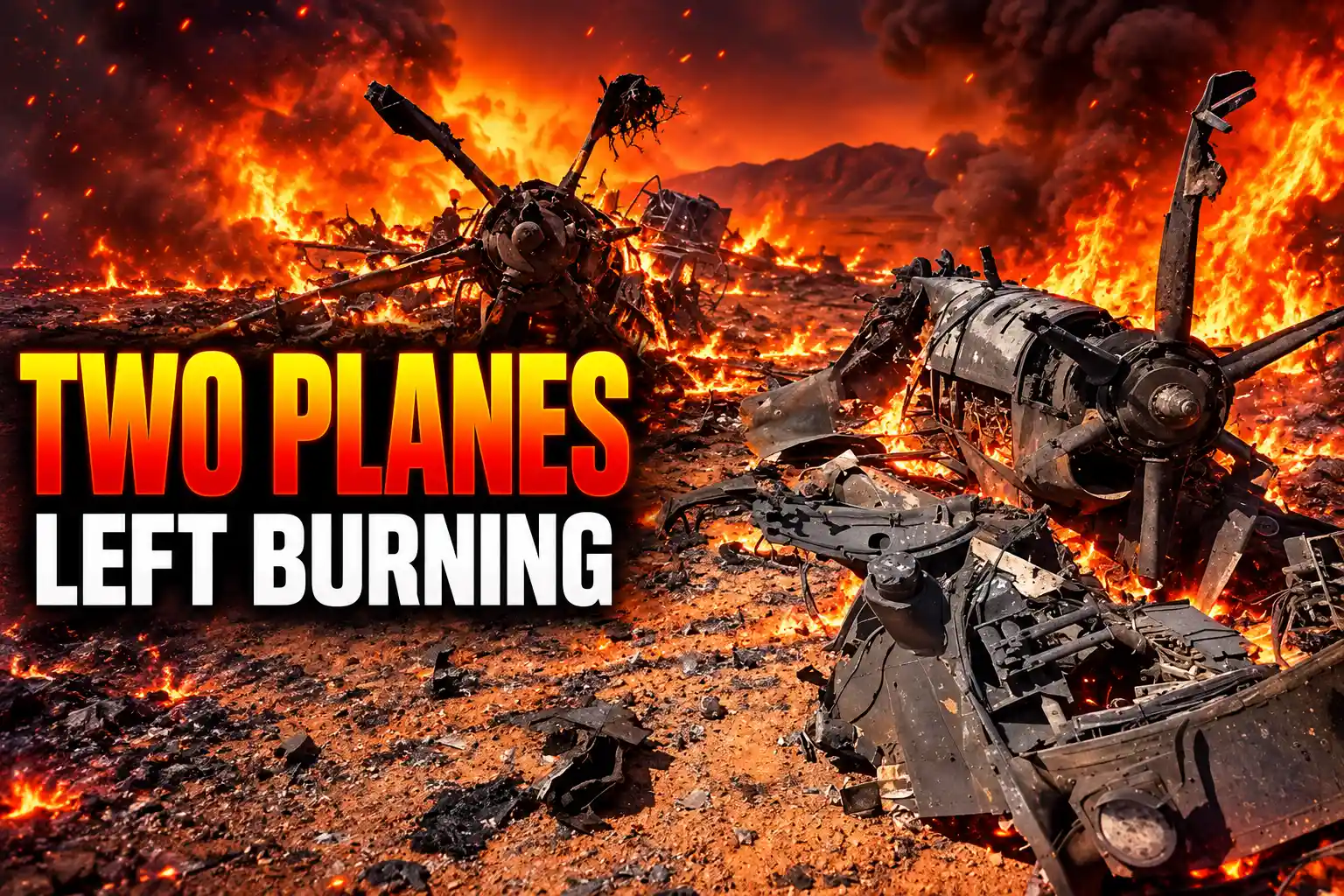
U.S. aircraft then bombed the two marooned planes, worth about $100 million each, and the Little Birds with them, so the gear would not go to Iran. Fifty hours after Dude 44 went down, Bravo was safe as the sun came up on Easter Sunday, April 5. He called his wife. “I was really proud of her and grateful for the strength that she showed.”
Alpha is already back in Air Force cockpits. He would not sit for the interview, citing security, and sent a written note instead. “I am still in awe of the professionalism and tactical prowess of the Combat Search and Rescue specialists and the Joint Force who executed the rescue missions of me and DUDE 44 Bravo, both those in theater and behind the scenes,” he wrote.
What Desert One Still Teaches This Force
The last time the United States put a rescue force on Iranian dirt, the sand won. On April 24, 1980, Operation Eagle Claw tried to free 52 Americans held in Tehran. Aircraft met at a desert site southeast of the capital. A sandstorm, broken helicopters, and a collision on the ground ended the raid. In April 2026, the same month Bravo came out, Air Force Special Operations Command marked the 46th anniversary at Hurlburt Field and named the dead again: eight Americans died at Desert One, five Airmen and three Marines.
The 1980 plan ran across two nights. C-130s were to land at Desert One, refuel Navy RH-53 helicopters, and stage Delta Force toward Tehran. Too few helicopters arrived fit to fly. During the pullout a helicopter struck a C-130. The wreckage and the dead were left in Iran. Retired Col. Bill Robb, who flew that night, told the Hurlburt ceremony the failure was not of the men who tried. Lt. Col. Walter Mitchell, who commands the 8th Special Operations Squadron, said recent work has “a familiar feel” to Eagle Claw, and that the community trains so that night does not repeat.
TWO DESERT LANDINGS
- April 24, 1980: Eagle Claw stages at Desert One; a collision kills eight; the hostage rescue is aborted.
- Night of April 2, 2026: Dude 44 is hit south of Isfahan; Alpha and Bravo eject about 5 miles apart.
- About six hours later: Helicopters pull Alpha out under fire; Bravo is still missing on the ridge.
- Easter Sunday, April 5, 2026: PJs reach Bravo; the strip traps two large planes; the United States bombs its own aircraft and brings the force home.
The rhyme is the sand. The change is the ending. In 1980 the force left bodies and machines. In April it left burning planes on purpose and brought every American out. Bravo still wants the story told as a team, not as a lone climb. That is not how a Sunday broadcast is built.
Hegseth Wanted Bravo on Sunday Night
By the night Bravo talked, the war that began in February had taken 18 U.S. lives. People familiar with the planning said Hegseth and political appointees pressed both airmen to appear, after the pair had raised concerns. Bravo sat down. Alpha did not. Uniformed officers, those people said, worried about exposing methods while the fight was still on, and about using a rescue as a message. The secretary still went on camera with Cooper and Caine.
That split is the honest frame. Bravo’s climb, the prayer, and “Let’s go” are not fiction. Alpha’s silence is not a small footnote either. A wartime interview that one of the two rescued men would not join is also a product, aimed at a public that has already watched the campaign run past the short war it was sold as. The line that travels is the PJ on the ridge. The line that does not is the gear in the sand, and the $100,000 missile that started the whole bill.
This is not a story about what I went through. Instead, it’s a story of the teamwork, the training, of the faith, of the decisions and the leadership to do something that will live in history as an example of what America’s willing to do in order to uphold our promise and leave no man behind.
Bravo, U.S. Air Force colonel, interview with Norah O’Donnell
Hegseth, on the same program, said the country was going to get them whether they were alive or not. Caine said the Iranian ground force had clear intent. Cooper counted the 92. Bravo said he never doubted the pickup: faith in his creator first, he said, and second only to that, faith in the men and women of the United States military. “It’s what we do.”
Frequently Asked Questions
Who Is Dude 44 Bravo, and Why Hide His Name?
He is a U.S. Air Force colonel and the weapon systems officer on the two-seat F-15E that flew as Dude 44; his name is withheld because of Iranian security threats. In the same interview he asked the airmen who packed his seat and survival gear to hear that the damaged ejection seat still beat its design limits, which he called a testament to their work.
What Does a Weapon Systems Officer Do in an F-15E?
The Air Force fact sheet puts a pilot and a weapon systems officer in the jet, a rear-cockpit job managing sensors and weapons while the aircraft flies air-to-air and air-to-ground in the same sortie. The same sheet lists a top speed of Mach 2.5 and a 2,400-mile ferry range with extra tanks, and it still prices the type at $31.1 million in fiscal 1998 dollars, the official unit figure behind the round $30 million used on air.
When Did Operation Epic Fury Start?
U.S. Central Command says the campaign began on Feb. 28, 2026, at the president’s direction, with American and partner strikes on IRGC command posts, air defenses, missile and drone sites, and military airfields. CENTCOM timed the opening wave at 1:15 a.m. ET that morning, which is the start line five weeks before Dude 44 went down.
What Was Operation Eagle Claw?
It was the April 1980 attempt to free 52 Americans held in Tehran, aborted at the Desert One staging site after a sandstorm, broken helicopters, and a deadly collision. Air Force Special Operations Command says the failure led directly to U.S. Special Operations Command and to AFSOC itself, the commands whose descendants landed in Iran again in April to pick up Bravo.
Did Bravo’s Damaged Parachute Mean the Seat Failed?
No. Bravo said the missile wrecked the chute and hurt the seat, and that the seat still threw him clear and then outperformed its specifications. He wanted that on the record for the maintainers, separate from the later climb and the CIA-aided pickup.
Fifty hours after the missile hit, Bravo was on the phone with his wife. Behind him, U.S. aircraft burned in Iranian sand so Iran could not have them.

Verity Beats Tom Cruise as October Movies Crowd Theaters

Morocco’s Next World Cup Government Starts 101 Seats Short

TSA CT Scanners Catch Oversized Carry-On Bags at Security

False AI Intel Nearly Put US Crews on a Chinese Ship

Anthropic Will Pay Accenture to Grade Its Own Models

How to Get Pre Boarding on Southwest – Skip the Line with These Tricks

Tim Cook’s $4.6 Trillion Apple Still Runs on One Phone

Dunes Air Sues Nora Fatehi Over Its Luxury Jet

Australia Treats Cloud Software Payments as Taxable Royalties

OpenAI Posts a Navier-Stokes Proof Clay Has Not Touched
-
 TRAVEL3 years ago
How to Get Pre Boarding on Southwest – Skip the Line with These Tricks
-
 BUSINESS1 month ago
Tim Cook’s $4.6 Trillion Apple Still Runs on One Phone
-
 ENTERTAINMENT4 weeks ago
Dunes Air Sues Nora Fatehi Over Its Luxury Jet
-
 NEWS4 weeks ago
Australia Treats Cloud Software Payments as Taxable Royalties
-
 NEWS4 weeks ago
OpenAI Posts a Navier-Stokes Proof Clay Has Not Touched
-

 LIFESTYLE3 years ago
How Often Do You Have to Change a Monkey’s Diaper? The Truth About Pet Monkeys
-

 BUSINESS4 weeks ago
Samsung India Cuts TV Jobs as Its Chip Unit Booms
-

 LIFESTYLE3 years ago
How Long Does It Take for Armpit Hair to Grow? The Stages of Hair Growth and How to Shave It