
BUSINESS
Sensex Jumps 564 Points as the NSE IPO Closes
Sensex rose 564 points and the NSE IPO closed 5.71 times, even as market breadth stayed negative and Brent held near $101.

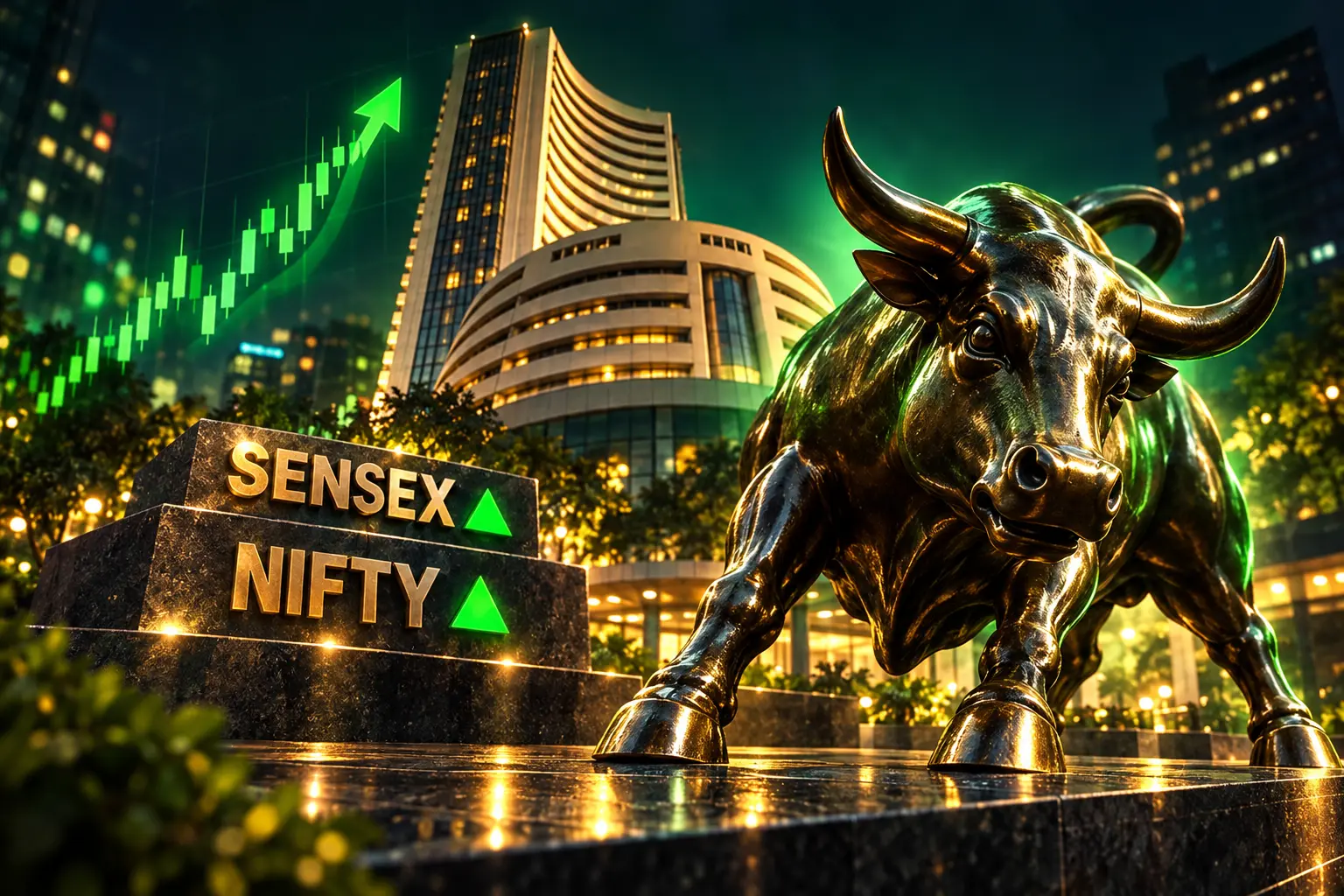
The BSE Sensex rose 564.03 points, or 0.76 per cent, to 74,858.99 on Monday, September 21, as the Nifty added a fourth session of gains. The 50-share index closed 67.90 points, or 0.29 per cent, higher at 23,414.30, its first finish above 23,400 since September 10.
The same Monday the National Stock Exchange’s Rs 22,569-crore initial public offer closed 5.71 times subscribed. Cheaper crude and a small foreign-fund print were the easy labels. The tape was narrower than those labels, and the IPO book was an offer for sale that pays existing holders, not the exchange.
Sensex at 74,858 After a 564-Point Jump
The 30-share index opened at 74,535.18 and ran as high as 74,987.40, a gain of 692.44 points, or 0.93 per cent, before giving some of that back into the close. Friday’s Sensex settlement was 74,294.96, down 19.63 points, or 0.03 per cent, while the Nifty had already been up 75.80 points at 23,346.40.
Nifty opened at 23,330.20. The four-day climb still leaves the index well below levels it held in the spring, and it follows a stretch of weekly losses that had pulled both benchmarks down. Asian peers helped the mood, with South Korea’s Kospi, Japan’s Nikkei 225, Shanghai’s SSE Composite and Hong Kong’s Hang Seng all finishing higher. European stocks were firmer in afternoon trade, and US markets had closed mostly higher on Friday.
The rupee finished at 95.8150 a dollar, firmer than Friday’s 95.87 close, as oil eased. India VIX, the market’s fear gauge, fell 1 per cent.
MONDAY’S BENCHMARK PRINTS
- Sensex: 74,858.99, up 564.03 points, or 0.76 per cent, after an intraday high of 74,987.40.
- Nifty 50: 23,414.30, up 67.90 points, or 0.29 per cent, a fourth straight gain.
- Nifty 500: closed 0.09 per cent higher, a thinner move than the Sensex headline.
- Rupee: 95.8150 per dollar, a third session of modest gains.
Ponmudi R, CEO of Enrich Money, tied the bounce to energy prices and to buying that he called broad. The advance-decline list on the BSE did not match that word.
Indian equity benchmarks closed higher today, extending their recent recovery as easing crude oil prices and broad-based buying improved market sentiment. The moderation in energy prices offered some relief on concerns over India’s import bill, inflation outlook and corporate margins, although the broader backdrop remained cautious amid persistent geopolitical uncertainty.
Ponmudi R, CEO, Enrich Money
Why Oil at $101 Still Moves the Tape
Brent crude, the global benchmark Indian importers watch, fell 2.36 per cent to USD 101.4 a barrel on the print cited with the close. That drop is the “relief.” It is also still a three-digit oil price in a country that buys most of the crude it burns.
Siddhartha Khemka, head of research for wealth management at Motilal Oswal Financial Services, said India’s oil import bill for April to August was up 48 per cent from a year earlier, at USD 75 billion. He also noted that the US 10-year yield was near 5 per cent and that India’s 10-year government bond yield had risen to 7 per cent, so financial conditions were not loose even as crude cooled.
Vinod Nair, head of research at Geojit Investments, pointed to talks between the United States and China, to diplomatic contact between the United States and Iran at the United Nations, and to softer oil and bond yields as the mix that let buyers step in. The geopolitics have not gone away. Houthi strikes on Saudi sites and a live US-Iran standoff remain the reason a barrel near $101 can still count as a down day.
On a longer view, about 50 per cent higher than a year earlier is where Brent still sits, even after four sessions of declines. Cement, housing and packaged goods are the first to treat that dip as margin relief. Auto and power names, which should like cheaper fuel, did not lead.
More BSE Stocks Fell Than Rose
On the BSE, 2,224 shares rose, 2,232 fell and 250 were unchanged. That is a coin flip, not a flood. The BSE MidCap Select index rose 0.35 per cent, while the BSE SmallCap Select index slipped 0.05 per cent. On NSE’s own style boxes the picture was weaker: the Nifty Midcap 100 fell 0.29 per cent and the Nifty Smallcap 100 slipped 0.07 per cent.
UltraTech Cement did the heavy lifting inside the Sensex, and that single 4.11 per cent jump is a large part of why the 30-share index outran the 50-share Nifty by almost half a percentage point. IT was mixed, with HCL Tech and Tech Mahindra up and Infosys down. Airtel, Power Grid and Adani Ports sat on the other side of the ledger.
SENSEX HEAVYWEIGHTS ON SEPTEMBER 21
| Stock | Move | Role in the session |
|---|---|---|
| UltraTech Cement | +4.11% | Top Sensex gainer; cement proxy for lower energy costs |
| HCL Tech | +3.42% | Largest IT winner in the 30-share pack |
| Eternal | +2.89% | Among the prominent Sensex winners |
| Titan | +2.49% | Consumer-discretionary bid |
| Sun Pharma | +2.15% | Helped the healthcare lead |
| ITC | +1.93% | FMCG heavyweight in the plus column |
| Bharti Airtel | -1.81% | Largest Sensex laggard |
| Power Grid | -1.02% | Utilities dragged with power names |
| Infosys | -0.97% | IT split, with this name in the red |
BSE sector gauges told the same selective story. Realty rose 1.71 per cent, consumer durables 1.55 per cent, healthcare 1.12 per cent, FMCG 1.07 per cent, housing finance 0.80 per cent and the Top 10 Banks index 0.71 per cent. Utilities, auto, insurance, power and the mid-small private-bank baskets lagged.
On Nifty sector indices, pharma led at 1.16 per cent, with realty 1.14 per cent and healthcare 1.10 per cent. FMCG and consumer durables each added 0.95 per cent. Nifty Bank rose 0.20 per cent and Nifty Private Bank 0.29 per cent. Metal dropped 0.61 per cent, IT 0.08 per cent and PSU banks 0.06 per cent. Rate-sensitive housing and staple cash flows got the bid. Cyclical metal and state-bank books did not.
A Rs 599-Crore FII Print Against a Month of Outflows
Foreign institutional investors bought equities worth Rs 599.54 crore on Friday, September 18, the latest exchange print available at Monday’s close. They bought Rs 38,461.63 crore and sold Rs 37,862.09 crore. Domestic institutions bought a net Rs 1,019.69 crore the same day, with purchases of Rs 17,310.04 crore and sales of Rs 16,290.35 crore.
That Friday FII figure is the “fresh inflow” in the session note. It sits against a month in which those same foreign accounts have sold Rs 7,040.94 crore of Indian shares in September. Domestic institutions have bought a net Rs 36,218.68 crore in the month. Year to date, foreign investors are net sellers of Rs 196,983.89 crore and domestic institutions are net buyers of Rs 362,530.41 crore.
Thursday, September 17, foreign accounts were net sellers of Rs 3,208.76 crore. Wednesday they sold Rs 2,032.61 crore. Tuesday they sold Rs 2,977.86 crore. One plus-Rs 599.54-crore session does not reverse that. The buyers who have actually been absorbing supply all month are Indian mutual funds, insurers, banks and pension money.
Nagaraj Shetti, senior technical research analyst at HDFC Securities, said the Nifty had pushed through the middle of the long bear candle from September 15, around 23,300, and that 23,600 is the next level that matters, with 23,200 as nearby support if the bounce fades.
SBI and Insurers Sell Shares in the NSE Offer
The capital event that dwarfed Friday’s FII print was the NSE sale. The issue is entirely an offer for sale of up to 126,436,650 equity shares, or about 12.64 crore shares. NSE itself does not receive the money. Selling shareholders do.
The price band of Rs 1,700 to Rs 1,785 was set on a Re 1 face value, with a bid lot of 8 shares, so the smallest retail ticket at the cap is Rs 14,280. Eligible employees had a Rs 170 discount and a reservation aggregating Rs 70 crore. At the cap, the sale values NSE at up to Rs 4.42 lakh crore. It is India’s second-largest public issue, behind Hyundai Motor India’s Rs 27,870-crore offer in 2024.
Books opened on September 17 and closed on September 21, with QIBs and non-institutions cut off at 4 pm and retail plus employees able to bid until 7 pm. Anchor investors had already taken Rs 6,746 crore, with Life Insurance Corporation of India, Goldman Sachs, Fidelity, Norway’s Government Pension Fund Global, the Monetary Authority of Singapore, the Abu Dhabi Investment Authority and Societe Generale among the names in that book. Shares are due to list on BSE on September 24.
That listing venue is the other exchange. The country’s dominant cash-market venue is selling a slice of itself onto BSE’s board.
WHO IS SELLING IN THE NSE OFFER
- State Bank of India: A lead selling shareholder in the offer for sale, cashing listed-market demand rather than funding NSE’s own books.
- Canada Pension Plan Investment Board: A long-standing foreign holder using the IPO window to exit part of its stake.
- Aranda Investments and MS Strategic: Mauritius-based sellers in the same OFS, alongside other financial holders.
- New India Assurance, GIC and United India Insurance: Public-sector insurers taking the listing as an exit, not a capital raise for the exchange.
- Bank of Baroda, SBI Capital Markets and Stock Holding Corporation of India: Bank and market-infrastructure holders in the selling group.
Kotak Mahindra Capital and JM Financial led a long roster of book-runners that also included Morgan Stanley, Citigroup, HSBC, J.P. Morgan, Axis Capital, HDFC Bank, ICICI Securities and SBI Caps. MUFG Intime is the registrar. None of that machinery changes the basic plumbing: this is old money leaving, priced into a public float.
How QIBs and Retail Split the NSE Book
BSE data showed bids for 50.58 crore shares, or 50,58,11,384 shares, against 8.86 crore shares, or 8,86,42,911 shares, on offer, a 5.71-times cover. Demand came to about Rs 90,300 crore against the Rs 22,569-crore size. The issue had already been fully subscribed on Friday, the second bidding day. Institutions then piled in on the close.
NSE IPO SUBSCRIPTION AT THE CLOSE
| Category | Times subscribed | What that cover means |
|---|---|---|
| Qualified institutional buyers | 12.68x | The book that made the 5.71x headline, with bids near 32 crore shares against 2.52 crore reserved |
| Non-institutional investors | 6.55x | High-net-worth demand, stronger above Rs 10 lakh than in the Rs 2-10 lakh slice |
| Retail individual investors | 1.39x | Covered, not crowded; allotment odds stay high for many applicants |
| Overall | 5.71x | Strong for a Rs 22,569-crore OFS, and still an institutional print |
Retail at 1.39 times is a pass, not a scramble. That is why so many household bids are likely to see stock. It is also why the 5.71-times headline overstates public hunger. Qualified institutions wanted the name at Rs 1,785. Households were polite. Unofficial grey-market premia, which had been talked about in double digits earlier in the sale, had already compressed to low single digits by the last day, so the listing was no longer being treated as a one-week flip.
V K Vijayakumar, chief investment strategist at Geojit Investments, told viewers the issue would be adequately subscribed and that buyers should treat it as a long holding rather than a listing-day trade, calling grey-market premia an unregulated and misleading guide. That advice fits the book that actually printed: QIBs at 12.68 times, retail at 1.39 times, and a secondary market that could lift Sensex 564.03 points while more BSE names fell than rose.
NSE shares are scheduled to list on BSE on September 24. Shetti’s map still has 23,600 as the Nifty hurdle and 23,200 as the first support if this four-day climb stalls.
Disclaimer: This article is news reporting and analysis of market closes, index moves and a completed IPO book-build. It is informational only and is not investment advice, a solicitation to buy or sell any security, or a recommendation on the NSE offer or on any Sensex or Nifty stock. Readers should consult a SEBI-registered investment adviser or a qualified financial planner who can consider their own objectives, horizon and risk before acting on any figure in this piece. Index levels, subscription ratios, oil prices, rupee prints and fund-flow totals reflect the exchange and company sources cited for September 21, 2026, and those prints can be revised or overtaken in later sessions, including around the September 24 listing.

A CubeSat Will Age Whisky That Never Comes Home

A Charity Quote Cost Shia LaBeouf the FKA twigs NDA

Looker Turned a Model’s Body Into Ad Inventory

Infinity Ward Bets a Paid DMZ Will Stick This Time

Disney Sidesteps a Kimmel Renewal as Failla Cites Losses

How to Get Pre Boarding on Southwest – Skip the Line with These Tricks

False AI Intel Nearly Put US Crews on a Chinese Ship

Tim Cook’s $4.6 Trillion Apple Still Runs on One Phone

OpenAI Posts a Navier-Stokes Proof Clay Has Not Touched

Dunes Air Sues Nora Fatehi Over Its Luxury Jet
-
 TRAVEL3 years ago
How to Get Pre Boarding on Southwest – Skip the Line with These Tricks
-
 NEWS1 month ago
False AI Intel Nearly Put US Crews on a Chinese Ship
-
 BUSINESS2 months ago
Tim Cook’s $4.6 Trillion Apple Still Runs on One Phone
-
 NEWS2 months ago
OpenAI Posts a Navier-Stokes Proof Clay Has Not Touched
-
 ENTERTAINMENT2 months ago
Dunes Air Sues Nora Fatehi Over Its Luxury Jet
-

 LIFESTYLE3 years ago
How Often Do You Have to Change a Monkey’s Diaper? The Truth About Pet Monkeys
-

 NEWS2 months ago
Australia Treats Cloud Software Payments as Taxable Royalties
-

 LIFESTYLE3 years ago
How Long Does It Take for Armpit Hair to Grow? The Stages of Hair Growth and How to Shave It