
NEWS
Radio Auroras on Beta Pictoris b Yield a Magnetic Field
MeerKAT tied auroral radio bursts to Beta Pictoris b, giving the first direct exoplanet magnetic field, at least 1.25 kG, and a method other giants can use.

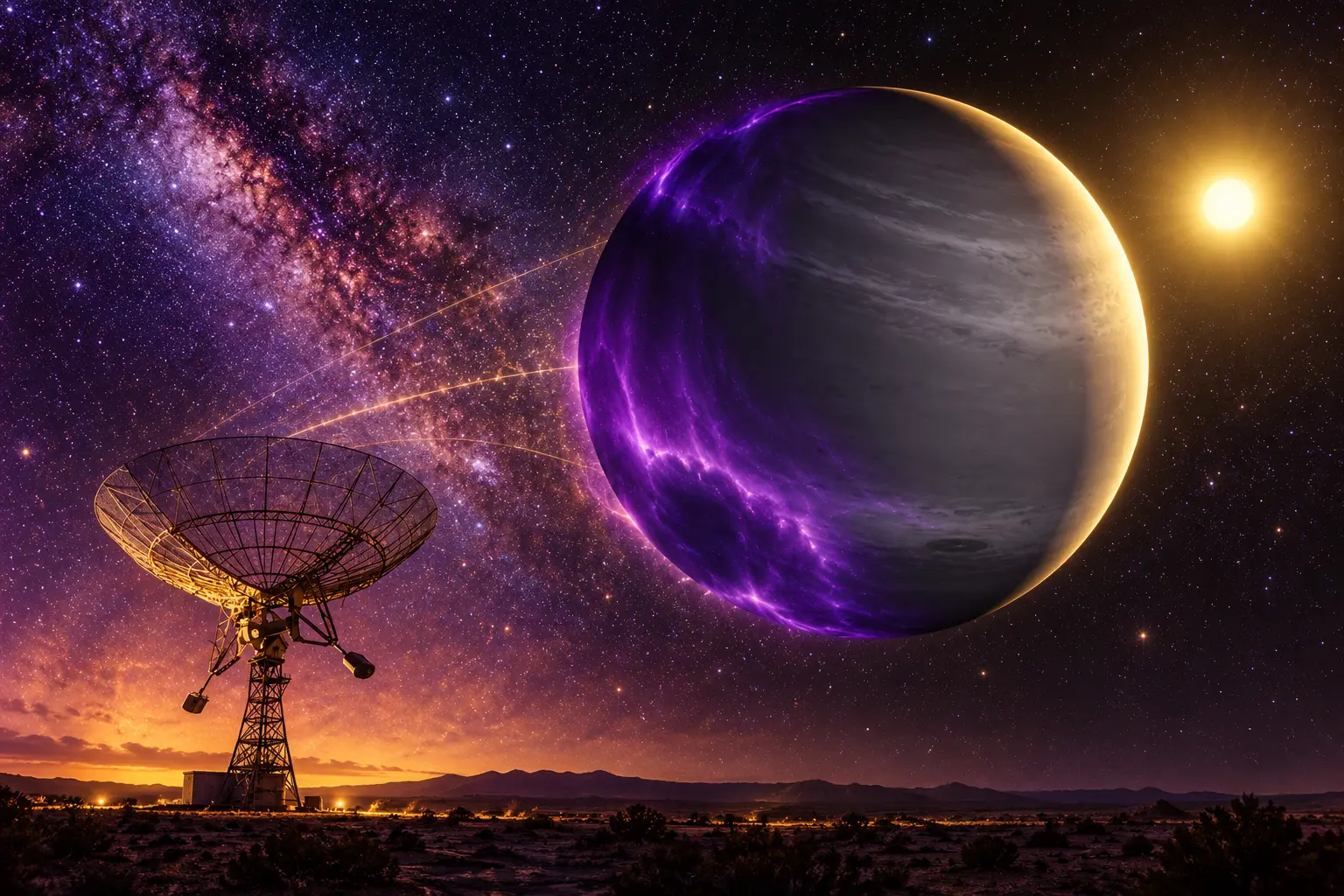
MeerKAT recorded repeating radio bursts from Beta Pictoris b and tied them to the planet, not its star. The waves run from 0.85 to 3.5 GHz, and the highest frequency implies a magnetic field of at least 1.25 kG at the source, thousands of times Earth’s surface field of about 0.25 to 0.65 gauss.
Yvette Cendes, an astronomer at the University of Oregon, said people hear “radio signal from an exoplanet” and think of a message. The bursts match auroral electron cyclotron maser emission, the same physics that lights Earth’s northern lights and Jupiter’s radio aurora. Kevin N. Ortiz Ceballos and Edo Berger at the Center for Astrophysics, Harvard and Smithsonian, posted the first direct detection of auroral radio emission on 15 September 2026 as arXiv:2609.16720. The preprint is not yet peer-reviewed.
MeerKAT Put the Bursts on Planet b
The array that caught the signal is a set of 64 dishes in South Africa’s Northern Cape, each 13.5 metres across, with baselines out to 8 km. The team pointed those dishes at Beta Pictoris, an A6V star 19.63 parsecs away (about 64 light-years) in a group only about 23 million years old, on four nights in 2025 and 2026.
A radio source sat on the system in every epoch. The hard job was saying whether it lived on the star, on planet b, or on planet c. The planet reaches an angular split of about 0.55 arcseconds on its 24-year path, wide enough for an interferometer if the sky grid is locked down. The team tied the radio image to the Gaia frame with compact radio matches to nine Gaia quasars plus one VLBI calibrator, then solved a small affine correction.
After that correction, which shifted the position by less than its 1σ error, the radio source matches planet b (p ≈ 0.53) and sits off the star at 4.4σ (p ≈ 6×10⁻⁶) and off planet c at 4.8σ. Cendes said the group can rule out the star and assign the emission to this one planet. The host star is also magnetically quiet: HARPSpol found a line-of-sight field of -14 ± 20 G and excludes a large-scale dipole of 300 G at 90% detection probability, far below the 0.3 kG ceiling that could have made this kind of gigahertz burst.
THE MEERKAT NIGHTS
| Date | Band | Frequency | Polarization |
|---|---|---|---|
| 15 February 2025 | L | 0.856 to 1.712 GHz | Handedness not constrained |
| 31 May 2025 | L | 0.856 to 1.712 GHz | Left-handed bursts |
| 20 February 2026 | S | 1.750 to 3.500 GHz | Two subarrays, one night |
| 2 May 2026 | S | Up to 3.5 GHz | Right-handed burst, about 70% |
The radio position is not a pinprick. It is still tight enough to drop the star and the inner planet, which is the step earlier planet-system radio claims never cleared.
A 3.5 GHz Cutoff Becomes a Field Strength
The bursts are short, they return, and they carry strong circular polarization of about 40% to 70%. Between them sits fainter persistent emission. That mix, plus brightness temperatures of at least 6×10¹⁰ K at 1.28 GHz for a source about 1.5 Jupiter radii across, points to a coherent nonthermal process. The team identifies electron cyclotron maser instability and discards plasma emission because it would need implausible densities.
For that maser, the emitted frequency is the electron cyclotron frequency, about 2.8 GHz per kilogauss. Emission that still fills the S-band up to 3.5 GHz, the top of the observing window, therefore requires B ≳ 1.25 kG at the emission site. The L-band bursts, which stop near 1.7 GHz, already demand at least 600 G. Because the signal is still there at the top of the band, 1.25 kG is a floor. The true peak at the aurora could sit higher.
The brightest L-band burst reached 307 μJy. Polarization handedness flipped from left-handed on 31 May 2025 to right-handed on 2 May 2026, which fits auroral maser emission whose sense is set by field geometry and rotation. Independent dynamo scaling, using the planet’s measured luminosity, mass, and radius, predicts a mean surface field of about 1.2 kG and a polar dipole of about 0.8 kG, in line with the radio limit.
THE FIELD AT A GLANCE
- Radio band: Rapid bursts plus persistent emission from 0.85 to 3.5 GHz on all four nights.
- Field floor: At least 1.25 kG at the aurora, the first direct exoplanet field strength.
- Earth comparison: Thousands of times a 0.25 to 0.65 gauss surface field.
- Star ruled out: 4.4σ astrometric miss, and a stellar dipole ≲ 0.3 kG.
Ortiz Ceballos, Berger, and Cendes write that this is the first direct measurement of magnetic field strength for an exoplanet and that it matches dynamo-scaling predictions for a young, massive giant.
The 9-Hour Spin That Powers the Aurora
Beta Pictoris b is a gas giant whose discovery was announced in 2008 by direct imaging. The paper takes its mass as about 12 Jupiter masses and its orbit as about 10 AU. Spectroscopy already gave a projected spin of about 20 km/s and an 8 to 9 hour period. JWST photometry later measured a rotation of 9.00 ± 0.13 hours with a nearly equator-on spin axis, so a day on this world is shorter than a work shift.
That spin is the engine the authors favour. In Jupiter and in ultracool dwarfs, a fast magnetosphere loaded with plasma cannot enforce corotation at large distances. The shear drives field-aligned currents that dump electrons into the aurora and power the maser. Beta Pictoris b now has both measured ingredients: a 9-hour spin and a kilogauss field. The plasma could come from sputtering of the atmosphere by those same currents, or from debris-disk gas around the young star.
The gap of about 8 hours between the first and third L-band bursts is close to the rotation period and may be that modulation. Two other drivers fall short. Scaling a stellar-wind interaction to the star’s mass-loss rate of 1.1×10⁻¹⁴ solar masses per year under-predicts the observed radio power by three orders of magnitude. A moon-driven Alfvénic interaction, even maximized, stays more than ten times fainter than the quiet emission, and existing mass limits already exclude moons heavier than about Saturn over most of the stable range.
WHAT THE TEAM RULED OUT
- The host star: The radio centroid misses it at 4.4σ, and its large-scale field is too weak for 3.5 GHz maser emission.
- Planet c: The same astrometric test rejects it at 4.8σ.
- The debris disk: Centimetre thermal emission extrapolated from the millimetre spectrum sits at nanojansky levels.
- A stellar wind: Wind-driven power falls short of the bursts by a factor of about 1,000.
- A massive moon: Predicted Io-style flux stays too faint, and Saturn-mass moons are already excluded.
The remaining picture is a young giant that generates its own aurora the way isolated ultracool dwarfs do, by spinning a strong field through its own plasma.
Why Earlier Radio Claims Did Not Stick
Solar System planets have been radio sources for decades. Earth, Saturn, Uranus, and Neptune emit at kilometre wavelengths, and Jupiter’s decametre bursts have been mapped to its aurora and to the Io flux tube. Ultracool dwarfs, some of them in the planetary-mass range, have shown gigahertz, highly polarized bursts for years. Massive exoplanets looked like the next step, and they kept failing a simple test: was the radio coming from the planet or from a magnetically active star?
Searches of directly imaged giants, including earlier megahertz observations of Beta Pictoris b itself, returned only upper limits. Where coherent emission did appear in a planet-hosting system, it could not be assigned to the planet on the sky. The best-known example is Tau Boötis b. Beam-formed LOFAR data were reported as circularly polarized bursts near 14 to 30 MHz, but later interferometric imaging of the same system found no significant Stokes V emission and set a 2σ ceiling of 24 mJy, well below the earlier 400 mJy claim. Follow-up campaigns at NenuFAR also came up empty.
Beta Pictoris b clears that bar because the star is an early-type A6V with no known radio mechanism that fits, the planet is angularly separated, and the radio centroid lands on the planet. It also has a dynamical mass, so the 1.25 kG maser limit can be checked against a dynamo law calibrated on Solar System planets and low-mass stars. Isolated brown dwarfs such as SIMP J013656.5+093347 already showed similar aurorae; they do not offer that mass test.
Magnetic Fields Decide What Atmospheres Keep
The opening of the paper is the reason the field number is the product, not a footnote. Optical and infrared spectra give temperature, clouds, and spin. They do not give the dynamo. Radio aurorae do, because the cutoff frequency is set by the field at the emission site, with no extra model layer in between.
Planetary magnetic fields shape atmospheric escape, mediate interactions with stellar winds, and encode information about planetary interiors, yet they have not been directly measured for planets beyond the Solar System.
Kevin N. Ortiz Ceballos, Edo Berger, and Yvette Cendes, arXiv:2609.16720
A global field stands off a stellar wind and can slow the stripping of an upper atmosphere, which is why Mars, after losing its global dynamo, shed most of its air to the solar wind. Models of Earth-like planets around M dwarfs often need only a few tenths of a gauss to keep a magnetosphere of early-Earth size. Those models have been running on assumed numbers. A measured kilogauss field on a young giant does not make Beta Pictoris b habitable. It gives dynamo scaling a real exoplanet data point, and it gives magnetosphere-atmosphere codes a field they did not have to guess.
The authors even float a side consequence: weak X-rays long blamed on the star might instead come from the planet, which would put Beta Pictoris b on the radio/X-ray track occupied by ultracool dwarfs. That claim is still speculation. The field measurement is not.
Seven More Giants Sit Just Out of Reach
The same localization trick works only when a planet is wide enough on the sky to split from its star. The paper counts seven more directly imaged giant exoplanets in five other systems within 45 parsecs that sit in that window. They are still too faint for MeerKAT. A roughly 5× to 7× gain in sensitivity, the improvement expected from the next radio arrays, would bring them into range.
That gain is already on the ground as hardware. SKA-Mid, rising around MeerKAT in the Karoo, will use 197 dishes, including the existing MeerKAT array, for 33,000 square metres of collecting area. Against the Jansky Very Large Array, SKA-Mid is designed for four times the resolution, five times the sensitivity, and a sky survey 60 times faster, across 350 MHz to 15.4 GHz. Those figures match the 5× to 7× step the Beta Pictoris b team says the other seven giants need.
Joe Callingham, an astronomer at the University of Amsterdam who was not on the paper, called the result an incredibly exciting advance if it holds up in peer review, and a fantastic result if it does. Continued MeerKAT monitoring can still do work before SKA-Mid is finished. Rotation should modulate the bursts, and a longer time series can yield magnetic obliquity and geometry, the same quantities Jupiter’s radio light curve has given for decades.
Until referees finish with arXiv:2609.16720, the field stays a lower limit from a submitted paper. The four nights already show a planet that radio telescopes can point at, a cutoff that converts into kilogauss, and a method that does not need the star to be silent in every other system, only separable on the sky.

A CubeSat Will Age Whisky That Never Comes Home

A Charity Quote Cost Shia LaBeouf the FKA twigs NDA

Looker Turned a Model’s Body Into Ad Inventory

Infinity Ward Bets a Paid DMZ Will Stick This Time

Disney Sidesteps a Kimmel Renewal as Failla Cites Losses

How to Get Pre Boarding on Southwest – Skip the Line with These Tricks

False AI Intel Nearly Put US Crews on a Chinese Ship

Tim Cook’s $4.6 Trillion Apple Still Runs on One Phone

OpenAI Posts a Navier-Stokes Proof Clay Has Not Touched

Dunes Air Sues Nora Fatehi Over Its Luxury Jet
-
 TRAVEL3 years ago
How to Get Pre Boarding on Southwest – Skip the Line with These Tricks
-
 NEWS1 month ago
False AI Intel Nearly Put US Crews on a Chinese Ship
-
 BUSINESS2 months ago
Tim Cook’s $4.6 Trillion Apple Still Runs on One Phone
-
 NEWS2 months ago
OpenAI Posts a Navier-Stokes Proof Clay Has Not Touched
-
 ENTERTAINMENT2 months ago
Dunes Air Sues Nora Fatehi Over Its Luxury Jet
-

 LIFESTYLE3 years ago
How Often Do You Have to Change a Monkey’s Diaper? The Truth About Pet Monkeys
-

 NEWS2 months ago
Australia Treats Cloud Software Payments as Taxable Royalties
-

 LIFESTYLE3 years ago
How Long Does It Take for Armpit Hair to Grow? The Stages of Hair Growth and How to Shave It