
BUSINESS
Gogoi Attacks the UPI Merchant Fee His Panel Sought
Gaurav Gogoi wants a UPI MDR rollback after sitting on the finance panel that asked for a fee, while small vendors stay exempt and banks take most of the 0.4%.

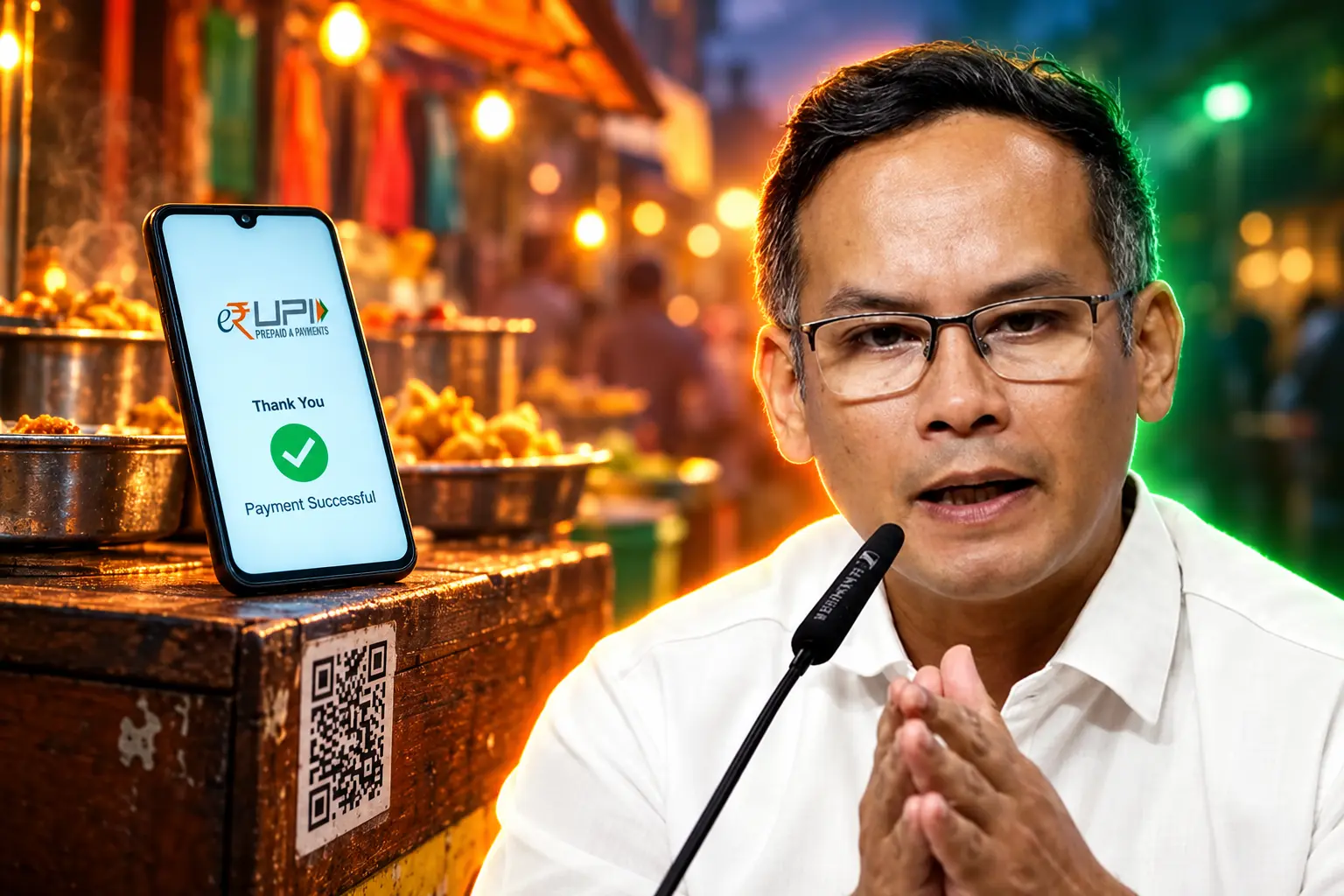
Congress MP Gaurav Gogoi said on September 17 that the Parliamentary Standing Committee on Finance did not discuss the new 0.4% merchant fee on UPI payments above ₹2,000. He called the charge a UPI tax that will “help the major American corporations” and “hurt the small Indian merchants, vendors, entrepreneurs,” and he asked the government to roll it back.
The National Payments Corporation of India issued the rules on September 15. They take effect on October 15, 2026. Person-to-person transfers stay free, street vendors under a monthly cap stay free, and the largest slice of the new fee goes to banks, not to the government.
Street Vendors Stay Free Under the New Rules
Gogoi’s warning is aimed at small Indian shops. The finance ministry’s note on the same circular already carves those counters out. On the Unified Payments Interface, a transfer between two people carries no merchant discount rate at any amount, and the ministry says those transfers are 37% of UPI volume and 70% of UPI value.
Person-to-merchant payments up to ₹2,000 also stay at zero, as do RuPay debit payments in the same band. Small merchants classed as person-to-person-merchant, meaning they take up to ₹1 lakh a month through UPI QR codes into their accounts, pay nothing on any ticket. A single payment above ₹2,000 does not by itself knock a shop out of that shield.
WHO STAYS OFF THE BILL
- Person to person: Transfers between people stay free at every amount, with no platform fee on the apps.
- Tickets up to ₹2,000: Ordinary shop payments at or under the threshold keep zero MDR.
- Small QR vendors: Shops taking up to ₹1 lakh a month on UPI QR, under the P2PM tag, pay zero on every ticket.
- Thin-margin public services: Rail, telecom, insurance, fuel and farm-input payments above ₹2,000 pay a flat ₹5, not 0.4%.
- Market payments: Mutual funds, securities and brokers pay 0.02%, capped at ₹300.
The ministry says MDR will apply to only about 4% of merchant payments, so about 96% of merchant transactions stay clear. It also says MDR is not a tax and is not collected by the government or by NPCI. Five percent of collections is supposed to feed a fund for small-merchant UPI use in smaller towns.
It is clarified that MDR is neither a tax nor a charge collected by the Government or NPCI. It is distributed among payment ecosystem participants, including banks and payment application providers, to support the operation and continued expansion of the UPI ecosystem.
Ministry of Finance, Press Information Bureau, September 15, 2026
Banks have been told not to let merchants add the fee at the counter, and UPI apps are barred from a platform charge. Daily UPI limits, generally ₹1 lakh to ₹5 lakh by category, are risk caps, not billing thresholds. Individuals keep unlimited free use.
🔰 UPI Remains Free for Consumers
UPI continues to be free for customers. Sending money to friends, paying at shops, or scanning a QR code — all remain without charges.
Key Facts:
✅ No charges on P2P: Person-to-Person transfers are always free, regardless of amount.
✅ Small… pic.twitter.com/PyQ7hotNMN— Ministry of Finance (@FinMinIndia) September 16, 2026
The Same Panel Gogoi Sat On Asked for This
Gogoi’s process complaint is narrower than the rollback slogan. He said the Department of Finance had no specific proposal on the MDR charges when officials met the finance committee, and that government representatives gave no “specific or satisfactory” answers on why the new UPI charges were needed. Bhartruhari Mahtab, the BJP MP who chairs the panel, said some MPs did raise the issue at that sitting and that it may come up at the next one.
That meeting is not the only record. The finance ministry says the new rules follow the Standing Committee on Finance in its 32nd Report, which had stressed a viable revenue model. Officials in the government said five Congress members of the panel, former finance minister P. Chidambaram, Manish Tewari, Gogoi, Kishori Lal and K. Gopinath, were present on August 12 when that report was adopted, and that the published minutes recorded no dissent.
The report, as cited in the fight that followed, pressed for a tiered MDR, or revenue, model for UPI and said it should be notified without delay. It had flagged a ₹2,000 crore budget line against an industry operating-cost estimate of ₹20,700 crore. Recommending a self-paying model is not the same as writing 0.4% on tickets above ₹2,000. Gogoi can still say this rate was not walked through in the later briefing. He cannot say the panel he sits on treated a merchant fee as unthinkable.
WHAT WE KNOW
- The September sitting: Gogoi says the Finance Department arrived with no specific MDR proposal, and Mahtab says the panel may take the issue at its next meeting.
- The August report: The ministry ties the new rules to the 32nd Report, which asked for a viable UPI revenue model and early notification.
- The legal switch: Lok Sabha passed the Taxation and Other Laws (Amendment) Bill, 2026, on August 6, rewriting Section 10A of the Payment and Settlement Systems Act, 2007, so the government could specify which electronic modes stay charge-free.
WHAT IS UNCONFIRMED
- Gogoi’s personal vote: Presence on August 12 and no recorded dissent is not a roll-call vote for 0.4%.
- Next sitting: Mahtab has not dated the follow-up, and the Department of Finance has not published a new paper on the rate.
- The court clock: Advocate Anjan Datta has filed a Supreme Court petition against the September 14 notification, the September 15 rules, and the amended Section 10A; the court has not decided it.
Finance Minister Nirmala Sitharaman had told the Rajya Sabha that the August change was an enabling provision on payment charges, and that NPCI’s UPI and Services Steering Committee would still have to decide whether any MDR should exist, and in what form. The September circular is that later decision, not the Bill itself.
Who Pays the 0.4 Percent, and Who Keeps It
Eligible mid-size and large merchants pay. The customer’s app still shows the shelf price. The acquiring bank takes the fee from the merchant’s settlement. For ordinary person-to-merchant tickets above ₹2,000, the rate is 0.4%, capped at ₹300 once the ticket hits ₹75,000. At ₹75,000 the raw 0.4% is exactly ₹300, so the cap is the rate at that point and a ceiling after it. A ₹1,00,000 ticket would be ₹400 before the cap, and settles at ₹300.
Gogoi’s American-corporation line points at the app layer. Google Pay is a Google product, and PhonePe and Google Pay together handle most UPI volume, so they collect most of the third-party app slice when a payment runs through them. The published split still sends the larger share to banks. On an illustrative ₹5,000 sale the merchant fee is ₹20, and the issuing bank, the customer’s bank, takes ₹7.60, more than the app and the payer PSP combined.
The finance ministry has also rejected the claim that the rate was set under foreign pressure, calling India’s UPI decisions independent. Both things can sit on the same page: US-owned apps earn a cut when they are the TPAP, and Indian issuing and acquiring banks still take 26.6 of the 40 basis points.
WHERE A ₹20 FEE GOES ON A ₹5,000 SALE
| Participant | Share | Rupees |
|---|---|---|
| Issuing bank | 15.2 bps | ₹7.60 |
| Acquiring bank | 11.4 bps | ₹5.70 |
| UPI app (TPAP) | 7.6 bps | ₹3.80 |
| Payer PSP | 3.8 bps | ₹1.90 |
| UPI Fund | 2 bps | ₹1 |
| Total | 40 bps | ₹20 |
The 2 basis points set aside for the UPI Fund is 5% of the 40-basis-point fee, matching the ministry’s small-merchant fund. NPCI says the money is meant for infrastructure, cybersecurity, fraud controls and service as volumes stay in the billions each month.
A 20-Rupee Cut on a 5,000-Rupee Sale
The arithmetic is simple, and it is the part a shop will feel. At ₹3,000 the merchant pays ₹12. At ₹50,000 the merchant pays ₹200. Credit-card MDR still runs about 1.5% to 2.5%, and debit-card MDR can run up to 0.90%, so UPI remains the cheaper rail even after the new rate. That comparison is how NPCI is selling the charge to larger stores. It is also why a restaurant that already eats card fees may absorb ₹12, while a thin-margin wholesaler on a ₹50,000 ticket will notice ₹200 leaving settlement.
WHAT THE MERCHANT PAYS
| Ticket | Rate | Merchant pays |
|---|---|---|
| ₹2,000 | Zero | ₹0 |
| ₹3,000 | 0.4% | ₹12 |
| ₹5,000 | 0.4% | ₹20 |
| ₹50,000 | 0.4% | ₹200 |
| ₹75,000 and above | Capped | ₹300 |
| Rail, fuel, telecom, insurance, farm inputs above ₹2,000 | Flat | ₹5 |
The people who pay are not the vegetable seller on a P2PM QR. They are the electronics counter, the garment wholesaler, the clinic, the restaurant and the online merchant whose tickets sit above ₹2,000 and whose monthly UPI take is too high for the small-vendor tag. That is a different political object from the “small Indian merchants” in Gogoi’s post, and it is the object the circular actually bills.
The 2020 Waiver Left Banks Holding the Cost
Until January 2020, UPI merchant payments could carry MDR of up to 0.30%. The 2019 Budget required firms with turnover above ₹50 crore to offer low-cost digital modes, and it told the Reserve Bank and the banks to absorb the cost from savings on cash. Section 10A of the Payment and Settlement Systems Act, read with Section 269SU of the Income-tax Act, then locked RuPay debit and BHIM-UPI at zero network MDR from January 1, 2020.
Banks and apps kept running the rails anyway. Government incentive schemes never matched what the industry said the pipes cost, which is the gap the 32nd Report put on paper. NPCI counted 24,508.96 million UPI payments in August 2026, worth ₹29,82,355.95 crore, across 752 live banks. A network that large does not run on goodwill. The September rules are the delayed invoice for a political choice made in 2019 and 2020, not a sudden levy invented for this fortnight.
HOW THE CHARGE BECAME LEGAL
- January 1, 2020: Zero network MDR begins on bank-account UPI person-to-merchant payments and on RuPay debit person-to-merchant payments.
- August 6, 2026: Lok Sabha passes the Taxation and Other Laws (Amendment) Bill, rewriting Section 10A so the Centre can notify which electronic modes stay free of charges.
- August 12, 2026: The Standing Committee on Finance adopts its report asking for a tiered UPI revenue model to be notified without delay.
- September 14, 2026: The Centre issues the gazette notification that the later court petition names as the trigger.
- September 15, 2026: NPCI puts out the MDR rules and the finance ministry publishes the exemptions and the 96% line.
- September 17, 2026: Gogoi says the panel did not discuss the decision and asks for a rollback.
- October 15, 2026: The 0.4% charge, the ₹300 cap and the flat ₹5 list are scheduled to go live.
Sitharaman’s August line, that the Bill itself imposed no UPI charge, was accurate on that date. The steering committee still had to set a rate. It did, two days after the gazette, at 0.4% above ₹2,000.
Why Shopkeepers Still Worry About the Till
The official design assumes merchants will swallow the fee as overhead, offset by less cash handling. The practical risk sits in the next rupee above ₹2,000. A neighbourhood shop that is busy enough to clear ₹1 lakh a month on QR loses the P2PM shield. A shop that stays under the cap can still meet a customer who wants to pay ₹2,500 in one scan. The rules say that one ticket does not reclassify the account. The counter may not wait for a three-month review. When RuPay credit on UPI started drawing a fee, some shops simply turned that option off after one billed payment, and the same reflex is sitting on this threshold.
The ban on passing the charge to customers is a compliance instruction, not a physical lock. On a listed retail price it is easier to police. On a utility bill, a society maintenance voucher, or a government site that already adds card fees, the 0.4% can reappear as a convenience line even if UPI apps themselves cannot levy a platform fee. That is the leak Gogoi’s small-merchant language is groping toward, even though the circular’s own text already protects the smallest QR vendors.
The Reserve Bank backed the large-ticket charge as a way to keep UPI growing, and it repeated that users pay nothing on P2P or on merchant tickets below ₹2,000.
The introduction of MDR on large-value UPI transactions (i.e., above ₹2,000) is an important step towards strengthening the long-term sustainability of India’s digital payments ecosystem. It will help UPI in continuing to scale, innovate and serve consumers and businesses across the country.
Reserve Bank of India, official X post, September 15, 2026
The introduction of MDR on large-value UPI transactions (i.e., above ₹2,000) is an important step towards strengthening the long-term sustainability of India’s digital payments ecosystem. It will help UPI in continuing to scale, innovate and serve consumers and businesses across…
— ReserveBankOfIndia (@RBI) September 15, 2026
Users will still tap a QR for chai and for splitting a dinner bill. The fight is about the tickets that made UPI a default for furniture, phones, school fees and clinic bills, and about whether a shop that sees ₹12 or ₹200 leave the settlement will keep the QR sticker on the glass.
The Charge Starts on October 15
Gogoi wants the government to withdraw the 0.4% fee. Mahtab has left the door open for the finance panel to talk about it again. A Supreme Court petition by advocate Anjan Datta now challenges the September 14 notification, the September 15 rules, and the amended Section 10A, arguing the executive was given too free a hand to decide which payment modes stay protected.
That does not stop the calendar. Unless the ministry changes the circular, eligible merchants start paying on October 15, 2026, banks and apps start sharing the 40 basis points, and the small vendors named in Gogoi’s post remain, on the ministry’s own terms, off the bill.

A CubeSat Will Age Whisky That Never Comes Home

A Charity Quote Cost Shia LaBeouf the FKA twigs NDA

Looker Turned a Model’s Body Into Ad Inventory

Infinity Ward Bets a Paid DMZ Will Stick This Time

Disney Sidesteps a Kimmel Renewal as Failla Cites Losses

How to Get Pre Boarding on Southwest – Skip the Line with These Tricks

False AI Intel Nearly Put US Crews on a Chinese Ship

Tim Cook’s $4.6 Trillion Apple Still Runs on One Phone

OpenAI Posts a Navier-Stokes Proof Clay Has Not Touched

Dunes Air Sues Nora Fatehi Over Its Luxury Jet
-
 TRAVEL3 years ago
How to Get Pre Boarding on Southwest – Skip the Line with These Tricks
-
 NEWS1 month ago
False AI Intel Nearly Put US Crews on a Chinese Ship
-
 BUSINESS2 months ago
Tim Cook’s $4.6 Trillion Apple Still Runs on One Phone
-
 NEWS2 months ago
OpenAI Posts a Navier-Stokes Proof Clay Has Not Touched
-
 ENTERTAINMENT2 months ago
Dunes Air Sues Nora Fatehi Over Its Luxury Jet
-

 LIFESTYLE3 years ago
How Often Do You Have to Change a Monkey’s Diaper? The Truth About Pet Monkeys
-

 NEWS2 months ago
Australia Treats Cloud Software Payments as Taxable Royalties
-

 LIFESTYLE3 years ago
How Long Does It Take for Armpit Hair to Grow? The Stages of Hair Growth and How to Shave It