
NEWS
India and Pakistan Cite a 1991 Rule After Ships Collide
After PNS Hunain met an Indian destroyer on September 15, both capitals cited the 1991 three-mile rule, a stopgap for the sea-incidents pact Lahore never wrote.

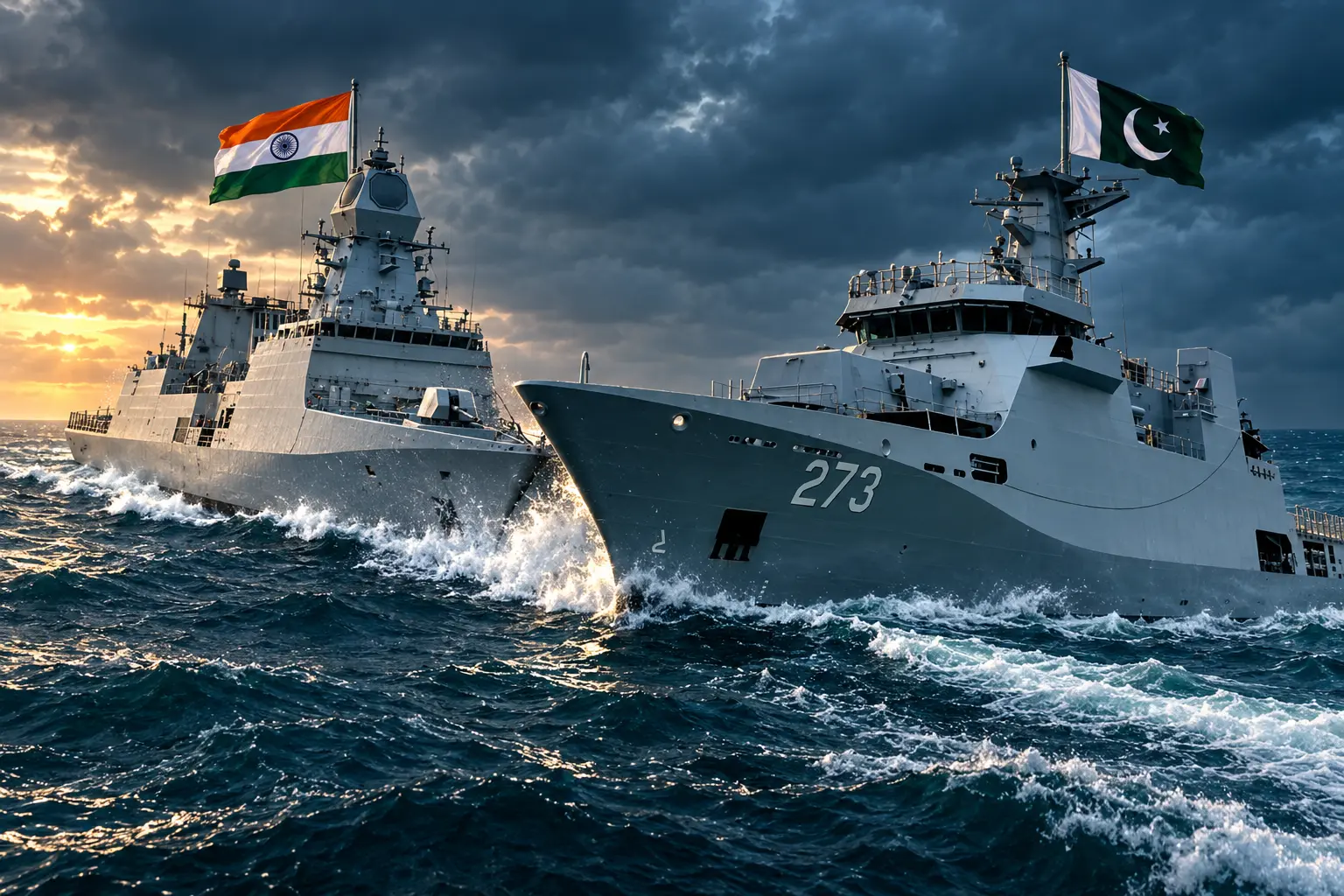
A Pakistan Navy patrol ship and an Indian destroyer made hull contact in the north Arabian Sea on the evening of September 15, 2026. The next day both foreign ministries summoned a charge d’affaires. Each pointed at the 1991 three-nautical-mile rule.
Foreign secretaries meeting in Lahore on February 21, 1999 had already promised a separate pact to stop incidents at sea. That text was never finished. Article 10 of the older agreement is still the only standing keep-out they can quote.
PNS Hunain Closed on a Kolkata-Class Destroyer
Indian officials said a Kolkata-class destroyer was on a surveillance task under Operation Urja Suraksha when PNS Hunain, a Yarmook-class offshore patrol vessel, began to shadow it. The contact was in the north Arabian Sea, about 220 kilometers east of Oman.
Repeated calls went out on Channel 16, the VHF channel ships use to raise one another, those officials said. Hunain then increased speed, cut across the destroyer’s bow from starboard, and the Pakistani ship’s bow brushed the Indian hull.
“No structural damage, no injuries, and no loss of capability reported on the Indian side. The Indian warship continued its mission after the incident,” Indian officials said. They added that Hunain was damaged and headed for home port. India’s Ministry of External Affairs, describing the episode as a whole, said it “did not cause any major damage.”
Pakistan’s account runs the other way. The Foreign Office said INS Kolkata, with a helicopter embarked, had been trying to enter the box for the navy’s biennial exercise SEASPARK-26, that the Indian ship changed course, and that Hunain’s own turn still produced a scrape. India’s ministry statement named neither hull. Pakistan did: INS Kolkata and PNS Hunain.
Indian officials also said ship logs showed no mechanical failure, steering fault, or emergency dodge on Hunain before the close. That is their reading of the track, not a joint finding. There is no agreed reconstruction of who turned first.
A Charge d’Affaires Heard the Same Protest Twice
On September 16 the ministry in New Delhi called in Saad Ahmad Warraich, charge d’affaires at the Pakistan High Commission. Missions in both capitals have been led at that rank since 2019, when ambassadors were withdrawn. India’s own charge d’affaires in Islamabad was told to deliver the same complaint at the Foreign Office.
The Charge d’Affaires of the High Commission for the Islamic Republic of Pakistan in New Delhi was summoned to the Ministry of External Affairs today and a strong protest was lodged with him over the unacceptable and unprofessional conduct of Pakistani naval units at sea that led to a collision with a unit of the Indian Navy.
Ministry of External Affairs, New Delhi, September 16, 2026
The ministry said the Pakistani ship’s conduct was in “direct contravention” of Article 10 of the April 1991 Agreement on Advance Notice on Military Exercises, Manoeuvres and Troops Movements. Warraich was told to take home a simple ask: military units should take care and respect the written rules, so this does not happen again.
Islamabad answered in kind the same day. It summoned India’s charge d’affaires and called the Indian ship’s action “highly provocative and unacceptable” inside Pakistan’s exclusive economic zone. Foreign Office spokesperson Sajjad Haider Khan said the contact was a “serious violation” of international law and of the same 1991 agreement.
“While the Pakistan Navy was undertaking its biennial exercise SEASPARK-26, the Indian vessel carried out aggressive manoeuvres in dangerously close proximity of Pakistani naval ship, resulting in contact between the two vessels,” the Foreign Office said. It told New Delhi that Pakistan “strongly rejects this belligerent Indian action,” and asked India to stick to the rules meant to prevent incidents at sea.
The legal map is split on purpose. India says international waters. Pakistan says its EEZ. An exclusive economic zone is not territorial sea, so both labels can sit on one patch of water. Article 10 is written for international waters. That is the clause New Delhi chose. Islamabad leaned on the exercise and on the zone.
What the Three-Nautical-Mile Rule Requires
The pact was signed in New Delhi on April 6, 1991, by Foreign Secretary Muchkund Dubey for India and Foreign Secretary Shaharyar M. Khan for Pakistan, while Chandra Shekhar was prime minister. It entered force on August 19, 1992, after the instruments of ratification were exchanged, and India registered it with the United Nations on December 15, 1994, as treaty No. 31420.
Most of the text is about warning the other side before a big drill. Article 10 is the odd clause out. It is always on. It does not wait for a notice telegram. Naval ships and submarines are not to close less than three nautical miles from each other, about 5.6 kilometers, “so as to avoid any accident while operating in international waters.”
THE 1991 BUFFERS
| Force | Standing limit | Notice for a major drill |
|---|---|---|
| Ships and submarines in international waters | 3 nautical miles | 30 days, and only if six or more destroyer- or frigate-size ships work in company and cross into the other side’s EEZ |
| Combat aircraft, including armed helicopters | 10 km from the other side’s airspace (5 km from named border bases) | 15 days at Regional Command level or above |
| Unarmed transport and logistics aircraft | Up to 1,000 metres from the other side’s airspace | Covered by the air-exercise notice if the drill is large enough |
| Land forces at division level and above | No such drills within 5 km of listed border belts | 30 days (division), 60 days (corps), 90 days (army) |
A naval drill in a country’s own EEZ does not, on that wording, trip the 30-day sea notice, because the trigger is crossing into the other side’s zone with a six-ship company of large combatants. SEASPARK-26, as Pakistan describes it, sat in Pakistani waters. India’s destroyer was on surveillance, not a notified fleet exercise. Article 10 still applied the moment the two hulls were in international waters, which is why it is the clause both can reach for after steel has already touched.
The same instrument also tells aircraft not to buzz the other navy’s ships. Pakistan says an Indian helicopter, flying from the destroyer, tried to enter the exercise area from September 7. India has not confirmed that claim in public.
Hulls Last Touched in the Gulf of Aden
This is not the first time the two navies have put paint on paint and then reached for Article 10. On June 16, 2011, INS Godavari and PNS Babur came into contact in the Gulf of Aden. Godavari was near the merchant ship MV Suez, which had just been freed from Somali pirates. Babur was escorting the same ship.
The scrape damaged Godavari’s flight-deck safety net. Pakistan said Indian sailors made “unfriendly gestures,” a charge India dismissed. The then Indian Navy chief said Babur came in from the stern at high speed. New Delhi protested and handed over photographs. Islamabad, in that round, was the side citing the 1991 text.
Roles reversed on September 16, 2026. India spoke first. Pakistan answered with the same treaty. Fifteen years apart, the pattern is the summons, the clause, and no shared inquiry.
TWO SCRAPES, ONE CLAUSE
| June 16, 2011 | September 15, 2026 | |
|---|---|---|
| Water | Gulf of Aden, near MV Suez | North Arabian Sea, about 220 km east of Oman |
| Hulls | INS Godavari and PNS Babur | Kolkata-class destroyer and PNS Hunain |
| Who protested first | Pakistan | India |
| Damage on the Indian ship | Helicopter safety net | No structural damage, mission continued |
| Legal hook | 1991 agreement, Article 10 | 1991 agreement, Article 10 |
A clip now circulating as Hunain’s wounded hull is the Aden incident. The older ship in that video carries Babur’s hull number. The 2026 contact has no released official film from either navy. Victory cuts on both sides are running ahead of the track data.
Lahore’s Sea-Incidents Promise Still Has No Text
The 1991 keep-out was never meant to be a full incidents-at-sea code. Eight years later the two foreign secretaries, K. Raghunath and Shamshad Ahmad, signed a memorandum in Lahore in the presence of Prime Minister Atal Behari Vajpayee and Prime Minister Muhammad Nawaz Sharif. Clause 5 said the sides would write the missing instrument.
The two sides shall conclude an agreement on prevention of incidents at sea in order to ensure safety of navigation by naval vessels, and aircraft belonging to the two sides.
K. Raghunath and Shamshad Ahmad, Lahore Memorandum of Understanding, February 21, 1999
The same page told experts to settle technical details before mid-1999, with a view to reaching bilateral agreements. Kargil followed that spring, and the Lahore process stalled. The prevention of incidents at sea clause never became a treaty. Missile-test notice and a later nuclear-accident text did. The maritime line did not.
A proper incidents-at-sea deal, on the 1972 United States-Soviet model, does more than set a distance. It bans buzzing and simulated attacks, sets radio procedures, and creates a yearly meeting where captains can complain in a room instead of a demarche. Bashir Ali Abbas, writing at the Stimson Center in December 2024, argued again for a fresh Incidents at Sea Agreement for both navies, plus better crisis links, as nuclear-armed boats join a crowded north Arabian Sea.
WHAT AN INCSEA WOULD HAVE ADDED
- Radio rules: Fixed channels and phrases for a close approach, rather than an ad hoc Channel 16 warning that one side says was ignored.
- Manoeuvre limits: Written bans on cutting across a bow, aiming guns in exercise, or flying low over the other ship, the behaviour Article 12 of 1991 already hints at for aircraft.
- A complaints table: A scheduled navy-to-navy meeting, so a scrape does not jump straight to a charge d’affaires.
There is still no permanent navy-to-navy consultative channel. Indian officials said the navy raised this contact through “established channels.” That is a working line, not the annual review a 1972-style pact would force. Twenty-seven years after Lahore, the only number both lawyers can still put on paper is three nautical miles.
The Yarmook-Class Ship That Returned to Harbour
PNS Hunain joined the fleet in July 2024 after being built at Damen’s yard in Galați, Romania. It is a Yarmook-class offshore patrol vessel of the larger second batch, fitted with anti-ship and anti-air weapons and a close-in gun. Indian officials called it an offshore patrol vessel that was in the area for Sea Spark. Pakistan lists the same hull as a corvette on a drill.
A Kolkata-class destroyer is a much heavier fleet unit, built to hunt other warships and to stay on station. The mismatch matters for the physics of a bow cut: the smaller ship is the one Indian officials say took the damage and turned for port. Pakistan’s public line was a “scraping incident” and, in some early posts from defence accounts, no serious harm to Hunain. Those two damage pictures have not been reconciled.
Pakistan’s 2018 maritime doctrine names the northern Arabian Sea as its primary area of interest. India’s own doctrine had, by 2015, already lifted the Gulf of Oman and the Gulf of Aden into the first rank of interest. The water east of Oman is where those two maps overlap. That is also where energy-security patrols and a biennial Pakistani fleet exercise now sit on top of each other.
Pakistan Says the Contact Happened Inside Its EEZ
SEASPARK-26 ran from September 1 to September 16, 2026, according to the Foreign Office and to Pakistani defence accounts posting the same window. The collision was on the penultimate evening. The demarches went out on the day the exercise was due to end.
If the drill stayed inside Pakistan’s EEZ, the 1991 naval-notice clause for a six-ship company crossing the other side’s zone would not have been the live rule. The live rule was the three-mile keep-out, plus ordinary collision regulations that bind every ship on the high sea. Neither capital has released a range plot showing the closest point of approach before contact. Without that plot, Article 10 is a charge, not a measured breach.
WHAT WE KNOW
- The date: Hull contact on the evening of September 15, 2026, in the north Arabian Sea.
- The protests: Each side summoned the other’s charge d’affaires on September 16 and cited the 1991 agreement.
- The Indian ship’s condition: Officials in New Delhi said no structural damage, no injuries, and no loss of capability, and the ship stayed on task.
- The named Pakistani hull: PNS Hunain, on both Indian official guidance and the Pakistani statement.
WHAT IS UNCONFIRMED
- The Indian hull in writing: Pakistan named INS Kolkata; the Indian ministry statement did not name either ship.
- Hunain’s damage: Indian officials said it was real and sent the ship home; Pakistan’s statement did not match that picture.
- The track: No shared log of who crossed whom, at what range, or whether Channel 16 calls were recorded.
- The helicopter: Pakistan’s claim of repeated attempts to enter the exercise box from September 7 is still one-sided.
This was the first public military scrape between the two since the four-day fighting of May 2025. It stayed at the level of a summons, because the Indian ship kept its mission and because both sides still have a 1991 clause to wave. They do not have the incidents-at-sea pact their foreign secretaries promised to write before mid-1999. Until that text exists, the next close pass will be argued the same way this one was: two charges d’affaires, one three-mile sentence, and no joint chart of what the hulls actually did.

A CubeSat Will Age Whisky That Never Comes Home

A Charity Quote Cost Shia LaBeouf the FKA twigs NDA

Looker Turned a Model’s Body Into Ad Inventory

Infinity Ward Bets a Paid DMZ Will Stick This Time

Disney Sidesteps a Kimmel Renewal as Failla Cites Losses

How to Get Pre Boarding on Southwest – Skip the Line with These Tricks

False AI Intel Nearly Put US Crews on a Chinese Ship

Tim Cook’s $4.6 Trillion Apple Still Runs on One Phone

OpenAI Posts a Navier-Stokes Proof Clay Has Not Touched

Dunes Air Sues Nora Fatehi Over Its Luxury Jet
-
 TRAVEL3 years ago
How to Get Pre Boarding on Southwest – Skip the Line with These Tricks
-
 NEWS1 month ago
False AI Intel Nearly Put US Crews on a Chinese Ship
-
 BUSINESS2 months ago
Tim Cook’s $4.6 Trillion Apple Still Runs on One Phone
-
 NEWS2 months ago
OpenAI Posts a Navier-Stokes Proof Clay Has Not Touched
-
 ENTERTAINMENT2 months ago
Dunes Air Sues Nora Fatehi Over Its Luxury Jet
-

 LIFESTYLE3 years ago
How Often Do You Have to Change a Monkey’s Diaper? The Truth About Pet Monkeys
-

 NEWS2 months ago
Australia Treats Cloud Software Payments as Taxable Royalties
-

 LIFESTYLE3 years ago
How Long Does It Take for Armpit Hair to Grow? The Stages of Hair Growth and How to Shave It