
BUSINESS
India Restates Veg Dots on Soaps After the 2014 Fight
The 21 September 2026 gazette moves the 2014 soap and toothpaste veg dots into a new clause, after Reckitt’s stay and a drugs-board split.

India on 21 September 2026 restated a 2014 rule that soaps, shampoos and toothpaste must carry veg or non-veg dots. The Legal Metrology (Packaged Commodities) Fourth Amendment Rules, 2026, published that Monday, put the duty in force the same day.
The gazette does not invent the marks. It moves them from Rule 6(8) into Rule 6(4A)(d) and deletes the old sub-rule, while Reckitt Benckiser (India) Limited still holds a 2015 High Court bar on coercive action against its own packs.
The Gazette Restates a 2014 Duty
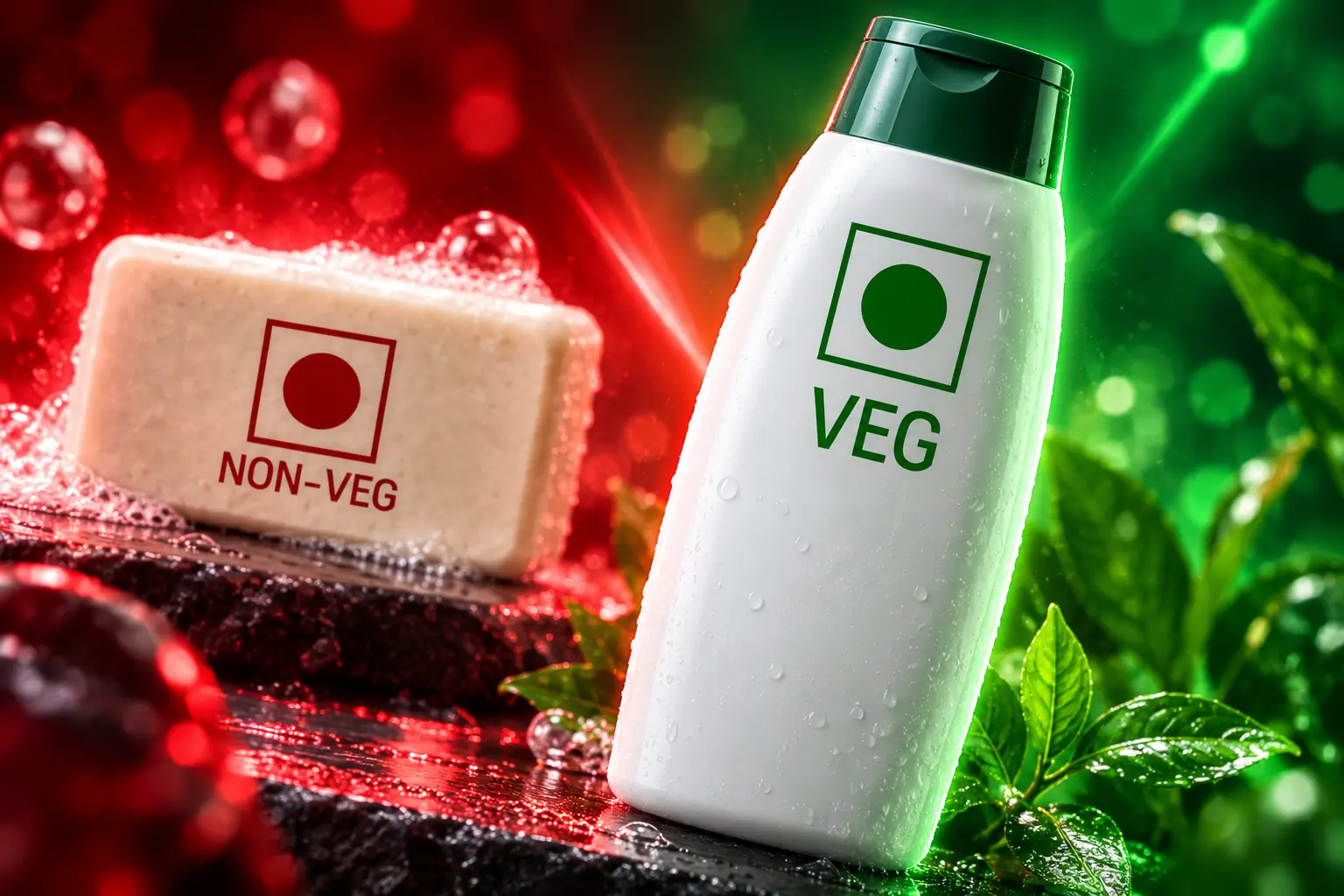
The Ministry of Consumer Affairs, Food and Public Distribution amended the Legal Metrology (Packaged Commodities) Rules, 2011. Packages of soaps, shampoos, toothpastes, other cosmetics and toiletries must now show, at the top of the principal display panel, a green dot if the product is of vegetarian origin, or a red or brown dot if it is of non-vegetarian origin.
Those words match the 16 June 2014 insertion of Rule 6(8). The September text keeps the product list, the colours and the placement. What changes is the legal shelf: the same sentence now lives under Rule 6(4A)(d), and Rule 6(8) is omitted.
THE 2014 RULE AND THE 2026 MOVE
| Item | 16 June 2014 | 21 September 2026 |
|---|---|---|
| Legal home | Rule 6(8) | Rule 6(4A)(d); Rule 6(8) omitted |
| Products named | Soap, shampoos, tooth pastes, other cosmetics and toiletries | Soaps, shampoos, toothpastes, other cosmetics and toiletries |
| Vegetarian mark | Green dot | Green dot |
| Non-vegetarian mark | Red or brown dot | Red or brown dot |
| Where it sits | Top of the principal display panel | Top of the principal display panel |
| When it bites | The 2014 notification | Date of gazette publication |
Shoppers already know the colours from the kirana shelf. The fight has always been whether a soap or a tube of paste is a packaged commodity like a biscuit, or a cosmetic the drug controller should police.
Reckitt’s Stay Has Run Since 2015
Reckitt Benckiser (India) Limited, which sells Dettol, Harpic, soaps, hand wash and sanitiser, filed W.P.(C) 1989/2015 in the Delhi High Court. It challenged the 16 June 2014 amendment. Counsel told the bench that the Director of Legal Metrology had no business prescribing veg and non-veg marks on products that fall under the Drugs and Cosmetics Act, 1940.
On 2 March 2015 the court issued notice and, noting a Bombay High Court interim order on the same point, barred coercive action against Reckitt for not declaring vegetarian or non-vegetarian origin on its labels until further orders. The writ was admitted. If Reckitt lost, it would face the usual follow-on action.
Justice Prathiba M. Singh and Justice Madhu Jain took the file up again on 7 February 2026. The bench said the case had been pending for more than ten years and that the two wings of government still had not settled whether the dots must appear. It directed both departments to consult, take stakeholder views, and file a joint affidavit. The Drug Controller General of India was added as Respondent No. 2. The next listing was 27 April 2026. The February order did not lift the 2 March 2015 stay.
HOW THE DOTS REACHED THE COURT
- 16 June 2014: Rule 6(8) is added to the Packaged Commodities Rules, requiring a green or red-brown origin dot on soap, shampoo, toothpaste and other cosmetics and toiletries.
- 2 March 2015: The Delhi High Court stays coercive action against Reckitt on the origin declaration, after a Bombay High Court interim order on the same dispute.
- 16 May 2018: The Drug Technical Advisory Board, at its 79th meeting, agrees in principle to mandate the dots under the Drugs and Cosmetics Rules and asks for stakeholder views.
- 15 December 2020: Separate Cosmetics Rules, 2020, are published vide GSR 763(E), moving cosmetics off the old 1945 drugs rules.
- 13 April 2021: DTAB reverses. It finds no national system to certify vegetarian and non-vegetarian cosmetic ingredients and prefers a voluntary mark.
- 10 September 2021: An advisory notice treats the red, brown or green indication as voluntary.
- 7 February 2026: The Delhi High Court records a contradiction between Legal Metrology and DTAB, orders a joint meeting, and lists the case for 27 April 2026.
- 21 September 2026: The Fourth Amendment Rules move the same duty to Rule 6(4A)(d) and omit Rule 6(8), in force on publication.
No later public judgment disposing of Reckitt’s petition showed up after the April listing. The stay as written in 2015 is petitioner-specific. The gazette is general. Both can sit on the books at once, which is the mess the bench asked the two departments to clean up.
Why the Drugs Board Called the Dots Unworkable
DTAB advises the Drug Controller General of India. In 2018 it was willing to write the dots into the drugs and cosmetics rules. By 13 April 2021, after the Cosmetics Rules, 2020, had come in, the board had changed its mind. The minutes, placed on the High Court record through Reckitt’s additional affidavit of 18 December 2025, are blunt about the gap the gazette still does not fill.
Board after detailed deliberation emphasized that there is no clarity and system to certify vegetarian and Non-vegetarian ingredients in the Country. Hence, the Board did not agree for mandating the indication of green or red /brown dot on every package of Cosmetics, as it may complicate the regulation and add regulatory burden on stakeholders. Board also opined that, it can be voluntary and left to the company’s own decision and accordingly, advisory may be issued for labeling red/brown or green dot on packages of soaps, shampoos, toothpastes and other cosmetics and toiletries for non-vegetarian or vegetarian origin.
Drug Technical Advisory Board, minutes recorded in Reckitt Benckiser (India) Limited v. Union of India, Delhi High Court
Justice Singh wrote that Legal Metrology treats the dots as required while DTAB treats the same marks as voluntary. “There is a clear contradiction in the stands of both these departments,” the bench said. Some of the goods sit with the drug controller. Some do not. A soap bar and a medicated toothpaste are not the same file.
The 21 September 2026 gazette does not publish a certification method, a test protocol, or a joint affidavit. It reprints the 2014 sentence in a new clause. That is the reckoning: the weights-and-measures wing has asserted the duty again, and the drugs wing’s 2021 objection is still the last detailed scientific view on the record.
Tallow, Glycerin and the Quiet Animal Ingredients
The dots answer origin, not safety, fragrance, or whether a formula was tested on animals. A plant-based detergent bar can take a green mark and still sting. A traditional tallow soap can take a brown mark and still be a simple fat-and-lye bar. That split is already how people argue the rule on the open web, and it is the right split. Colour is not a quality grade.
Formulators treat several common inputs as dual-source. Each one can come from an animal, a plant, or a lab, and the pack has often been silent about which.
THE USUAL ORIGIN QUESTIONS ON A TOILETRY PACK
- Tallow: Rendered animal fat used in some bar soaps; plant oils stand in when the brief is vegetarian.
- Glycerin: A humectant in toothpaste and wash products, historically from animal fat, now often from plant oils or biodiesel by-product.
- Collagen: Used in some skin-care lines; bovine or marine sources sit beside synthetic and plant-sold alternatives.
- Keratin: Hair and nail claims often start from animal protein; plant “keratin” marketing is a different chemistry.
- Squalane: Once associated with shark liver; olive and sugar-cane routes are widely sold.
Shoppers already police shampoo for egg and tooth powder for cuttlefish bone because those packs have not carried a court-grade origin mark. The new clause does not name those ingredients. It asks the maker to pick a colour for the whole product. Without the certification system DTAB said was missing, that pick is an internal sourcing call printed as a dot.
Cosmetics Rules, 2020, already make inner and outer packs carry the official name, the maker’s address, metric quantity, batch, manufacturing licence number with an M, dates, MRP inclusive of taxes, directions and warnings. Ingredients above 1 per cent must be listed in descending order of weight or volume; those at 1 per cent or less may follow in any order after the heading “INGREDIENTS”. Packs under 30 grams for solids or semi-solids, or 60 ml for liquids, are exempt from the full ingredient list. The origin dot is a separate line, and the 2026 text does not copy that small-pack carve-out onto the dot.
Soap Dots Do Not Match Food Marks
Indian packaged food has carried veg and non-veg marks since a 2001 notification, later folded into FSSAI rules. Beauty Without Cruelty, which ran a long campaign for marks on toiletries, food and drinks, dates the food symbols to that 2001 order and the toiletries extension to 2014.
Food art changed. Under the Food Safety and Standards (Labelling and Display) Regulations, vegetarian food takes a green circle inside a square. Non-vegetarian food takes a brown filled triangle inside a brown square, a shape shift meant to help people who cannot tell green from brown. FSSAI’s non-vegetarian definition covers whole or part of any animal, including birds, insects, freshwater or marine animals or eggs, and excludes milk, milk products, honey, beeswax, carnauba wax and shellac.
The toiletries clause still says “dot”. It does not import the square, the triangle, or FSSAI’s definition of vegetarian food. A green food mark and a green soap mark can look related in the aisle and mean different legal things.
TWO REGIMES, TWO MARKS
| Feature | Packaged food (FSSAI) | Toiletries (Legal Metrology) |
|---|---|---|
| Veg mark | Green filled circle in a green square | Green dot |
| Non-veg mark | Brown filled triangle in a brown square | Red or brown dot |
| Placement | Near the name or brand on the principal display panel | Top of the principal display panel |
| Definition of origin | Written into the labelling regulations, with listed exclusions | The 2026 clause does not define “vegetarian origin” |
| Who writes the rule | Food Safety and Standards Authority of India | Department of Consumer Affairs, Legal Metrology |
That mismatch is why DTAB’s certification complaint still matters. Food labs at least have a statutory definition to test against. A shampoo formula does not, unless the two departments finish the joint paper the court asked for in February.
What Shoppers Will See on the Pack
On covered goods, the colour is supposed to sit at the top of the main face, not buried next to the batch code. Vegetarian origin gets green. Non-vegetarian origin gets red or brown. The clause names soaps, shampoos, toothpastes, other cosmetics and toiletries. It does not name medicines. A tablet strip is still a drugs-law object.
Makers and importers of pre-packed toiletries have to print the mark. Imported packs already need the importer’s or agent’s name and address. The origin dot is one more front-of-pack claim on that same panel. First-time procedural lapses under the Legal Metrology Act, 2009, can now draw an improvement notice before a penalty, after the Jan Vishwas (Amendment of Provisions) Act, 2026, for specified breaches, including packaged commodities. Repeat failures still attract the older penal route.
The 21 September 2026 gazette is in force. Reckitt’s 2 March 2015 stay still reads as a bar on coercive action against that petitioner unless a later order, not on the public docket reviewed here, lifted it. DTAB’s 2021 line is unchanged: the country still lacks a system to certify the ingredients these dots claim to sort.
Frequently Asked Questions
Does a Green Dot on Soap Mean the Product Is Vegan?
No. The Packaged Commodities clause sorts vegetarian origin from non-vegetarian origin. It does not say the formula is free of milk derivatives, honey or beeswax, and it does not speak to animal testing. FSSAI’s food definition already treats milk, honey, beeswax, carnauba wax and shellac as compatible with a vegetarian food mark; the toiletries gazette does not copy that list. Vegan claims, if a brand makes them, sit outside this colour rule.
Are Medicines Covered by the Same Origin Dots?
The 21 September 2026 text names soaps, shampoos, toothpastes, other cosmetics and toiletries. It does not name drugs. The Delhi High Court noted that some of these goods fall under the Drug Controller General of India and some do not, which is why the bench wanted a joint decision rather than a single-ministry reprint of Rule 6(8).
Do Imported Shampoos and Toothpastes Need the Marks?
Yes, if they are pre-packed commodities sold in India under the Packaged Commodities Rules. Imported inner and outer packs already have to carry the importer’s or authorised agent’s name and address, metric quantity, batch, dates and MRP. The origin dot is an extra principal-display-panel duty on that same imported pack, not a domestic-only sticker.
How Much Animal Content Turns a Pack Brown or Red?
The toiletries clause does not set a percentage. FSSAI has treated food origin marks as required even when the animal input is a small additive. The Legal Metrology sentence only says “products of vegetarian origin” and “products of non-vegetarian origin.” Until the joint affidavit the court sought defines a test, the colour is the maker’s call on the whole formula, not a published parts-per-million threshold.
Does Unwrapped Loose Soap Need a Dot?
The duty is written onto “every package containing” the named goods. A bar sold with no package is outside the Packaged Commodities Rules as a labelling object. Most shop soap still has a wrapper, a carton or a multi-pack film, and that wrapper is the package the green or red-brown dot is supposed to occupy at the top of the main face.

A CubeSat Will Age Whisky That Never Comes Home

A Charity Quote Cost Shia LaBeouf the FKA twigs NDA

Looker Turned a Model’s Body Into Ad Inventory

Infinity Ward Bets a Paid DMZ Will Stick This Time

Disney Sidesteps a Kimmel Renewal as Failla Cites Losses

How to Get Pre Boarding on Southwest – Skip the Line with These Tricks

False AI Intel Nearly Put US Crews on a Chinese Ship

Tim Cook’s $4.6 Trillion Apple Still Runs on One Phone

Dunes Air Sues Nora Fatehi Over Its Luxury Jet

OpenAI Posts a Navier-Stokes Proof Clay Has Not Touched
-
 TRAVEL3 years ago
How to Get Pre Boarding on Southwest – Skip the Line with These Tricks
-
 NEWS1 month ago
False AI Intel Nearly Put US Crews on a Chinese Ship
-
 BUSINESS2 months ago
Tim Cook’s $4.6 Trillion Apple Still Runs on One Phone
-
 ENTERTAINMENT2 months ago
Dunes Air Sues Nora Fatehi Over Its Luxury Jet
-
 NEWS2 months ago
OpenAI Posts a Navier-Stokes Proof Clay Has Not Touched
-

 LIFESTYLE3 years ago
How Often Do You Have to Change a Monkey’s Diaper? The Truth About Pet Monkeys
-

 NEWS2 months ago
Australia Treats Cloud Software Payments as Taxable Royalties
-

 LIFESTYLE3 years ago
How Long Does It Take for Armpit Hair to Grow? The Stages of Hair Growth and How to Shave It