
NEWS
Langtang Lirung’s Second Collapse Becomes Nepal’s Climate Bill
A new attribution study says human warming primed Langtang Lirung’s north wall, then stops short of saying the collapse would not have happened anyway.

A World Weather Attribution study published on 17 September says human warming helped prime the Himalayan slope that collapsed on 26 August and sent a debris flood through Nepal and Tibet. National Disaster Risk Reduction and Management Authority figures cited in the study put confirmed deaths above 1,300 as of 14 September, with more than 5,000 people still missing.
The team will not say the wall would have stood in a cooler climate. Nepal’s new prime minister is taking the paper, and a 4.78 billion dollar rebuild, to the United Nations anyway.
The North Face Came Down in Seven Minutes
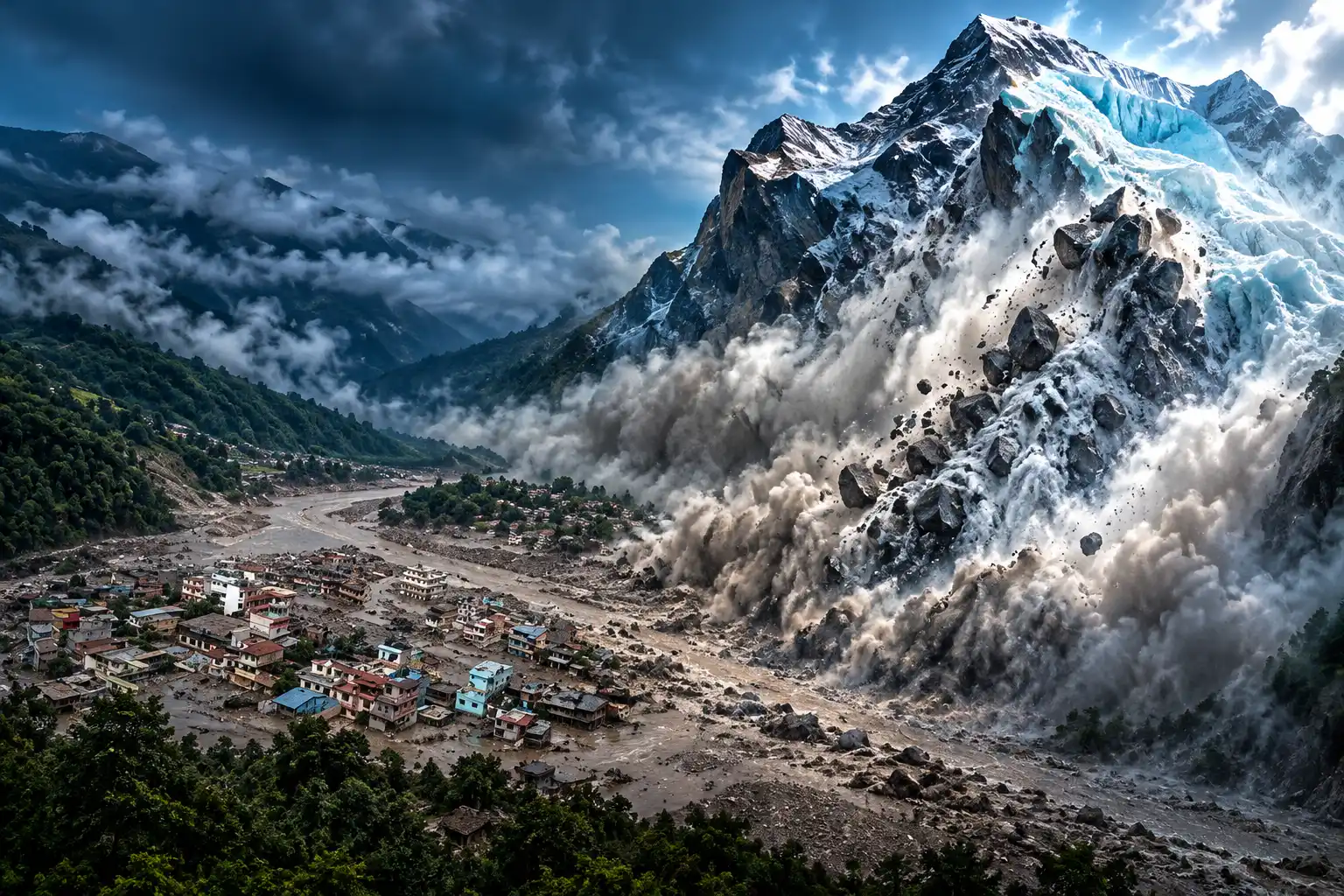
The failure began on Langtang Lirung, on Nepal’s side of the border with Tibet. Roughly 2 square kilometres of rock wall and glacier ice broke away at about 5,150 metres, fell some 1,400 metres, and hit the valley floor near 3,750 metres. World Weather Attribution said the impact released energy equal to a magnitude 5.5 earthquake. First reports treated the shaking as a quake. Later evidence showed the signal came from the collapse itself, which the US Geological Survey logged the collapse as a seismic event.
Friction likely melted part of the ice on the way down. The mass then struck buried ice on the valley floor and picked up more water. What started as rock and ice became a debris flood, then a water-heavy flash flood, moving at an average 188 kilometres per hour.
HOW THE FLOOD RAN DOWNRIVER
- 26 August, seven minutes after collapse: A wall of water, ice, rock and sediment reaches the Rasuwagadhi border, 22 kilometres downstream, and wipes out the border post.
- The next quarter hour: The flow erases the town of Timure and the market at Syabrubesi, catching pilgrims, border staff and hydropower crews.
- About 30 minutes later: It is in the Trishuli valley at Betrawati, still moving boulders and pulling multi-storey buildings into the river at Trishuli Bazaar.
- Under seven hours: The flood has travelled 200 kilometres to Devghat, where river flow more than doubles to about 5,850 cubic metres per second, and an estimated 20 million cubic metres of extra water passes in under four hours before the surge continues into India.
The water dumped 30.5 million cubic metres of sediment along the corridor. At Glachi, 88 kilometres downstream, the Trishuli rose 8.5 metres. About 13,700 people had been rescued by 14 September, more than 8,600 had received medical treatment, and some 3,400 were in holding centres. The study put the affected population at 84,270 people across 17 local levels in Rasuwa, Nuwakot, Dhading, Gorkha, Chitwan and Tanahu, with 15 municipalities declared crisis-hit for three months.
Langtang Lirung Already Buried a Village in 2015
This was the mountain’s second ice-and-rock disaster in 11 years. On 25 April 2015, a magnitude 7.8 earthquake, the Gorkha shock, tore ice and rock from the south face and sent it into Langtang Valley. A 2024 reconstruction of the 2015 Langtang Valley avalanche put the moving mass at 14.38 million cubic metres of rock, ice and snow, of which 6.95 million cubic metres settled in the valley. The avalanche core missed Langtang village. The air blast did not. More than 350 people were killed or left missing. Houses of stone slabs were flattened. Forest on the opposite slope came down.
That earlier failure was also a climate story of a kind. Four heavy snowfalls the previous winter had loaded the slope. Warm air helped the mass run farther. Walter Immerzeel, a Utrecht University mountain hydrologist who is a co-author of the new study, was already on the Langtang science then. The 2026 collapse came off the north face, toward Tibet and the Rasuwa corridor, not into the rebuilt village. Same peak. Different valley. A much larger failed slab.
TWO FAILURES ON ONE PEAK
| Fact | 25 April 2015 | 26 August 2026 |
|---|---|---|
| Face and path | South, into Langtang Valley | North, toward Rasuwa and Tibet |
| Immediate trigger | Magnitude 7.8 Gorkha earthquake | Rock-wall collapse that became a debris flood |
| Human toll | More than 350 killed or missing | Over 1,300 confirmed dead, over 5,000 missing as of 14 September |
| Failed mass | 14.38 million cubic metres | About 2 square kilometres of rock and ice |
| Climate finding | Anomalous winter snow and warm air, shown in later papers | About 1.5C extra July-August heat attributed to human warming |
The new study says the 2015 quake triggered a rock-ice avalanche at Langtang Lirung and that landslide activity stayed high, especially at elevation, which suggests the shaking may have weakened rock over the long term. It also says the quake’s specific role in the 2026 failure cannot yet be confirmed. Authorities have said the same. The 2015 shock is a possible primer, not a proven one.
What the Attribution Study Will Not Claim
World Weather Attribution usually asks whether a heatwave or a rainstorm was made more likely by fossil warming. This event was a slope failure, so the team changed method. Researchers from Nepal, Pakistan, the United Kingdom, Ireland, Sweden, Denmark, Norway, the United States, New Zealand and the Netherlands pulled together what is known about the wall, then asked how those drivers have changed in a warmer climate. They did not run a conventional yes-or-no on the collapse itself.
There’s absolutely no doubt that human induced climate change played a role here in the preconditioning of the disaster through permafrost thawing, through thinning of the glaciers, through having more rainfall instead of snow.
Friederike Otto, climatologist, Imperial College London, at the study briefing
The written findings are cooler than that briefing line. Climate change, the paper says, is a destabilising factor acting on a pre-existing geological predisposition, rather than the fundamental cause of the failure. The authors state they have not assessed whether this specific rock-ice avalanche would have occurred without human-induced climate change. That would need a chain from air temperature through subsurface heat, water pressure in fractures, and the mechanical life of the slope.
The gap is the one people argued over in late August, before any attribution team had published. A rock wall came down, not a glacial lake. Calling it a glacier collapse was always a shorthand. The science now says warming loaded the dice. It still will not say the dice were going to sit still in 1850.
A Slope Thinned, Thawed and Soaked
July and August at the grid cell nearest the failure, and across the wider Himalaya, were much warmer than the old average. Using the group’s usual frame, a climate 1.4C cooler than today, the team found human-caused warming added about 1.5C to those two monsoon months. The attributable rise in annual temperature is larger than the global mean, about 2C. In individual winter months the observed increase reaches 3C. The 12 months from September 2025 through August 2026 were warm at the site. July and August, the two hottest months of the year, sat directly on top of the collapse.
HOW THE WALL WAS SOFTENED
- Permafrost thaw: Warming raised bedrock temperatures and thawed ice in fractures, cutting the bond that holds rock together, while meltwater raised pressure in those cracks.
- Glacier thinning: Regional glaciers have been losing mass for decades at a rate equal to more than half a metre of thinning a year, reducing the ice buttress against the wall.
- Faster retreat since 2010: Langtang-Lirung glacier extent receded at 0.5 percent a year over the previous two centuries, then at 1 to 2.3 percent a year across the past 16 years, changing stresses in the adjacent rock.
- Rain instead of snow: The 0C line has climbed on the order of 100 metres per decade in the monsoon and post-monsoon, so more precipitation falls as rain and soaks the slope instead of sitting as snow.
Stations also recorded exceptionally high precipitation in October 2025. Combined with the later warmth, that snow and rain were a likely source of meltwater through spring and the monsoon. None of those processes needed to be the single trigger. The paper’s point is that they can stack.
Hydropower Crews, Pilgrims and the River Towns
Habitable land in these valleys is a strip along the river. Roads, markets, border posts and power plants sit in the same strip. The study says Nepal already has early warning systems that save lives in ordinary river floods, and that this cascade exceeded existing Himalayan flood warnings. Magnitude, speed and complexity were outside the design. No system in place could have given enough lead time in the worst-hit stretches.
That is the practical meaning of a rock wall that announces itself as a seismic jolt. Rain gauges and river sensors do not forecast a face coming off at 5,150 metres. The seven minutes to Rasuwagadhi were the warning. Immerzeel called the slope geologically vulnerable, potentially weakened by the 2015 earthquake, then destabilised further by glacier and permafrost retreat. He also called the disaster unprecedented in the Himalaya.
The Nepal Electricity Authority reported damage to 14 hydropower projects with a combined capacity of about 748 megawatts, nine of them operating plants (354 megawatts) and five still being built (394 megawatts). Early missing-person lists were heavy with project staff, security forces, customs officers and foreign travellers on a route that links Kathmandu with Lhasa. In a high mountain setting, the paper says, cutting exposure in river valleys would be socially, economically and politically very hard. That is a soft limit to adaptation. The hard limit is an event this fast.
Shah Takes a Reconstruction Brief to New York
Prime Minister Balendra Shah took office on 27 March after Nepal’s Gen Z protests. He had not made a foreign trip. Foreign Secretary Amrit Bahadur Rai said Shah will be in the United States from 22 to 26 September for the 81st General Assembly and will address the General Debate on 24 September. Rai said the Bhote Koshi flood had again shown Nepal at the front of a crisis it did little to cause, and that Shah will ask for compensation from the Fund for Responding to Loss and Damage. The Foreign Ministry put reconstruction after the disaster at 4.78 billion dollars. Nepal will also host a side event titled “Sagarmatha to the Sea.”
The emissions ledger behind that ask is small. Our World in Data puts Nepal’s 2024 carbon dioxide at 18.8 million tonnes, or 0.05 percent of global carbon dioxide, and 0.63 tonnes per person. Cumulative emissions since 1751 are 232 million tonnes, 0.01 percent of the world total. Shah told parliament the mountain region is carrying rising risk from a change with a global source, and that managing it is a global job.
Kathmandu had already costed a longer bill. The third national climate plan, filed in May 2025, seeks to cut net greenhouse gases 17.12 percent by 2030 and 26.79 percent by 2035 against business as usual, and to reach net zero by 2045. UNDP’s country brief puts the adaptation work priced at 18 to 20 billion dollars for 2025 to 2035, money Kathmandu expects from international climate finance. That decade figure is separate from the 4.78 billion dollar flood rebuild. The Loss and Damage section of the same plan had previously put infrastructure and sector losses at 345 million dollars. The August flood sits in a different column.
World Weather Attribution’s last finding is the one Shah can read out without overclaiming the physics. Events of this size, the authors write, ultimately exceed the limits of adaptation. Recovery and reconstruction support in the affected communities has become an unavoidable part of climate response. He addresses the General Debate on 24 September.

A CubeSat Will Age Whisky That Never Comes Home

A Charity Quote Cost Shia LaBeouf the FKA twigs NDA

Looker Turned a Model’s Body Into Ad Inventory

Infinity Ward Bets a Paid DMZ Will Stick This Time

Disney Sidesteps a Kimmel Renewal as Failla Cites Losses

How to Get Pre Boarding on Southwest – Skip the Line with These Tricks

False AI Intel Nearly Put US Crews on a Chinese Ship

Tim Cook’s $4.6 Trillion Apple Still Runs on One Phone

OpenAI Posts a Navier-Stokes Proof Clay Has Not Touched

Dunes Air Sues Nora Fatehi Over Its Luxury Jet
-
 TRAVEL3 years ago
How to Get Pre Boarding on Southwest – Skip the Line with These Tricks
-
 NEWS1 month ago
False AI Intel Nearly Put US Crews on a Chinese Ship
-
 BUSINESS2 months ago
Tim Cook’s $4.6 Trillion Apple Still Runs on One Phone
-
 NEWS2 months ago
OpenAI Posts a Navier-Stokes Proof Clay Has Not Touched
-
 ENTERTAINMENT2 months ago
Dunes Air Sues Nora Fatehi Over Its Luxury Jet
-

 LIFESTYLE3 years ago
How Often Do You Have to Change a Monkey’s Diaper? The Truth About Pet Monkeys
-

 NEWS2 months ago
Australia Treats Cloud Software Payments as Taxable Royalties
-

 LIFESTYLE3 years ago
How Long Does It Take for Armpit Hair to Grow? The Stages of Hair Growth and How to Shave It