
NEWS
Meta’s New VR Glasses Cost $1,299.99 and Need a Puck
Meta’s $1,299.99 VR Glasses look like sunglasses because the computer sits in a clip-on puck, and they will not go on sale until spring 2027.

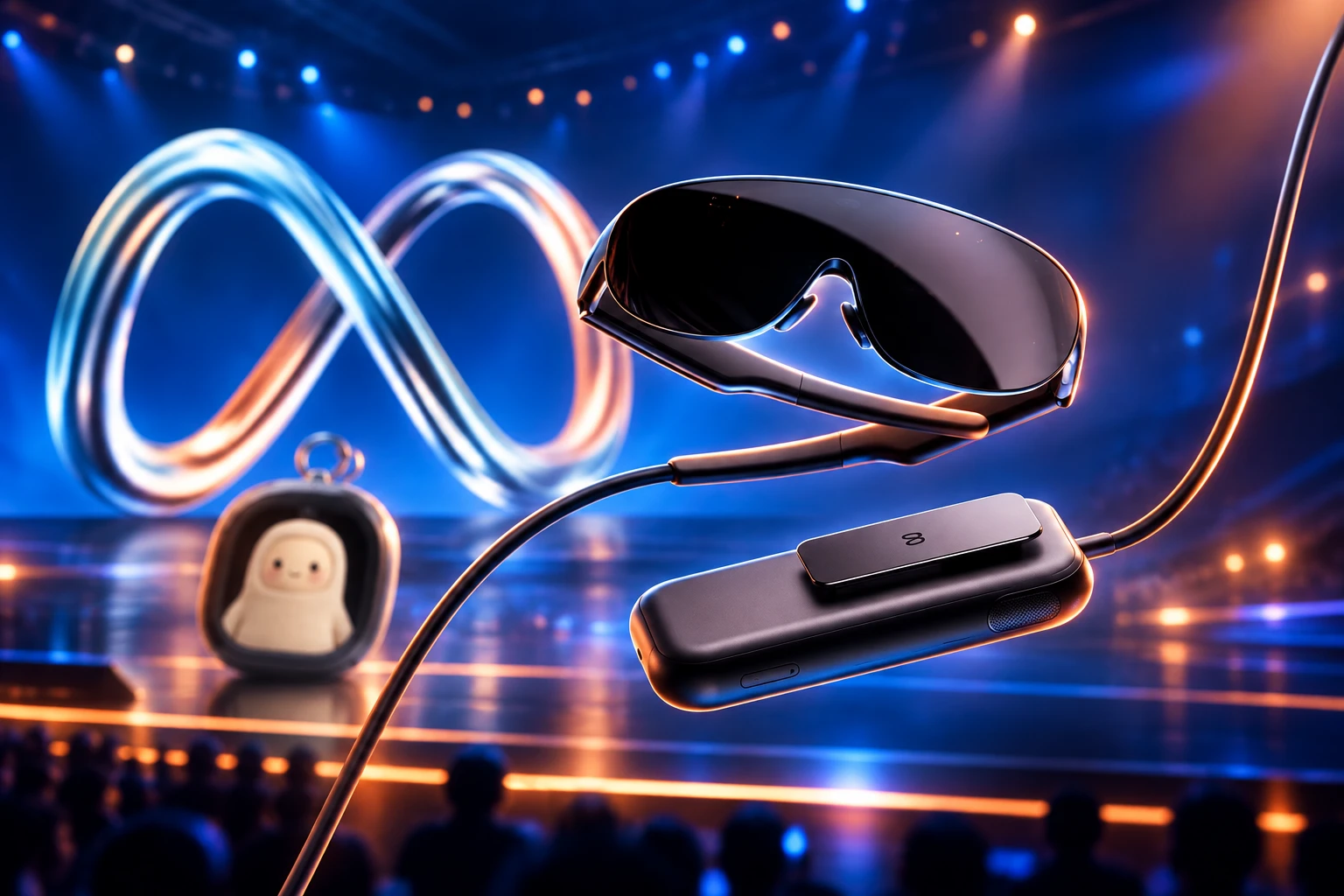
Mark Zuckerberg unveiled Meta VR Glasses at $1,299.99 on September 23, with sales delayed until spring 2027. The frames sit on your ears like sunglasses. The chip, battery, and storage live in a separate puck on an optical tether you clip to a belt, pocket, or bag.
The gadget Meta says it can actually finish for the holidays is Muse Charm, a keychain for the Muse AI agent it launched in early September. Zuckerberg still has to lock the Charm’s parts. The glasses already have a season, a price, and a computer that does not sit on your face.
Meta Put VR in Glasses and Left the Computer Behind
After more than a decade of strapped headsets, Meta is calling this its first VR device that is a pair of glasses. There are no straps. The open sides and color passthrough are meant to leave you aware of the room. Magnesium alloy in the frame is there to keep the optics rigid and cool once the heat has somewhere else to go.
That somewhere else is the puck. Meta says the glasses are five times lighter than Meta Quest 3 at about 100 grams, because sensors and displays stay on the face while compute, battery, and storage move off it. You can talk to a Meta AI agent in the OS, or aim with your eyes and hands. Controllers are optional. Touch Plus still pairs if you want them.
We have built a new kind of VR device that delivers the same magical feeling of presence and immersion, high-resolution displays and views of the world around you in a form factor that is a pair of glasses for the first time
Mark Zuckerberg, CEO, Meta Connect 2026
The chip in that puck is Qualcomm’s Snapdragon Reality Elite, the same platform Qualcomm said in June would power both all-in-one headsets and lighter, cooler headsets and tethered glasses. Qualcomm rated it at up to 48 TOPS of on-device AI, with up to 60% more GPU performance, 30% more CPU, and 160% more NPU than Snapdragon XR2+ Gen 2. It also claimed up to 20% longer battery life at the same load and a chip that runs up to 12 degrees Celsius cooler. The first named Reality Elite product was XREAL’s Project Aura, not Meta’s.
So the “breakthrough” form is a split Meta already had language for. The computer left the face because a glasses frame still cannot hold a Quest-class chip and a battery without becoming a headset again.
What $1,299.99 Buys in the New VR Glasses
Meta’s Connect recap puts the set on sale in spring 2027 for $1,299.99. That is more than four times the $299 launch price of Quest 3S, the last new Meta VR device, which arrived in 2024. Preorders are not open. There is no day inside “spring.”
The display is Meta’s 5K Infinite Display on micro-OLED panels, rated at 37 pixels per degree, with pancake lenses built for this frame, Dolby Vision on the panels, and Dolby Atmos in the arms. The puck is rated for up to three hours of continuous high-resolution media playback and takes 45W fast charging. Spec sheets that followed the keynote listed 12GB of RAM, 128GB of storage, and a microSD slot in the puck. Meta did not put those storage figures in its own blog posts.
HOW THE $1,299.99 SET COMPARES
| Device | Price (US) | When you can buy it | What you wear |
|---|---|---|---|
| Meta VR Glasses | $1,299.99 | Spring 2027 | About 100 g glasses plus a clip-on compute puck |
| Steam Frame 256GB | $1,059 | Reservations opened September 14, 2026 | Wireless headset; controllers in the kit |
| Steam Frame 1TB | $1,299 | Same reservation window | Same headset with more storage |
| Quest 3S (2024 launch) | $299 | Already on sale | Standalone headset, no puck |
Meta is selling a cinema, a multi-panel desk, and a console in one bag. Surface input can turn a table into a keyboard and touchpad. A Mac or Windows PC can join over Wi-Fi or USB-C, and full-color passthrough is supposed to keep your real keyboard in view. Xbox Cloud Gaming needs a Bluetooth gamepad. The glasses are Meta’s first IMAX Enhanced VR device, and Disney+ gets 3D titles such as Marvel’s The Avengers and Black Panther in November, months before these frames exist.
WHAT META PUTS ON THE FACE, AND WHAT IT DOES NOT
- On the face: Displays, pancake lenses, cameras, eye tracking, and hand tracking in a glasses frame.
- On the tether: The Snapdragon Reality Elite chip, the battery, and storage in a clip-on puck.
- Left out of the pitch: A default controller pair; Touch Plus is compatible and sold as an extra.
- Software carryover: The Quest catalog, plus more than 75 titles built to play with hands alone at launch.
A first look at the Connect demo found a smaller view than a full Quest visor, because the lenses sit in a glasses opening instead of a sealed headset. That is the trade for looking like eyewear. Presence gets a window. It does not get a cave.
Valve Opened a $1,059 Queue Nine Days Earlier
On September 14, Valve opened reservations for the Steam Frame 256GB kit at $1,059, with a 1TB kit at $1,299. Both include the headset, Steam Frame controllers, a Wi-Fi adapter, and Half-Life: Alyx. A 45W power supply is $29 extra. Signups ran through September 17, then a one-time shuffle set the buy queue, with the first purchase mails on September 18.
Meta’s glasses land in the same dollar band as Valve’s 1TB kit and about $241 above the 256GB kit, then ask buyers to wait until spring 2027 and clip a computer to their clothes. Valve is selling a wireless headset with controllers in the box now. Meta is selling a slimmer face and a later calendar.
Quest owners who wanted a cheap next standalone unit did not get one on this stage. There was no new Quest. The next Meta VR SKU is a $1,299.99 glasses set with a puck. If you already own Touch Plus, those controllers still work. If you wanted the $299 habit to continue, Connect closed that door for this cycle.
Reality Labs Still Burns Billions While Glasses Sell
This hardware arrives after a year in which Meta told investors VR would get less of the incremental dollar. In January, Zuckerberg said Reality Labs would direct most of its spending toward glasses and wearables. Finance chief Susan Li told analysts VR investment would decrease as that shift took hold. About 10 percent of Reality Labs jobs were cut as part of the move.
The books did not shrink with the talking points. Meta’s second-quarter filing shows Reality Labs revenue of $431 million and a $4.619 billion operating loss in the quarter. A year earlier the same slice did $370 million of revenue and lost $4.530 billion. For the first half of 2026, Reality Labs took in $833 million and lost $8.647 billion. Meta wrote that it expects full-year 2026 Reality Labs losses to stay similar to 2025.
REALITY LABS IN THE SECOND QUARTER
- Segment revenue: $431 million, up 16% from $370 million a year earlier.
- Operating loss: $4.619 billion, against $4.530 billion in the second quarter of 2025.
- First-half loss: $8.647 billion on $833 million of revenue.
- Mix on the call: Li said AI glasses sales rose while Quest headset sales fell.
Glasses are the line that is growing. Quest is the line that is not. Connect still needed a VR showpiece, so Meta showed the lightest headset it has ever put on a face and attached the hard parts to a clip. That is how a company can cut VR spend, keep a VR keynote, and put the computer in your pocket.
Why the Muse Charm Ships Before the Glasses
Muse is Meta’s personal agent, launched in early September on phones, the web, WhatsApp, and Mac. Connect added a real-time voice mode, a realtime avatar, an email address of its own, computer use on Mac, and a pile of shop and work connectors, including Walmart, Best Buy, Gap, Sephora, Wayfair, Shop Pay, PayPal, GitHub, and Instacart. Muse is also headed to Meta’s AI glasses in the coming months, woken by saying the agent’s name.
Charm is the holdable version. Zuckerberg described a fingerprint sensor in the corner and a talk-first loop that skips the phone unlock. “We’ve packed a lot of technology with this little guy,” he said. “So, if you’re not wearing glasses, this is going to be by far the fastest way to talk to your Muse and to show it what’s going on around you.” He said Meta has built only a few units, still needs to finish laying out the components and the finishing material, and is planning to ship in time for the holidays in December. He teased a translucent shell he called an elevated hacker look.
Alexandr Wang, Meta’s chief AI officer, put the same month on the calendar the night of the show.
MUSE DEVICE ALERT:
muse charm, the easiest way to use muse that fits on your keychain.
shipping in dec in time for the holidays 🎄 pic.twitter.com/rqzz9zWrqu
— Alexandr Wang (@alexandr_wang) September 24, 2026
Meta’s written recap was thinner. It called Charm a pocket device for talking to Muse and said the company would have more to share later this year. That later year, on stage, had a month. It did not have a price.
WHAT WE KNOW
- Job: A pocket or keychain gadget for voice and a live Muse avatar, without unlocking a phone.
- Inputs shown: A fingerprint sensor, a small screen, microphones, and at least one camera so Muse can see nearby context.
- Ship target: December, in time for the holidays, per Zuckerberg and Wang.
WHAT IS UNCONFIRMED
- Price: Meta has not published one.
- Radios and build: Cellular, battery life, and the final shell are still open, and only a few units exist.
- How it talks to Muse: Zuckerberg did not explain the link to Meta’s servers.
The louder object in the room was this keychain, not the $1,299.99 glasses. A talking pendant with a camera also drags the same always-on worry Meta has been managing on Ray-Ban frames, which is why the company is adding camera-free Ray-Ban Meta Audio glasses with 12 hours of battery and pushing past 100 AI glasses styles by year end. Charm still has to show it is a tool, not a toy that listens.
Hand Tracking First and a Tighter View
Meta needs the Quest library to follow the puck, or the glasses are a movie screen with a $1,299.99 ticket. It is promising the full catalog, then a hands-first layer on top. More than 75 games are due at launch that can be played with gestures alone, including Cardmada, Dice Throne Digital, Dragon Grove, Phoenix Wright: Ace Attorney Dual Destinies, Supernatural, Tetris Effect: Mixed Realities, and Two Point Hospital.
WHAT LANDS WITH THE GLASSES NEXT SPRING
- Beat Saber Flux: Hands become the blades, with a visual refresh due on VR Glasses and Quest next spring.
- Hologram calls: A phone self-capture becomes a face and voice that other people see in WhatsApp, Zoom, and other apps; Ray-Ban Display users in the US get early access first.
- Sports and film: ESPN immersive college football on Quest this year, then more than 100 immersive live sports events a year after the glasses launch, plus VR-enhanced Disney titles in the ILM cinema app.
Hologram is the social pitch that used to live inside the metaverse branding. On a phone screen it is still a video of a face. In the glasses it is supposed to sit in the room with spatial audio. Until people spend an evening in that call, it remains a demo with a spring date.
Developers now have to think in two input modes: hands on the glasses, controllers on Quest. The puck runs the same OS family as Quest 3, which is how the store carries over. A narrower window and no default wands still change how a game is aimed, blocked, and held. The 75-title list is the start of that rewrite, not the end of the Quest catalog.
December Gets a Keychain, Spring Gets the Cinema
Connect did not pick one wearable future. It stacked three, on three clocks. AI glasses you can order now, including camera-free Audio frames. A Muse Charm Meta wants in stores in December. VR Glasses on sale in spring 2027 for $1,299.99, with a puck on a leash.
THE SHIP CALENDAR META JUST SET
- Early September 2026: Muse launches as a phone, web, WhatsApp, and Mac agent.
- September 14, 2026: Valve opens Steam Frame reservations at $1,059 and $1,299.
- September 23, 2026: Zuckerberg shows Meta VR Glasses and Muse Charm at Connect.
- November 2026: Disney+ 3D titles begin on Meta’s existing VR apps, before the new glasses exist.
- December 2026: Muse Charm is supposed to ship, with the shell still being finished.
- Spring 2027: Meta VR Glasses go on sale at $1,299.99.
The glasses are the visor Meta has described for years. They are also a $1,299.99 accessory to a puck, on a calendar that starts after Valve has already sold a headset in the same price band, and after Reality Labs lost $4.619 billion in one quarter selling the line that is supposed to replace Quest volume. Charm is the object with a holiday date, a missing price, and a handful of prototypes.
Zuckerberg said Meta still has to finish laying out the Charm’s components. The VR Glasses have a season, a price, and a puck. Neither is in stores.

A CubeSat Will Age Whisky That Never Comes Home

A Charity Quote Cost Shia LaBeouf the FKA twigs NDA

Looker Turned a Model’s Body Into Ad Inventory

Infinity Ward Bets a Paid DMZ Will Stick This Time

Disney Sidesteps a Kimmel Renewal as Failla Cites Losses

How to Get Pre Boarding on Southwest – Skip the Line with These Tricks

False AI Intel Nearly Put US Crews on a Chinese Ship

Tim Cook’s $4.6 Trillion Apple Still Runs on One Phone

OpenAI Posts a Navier-Stokes Proof Clay Has Not Touched

Dunes Air Sues Nora Fatehi Over Its Luxury Jet
-
 TRAVEL3 years ago
How to Get Pre Boarding on Southwest – Skip the Line with These Tricks
-
 NEWS1 month ago
False AI Intel Nearly Put US Crews on a Chinese Ship
-
 BUSINESS2 months ago
Tim Cook’s $4.6 Trillion Apple Still Runs on One Phone
-
 NEWS2 months ago
OpenAI Posts a Navier-Stokes Proof Clay Has Not Touched
-
 ENTERTAINMENT2 months ago
Dunes Air Sues Nora Fatehi Over Its Luxury Jet
-

 LIFESTYLE3 years ago
How Often Do You Have to Change a Monkey’s Diaper? The Truth About Pet Monkeys
-

 NEWS2 months ago
Australia Treats Cloud Software Payments as Taxable Royalties
-

 LIFESTYLE3 years ago
How Long Does It Take for Armpit Hair to Grow? The Stages of Hair Growth and How to Shave It