
BUSINESS
Sunflower Gets the Steeper Cut in India’s Oil Duty
Crude sunflower duty falls to nil while palm and soy stay at 5%, a split that helps snack kitchens more than crushers and still leaves Nepal cheaper.

India cut the basic customs duty on crude sunflower oil to nil from 10% from 24 September 2026, and only to 5% from 10% on crude palm and soybean oil. Packaged-food and edible-oil shares were in focus on that session, but the gazette does not treat every kitchen, refinery or farm the same way.
Refined sunflower oil now attracts 22.5% basic duty, 10 points lower than before. Refined palm and soybean oil were trimmed by 5 points, to 27.5%. Snack companies that fry in bulk sit closer to that saving than soap makers or seed crushers, and tins moving duty-free from Nepal still undercut Indian refineries in the north and north-east.
Crude Sunflower Oil Now Clears Customs at Nil
The Department of Revenue issued Notification No. 31/2026-Customs on 23 September 2026 as G.S.R. 840(E), amending Notification No. 45/2025-Customs of 24 October 2025. Under Secretary Dheeraj Sharma signed the order, which came into force on 24 September 2026.
Serial 49 in that table is the line that matters for South Indian kitchens. Crude sunflower oil’s basic duty goes from 10% to nil. Crude soybean and palm oil, serials 41 and 46, go from 10% to 5%. Refined sunflower oil drops from 32.5% to 22.5%; refined soybean and palm oil drop from 32.5% to 27.5%.
THE NEW BASIC CUSTOMS DUTY
| Oil | Old basic duty | New basic duty |
|---|---|---|
| Crude sunflower | 10% | Nil |
| Refined sunflower | 32.5% | 22.5% |
| Crude soybean | 10% | 5% |
| Crude palm | 10% | 5% |
| Refined soybean | 32.5% | 27.5% |
| Refined palm | 32.5% | 27.5% |
Basic duty is not the whole bill. Imports also carry the Agriculture Infrastructure and Development Cess and the Social Welfare Surcharge. With those levies counted, the total duty on crude palm and soybean oil falls to 11% from 16.5%, and the total on crude sunflower oil falls to 5.5% from 16.5%.
That is an 11-point cut on crude sunflower and a 5.5-point cut on the other two crudes. Aashish Acharya, vice president at Patanjali Foods, said sunflower oil could become more attractive for refiners after the cut and could pull some demand away from soyoil and palm oil. Sudhakar Desai, president of the Indian Vegetable Oil Producers’ Association, made the same regional point: the sunflower cut is steeper, and it lands hardest in South India.
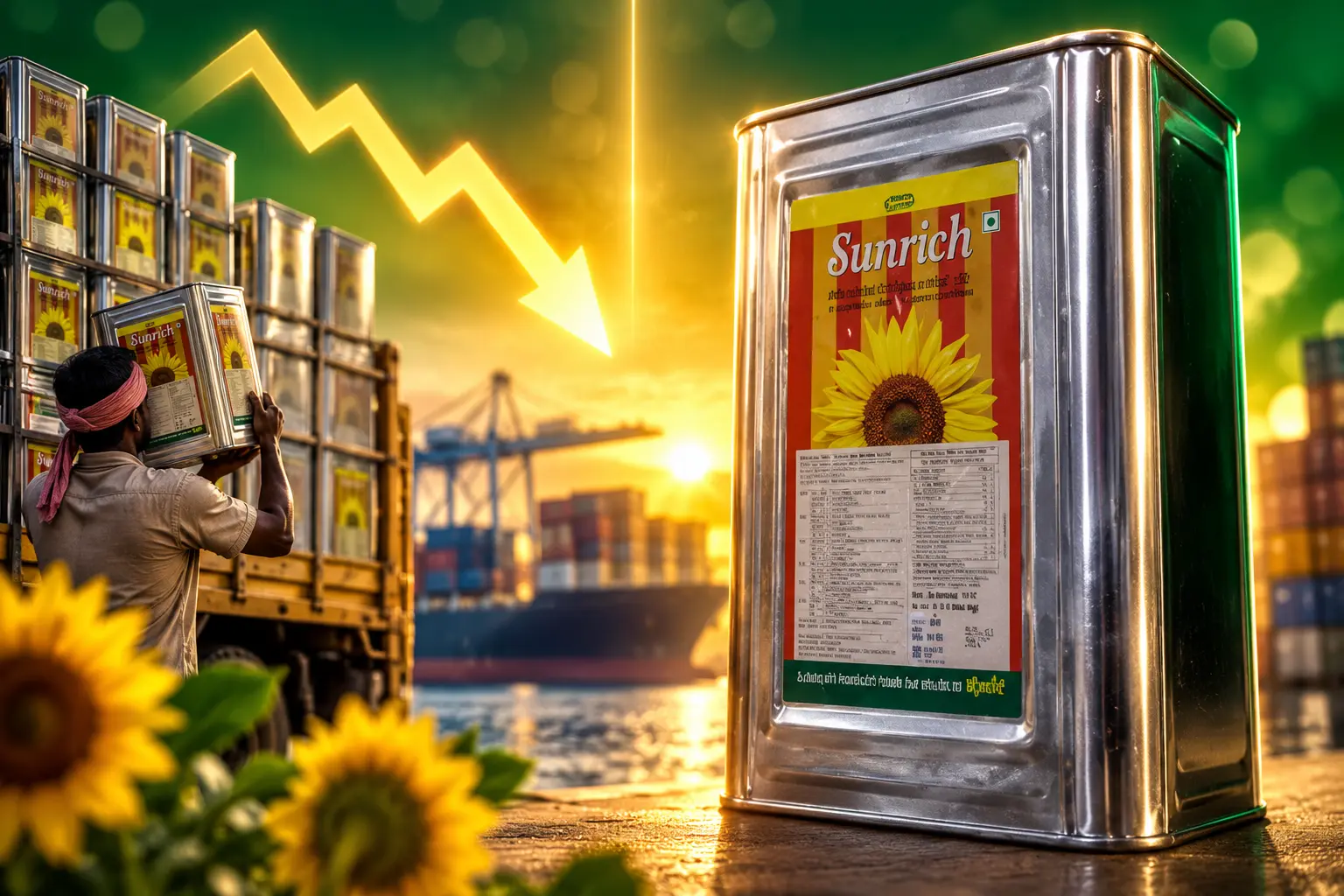
19.5% More for Sunflower Oil Than Last September
The duty order follows a year in which bottled oil ran well ahead of last autumn’s ticket. The Department of Consumer Affairs’ all-India average retail prices for 23 September 2026 put packed sunflower oil at ₹194.26 a kg, up 19.50% from ₹162.56 a year earlier.
COOKING OIL AT THE KIRANA, 23 SEPTEMBER 2026
- Sunflower oil: ₹194.26 a kg, up 19.50% from ₹162.56 a year earlier.
- Palm oil: ₹153.89 a kg, up 16.34% from ₹132.28.
- Soybean oil: ₹166.87 a kg, up 13.95% from ₹146.44.
- Mustard oil: ₹202.87 a kg, up 8.09% from ₹187.68.
Sunflower, already the dearer bottle on that tape, is the grade whose basic duty the gazette wiped out. Palm remains the cheaper bottle and the smaller duty cut. A government statement said the purpose of the change was to find a solution to the rise in edible-oil prices, and it asked associations to see that the full benefit of the lower duty reaches consumers.
Navratri begins on 11 October 2026, Dussehra falls on 20 October, and Diwali is on 8 November. Desai said the immediate job for the trade is to keep oil in the shops through those weeks, when households, sweet shops, snack kitchens and food-service all lift their offtake together.
Who Keeps the Saving After the Duty Cut?
Edible-oil companies such as AWL Agri Business, Godrej Agrovet and Patanjali Foods import crude palm, soybean and sunflower oil, refine it, and pack it. A lower landed cost can fatten their crush-and-refine spread, or it can be handed on as a cheaper bottle. The gazette does not say which way that split goes.
For Britannia Industries, Hindustan Unilever, Marico, Nestlé India, Bikaji Foods, Godrej Consumer Products, Dabur India and Jyothy Labs, oil is an input in biscuits, namkeen, packaged foods and some home-care lines. ICICIdirect Research called the cut a breather against inflated vegetable-oil and crude prices, and tagged the impact as positive. How much of that breather sticks in the margin depends on each firm’s mix and on whether rivals cut consumer prices first.
Industry, especially in the north and north east, has been reeling under the pressure of zero-duty imports from Nepal due to duty arbitrage with Indian duties, which will continue as Nepal goods will still be more competitive compared to domestically refined oils.
Sudhakar Desai, President, Indian Vegetable Oil Producers’ Association
Desai added that IVPA has been demanding an import quota on zero-duty shipments from SAFTA countries. The 24 September rates do not install that quota. A refiner who imports crude on the new Indian tariff still pays more than a packed tin that crosses from Nepal at zero.
Snack Makers Carry a Heavier Oil Bill
The companies that fry namkeen feel a duty cut in the kettle, not in a soap kettle. ICICIdirect Research put vegetable oils at about 32% of raw-material cost at Bikaji Foods and Gopal Snacks. Marico’s soybean and sunflower oil exposure is about 10% of raw-material cost. Hindustan Unilever’s exposure is through PFAD, palm fatty acid distillate, at about 12% to 13% of raw-material cost.
OIL’S SHARE OF THE RAW-MATERIAL BILL
- Bikaji and Gopal Snacks: Vegetable oils are about 32% of raw-material cost, so a cheaper tin moves the whole snack P&L.
- Hindustan Unilever: PFAD is about 12% to 13% of raw-material cost, a soap and oleochemicals line, not a namkeen line.
- Marico: Soybean and sunflower oils are about 10% of raw-material cost, and the same house also sells bottled oil against cheaper imports.
Bikaji’s own numbers from 23 September 2026, the day before the new rates, show why that 32% weight bites. Manoj Verma, the company’s chief operating officer, said overall raw-material inflation was 6% to 7% year on year, led by edible oil and crude-linked packing, and that the firm had passed on only 4.5% to 5% to buyers. He said full-year margins could slip by 100 to 150 basis points, even as he kept a mid-teens sales outlook and volume growth of about 10% to 11% on festive demand and e-commerce.
A duty cut that lands the next morning is a gift to that kettle. It is a smaller gift to a soap maker whose oil share is a third as large, and it is a mixed gift to Marico, which both buys oil as an input and sells oil as a brand.
Nepal’s Zero-Duty Route Survives the New Gazette
Indian refiners have spent 2026 arguing that the SAFTA door, not the MFN tariff, is the leak. IVPA put refined edible-oil imports from Nepal at 47,295 tonnes in 2023, 124,056 tonnes in 2024, and more than 804,000 tonnes in 2025, a rise of more than 17-fold in two years. Shipments in the first five months of 2026 were already 284,976 tonnes. The Solvent Extractors’ Association of India put fiscal 2026 volumes at 7.36 lakh tonnes, more than double 3.45 lakh tonnes a year earlier.
NEPAL’S DUTY-FREE SURGE
- 2023: Refined edible-oil imports from Nepal stand at 47,295 tonnes.
- 2024: Volumes rise to 124,056 tonnes under SAFTA zero duty.
- 2025: Shipments top 804,000 tonnes, more than 17 times the 2023 load.
- January to May 2026: A further 284,976 tonnes arrive, on course toward IVPA’s 1 million tonne year.
IVPA has told the commerce ministry that this flow could cost ₹2,000 to ₹2,500 crore a year in customs revenue and pull refining, jobs and oilseed demand out of India. Northern and eastern markets that sit on the Nepal border account for an estimated 35 lakh tonnes of yearly edible-oil demand; industry papers have said Nepal could supply nearly 25% of that regional pool at zero duty. Nepal has little palm or soybean of its own, which is why IVPA wants stricter checks under the Customs Administration of Rules of Origin under Trade Agreements Rules, 2020.
Domestic production still covers only about 40% of what India uses. Desai, who is also chief executive of Emami Agrotech, put 2025-26 oil-year output at 9.6 million tonnes and imports at about 16.7 million tonnes: 8 to 8.5 million tonnes of palm, 5 to 5.5 million tonnes of soybean oil, 2.8 to 3 million tonnes of sunflower oil, and about 200,000 tonnes of other oils, including the Nepal route. The USDA’s India oilseeds and products annual has farmers still moving away from soybean toward corn and pulses, which is the other side of cheaper imported oil: weaker offtake for Indian seed.
Jakarta’s B50 Blend Pulls Palm out of Kitchens
Palm is still India’s largest imported oil, but it is no longer the default. Desai said palm imports have already fallen from more than 10 million tonnes in 2021-22 to around 8 million tonnes, and that palm is likely to stay relatively expensive because of B50 biofuel mandates and slower acreage growth. Indonesia rolled out B50 on 1 July 2026, lifting the palm-oil share in diesel from 40% to 50%.
Under B40, about 25% of Indonesian output, around 12 million tonnes a year, went into biodiesel. Under B50 that share can rise to about 41%, or nearly 21 million tonnes. Less of the crop then leaves as food oil. India still buys the bulk of its palm from Indonesia and Malaysia, soybean oil from Argentina and Brazil, and sunflower oil from Russia, Argentina and Ukraine, a split visible in the Solvent Extractors’ Association’s country-wise edible oil import table for November 2025 to May 2026.
Cheaper sunflower crude, at nil basic duty, arrives in a market where palm is being pulled into fuel. That is the mix shift the festive-boost copy underplays. A refiner who can land sunflower at 5.5% total duty has a new reason to change the blend in the tank, especially for southern packed-oil brands, while palm-heavy lines keep a 11% total levy and a tighter exportable surplus in Jakarta.
Domestic crushers sit on the other side of that arithmetic. Cheaper imported crude and refined oil narrows the gap for plants that buy Indian seed, pay Indian costs, and then compete with tins that did not. The people who lose first are soybean and mustard growers, whose meal and oil have to clear a lower import hurdle, and the solvent units that crush that seed.
Refiners Held Cargo Until the Gazette Dropped
The 24 September rates are the second step down in less than a year. In 2025 the Centre cut basic duty on crude sunflower, soybean and palm oils from 20% to 10%. After that round, the Department of Food and Public Distribution ran nationwide inspections of edible oil refineries to check that MRP and distributor prices actually fell. Associations were told to file brand-wise MRP sheets every week. The same pass-through test now returns, with Navratri 17 days after the new gazette.
Trade had already positioned for it. Sandeep Bajoria, chief executive of vegetable-oil brokerage Sunvin Group, said refiners had held back on purchases in anticipation of a duty cut and would now raise imports to meet festival demand. That restock, if it comes, is the volume story for AWL Agri Business, Patanjali Foods and Godrej Agrovet. It is also a near-term risk for anyone sitting on high-cost inventory bought under the old 10% crude tariff.
Anticipating a reduction in import duty, refiners had held back on purchases, but they will now step up imports to meet festival season demand.
Sandeep Bajoria, Chief Executive, Sunvin Group
Even the sunflower gift is not sitting at the port. Patanjali Foods said about 90% of its sunflower-oil imports were stuck because of the West Asia crisis, and that freight and insurance had already lifted the cost of what does move. A nil basic duty on crude sunflower does not unload a cargo that is still in the Gulf. It does change the maths on the next fixture, which is why Acharya flagged sunflower as the grade that could steal demand from soyoil and palm.
India remains the world’s largest vegetable-oil importer, so a cheaper Indian bid shows up in palm, soybean and sunflower flows well beyond Mumbai. How much of the 5.5% or 11% total levy actually reaches the kirana still depends on global prices, the rupee, freight, and whether Nepal’s zero-duty tins keep undercutting the domestic refine. The gazette of 23 September 2026 set those two Indian tariffs. It did not close the third door.
Disclaimer: This article is news reporting and analysis for information only. It is not investment advice, a stock recommendation, or a solicitation to buy or sell any security named here, including Britannia Industries, Hindustan Unilever, AWL Agri Business, Patanjali Foods, Marico, Bikaji Foods or any other share. Readers should consult a SEBI-registered investment adviser or a qualified financial planner before acting on duty changes, margin estimates or festive-demand views. Duty rates, retail prices, import volumes and company comments reflect the gazette, the Department of Consumer Affairs tape and the named speakers as of 24 September 2026 and can change with the next notification, cargo or earnings print.

A CubeSat Will Age Whisky That Never Comes Home

A Charity Quote Cost Shia LaBeouf the FKA twigs NDA

Looker Turned a Model’s Body Into Ad Inventory

Infinity Ward Bets a Paid DMZ Will Stick This Time

Disney Sidesteps a Kimmel Renewal as Failla Cites Losses

How to Get Pre Boarding on Southwest – Skip the Line with These Tricks

False AI Intel Nearly Put US Crews on a Chinese Ship

Tim Cook’s $4.6 Trillion Apple Still Runs on One Phone

OpenAI Posts a Navier-Stokes Proof Clay Has Not Touched

Dunes Air Sues Nora Fatehi Over Its Luxury Jet
-
 TRAVEL3 years ago
How to Get Pre Boarding on Southwest – Skip the Line with These Tricks
-
 NEWS1 month ago
False AI Intel Nearly Put US Crews on a Chinese Ship
-
 BUSINESS2 months ago
Tim Cook’s $4.6 Trillion Apple Still Runs on One Phone
-
 NEWS2 months ago
OpenAI Posts a Navier-Stokes Proof Clay Has Not Touched
-
 ENTERTAINMENT2 months ago
Dunes Air Sues Nora Fatehi Over Its Luxury Jet
-

 LIFESTYLE3 years ago
How Often Do You Have to Change a Monkey’s Diaper? The Truth About Pet Monkeys
-

 NEWS2 months ago
Australia Treats Cloud Software Payments as Taxable Royalties
-

 LIFESTYLE3 years ago
How Long Does It Take for Armpit Hair to Grow? The Stages of Hair Growth and How to Shave It