
BUSINESS
Oman Shelves Salalah Hormuz Talks as Gulf States Balk
Oman delayed Salalah Strait of Hormuz talks after Tehran said Saudi Arabia asked, with Bahrain out and the East-West pipeline shut.

Oman called off a Monday meeting in Salalah that was meant to brief Gulf states on a new Strait of Hormuz shipping route. Iranian officials said Saudi Arabia asked for the delay, and Muscat set no new date.
The session was never a reopening ceremony. Iranian Foreign Minister Abbas Araghchi said the Iran-Oman text only sets traffic rules if the strait is allowed to open, and that this still depends on Washington honoring the Islamabad memorandum. Gulf governments were being asked to bless that paper in the same week Saudi Arabia’s main land bypass was shut and a cargo ship was hit in the waterway.
Oman Puts Monday’s Salalah Meeting on Hold
Omani Foreign Minister Sayyid Badr Albusaidi posted the decision on Sunday evening. He did not name a requester and offered no substitute day.
https://x.com/badralbusaidi/status/2099224052619735498
The Oman News Agency said the gathering planned for Monday in Salalah was put off “in order to create conditions conducive to a constructive dialogue.” Mohammad Ali Bek, director-general for the Persian Gulf at Iran’s foreign ministry, said the move came “at the request of some regional countries and by joint decision of Oman and Iran,” and that Tehran would work with Muscat on another time. Iranian officials separately named Saudi Arabia. Riyadh has not commented on that claim.
Albusaidi’s post carried the flags of Bahrain, Iran, Iraq, Kuwait, Oman, Qatar, Saudi Arabia and the United Arab Emirates, the eight governments the invitation was built around. No Gulf capital had publicly confirmed it would send a minister. President Donald Trump, asked about the meeting on Sunday, said he “didn’t give a damn” and called it “their business.”
WHAT WE KNOW
- The decision: Oman postponed the Salalah foreign ministers’ meeting set for Monday, September 14, and announced no new date.
- The agenda: Iran said the only item was a new maritime route agreed with Oman, with maps to go later to the International Maritime Organization.
- The walkout already on file: Bahrain said on Saturday it would not sit in any collective meeting with Iran until diplomatic ties are restored.
WHAT IS UNCONFIRMED
- Who asked: Iranian officials named Saudi Arabia; Oman has not identified a country.
- Who fired on Qeshm: The projectile that hit an Iranian container ship on Sunday is still unidentified.
- Who launched the drones: Riyadh traced the East-West strikes to Iraq; no group has claimed them, and Iran has not answered Trump’s charge.
A meeting that needed consensus never had it. Bahrain was already out. Saudi officials had objected to proposed changes in the Iran-Oman text. The rest of the table stayed silent until Muscat pulled the chairs away.
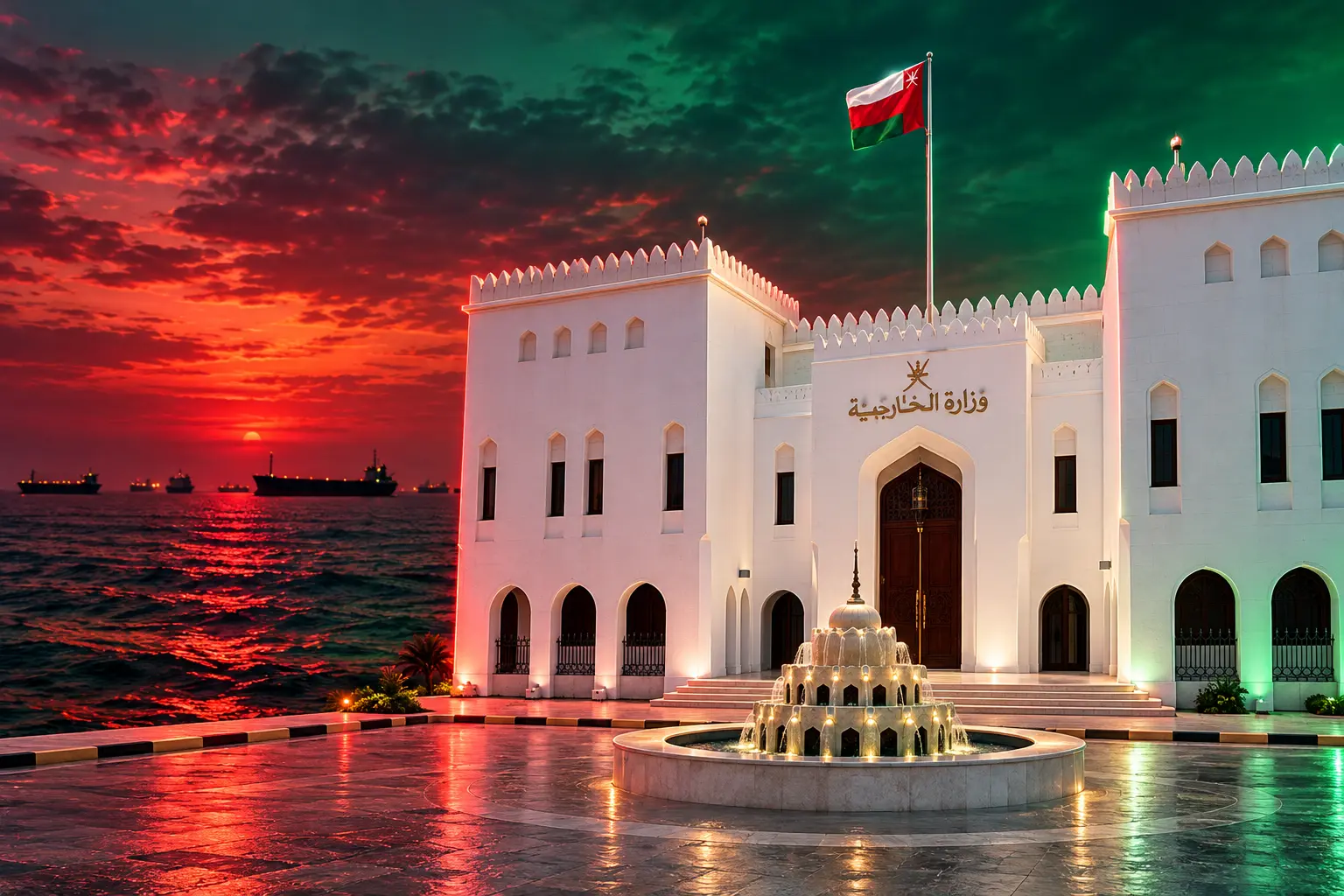
The Shipping Corridor Gulf States Were Asked to Bless
Iran and Oman, the two states on the strait, have been drafting a traffic plan for months. A joint statement after talks in Tehran on August 25 described a phased framework that both foreign ministers called a practical basis for moving ships again. Araghchi told Al-Araby Al-Jadeed that the Muscat session would cover only that route, not Yemen and not a new regional security pact, and that the maps would be shown to neighbors and then filed with the IMO.
Kazem Gharibabadi, Iran’s deputy foreign minister for legal and international affairs, said the temporary lane would be 7 miles (11.3 km) wide, with the entry through Iranian territorial waters and part of the exit through Iranian waters as well. Technical talks were also meant to cover mine clearance, information sharing, and who would sell navigation and security services, the same file that later showed up in Qatar as a temporary joint shipping corridor through the Strait.
WHAT THE IRAN-OMAN FRAMEWORK SETS OUT
- A temporary lane: A joint corridor and a joint project to clear mines, described as a first phase, not a full reopening.
- Iranian water at both ends: Entry wholly in Iranian waters, with part of the exit also in Iranian waters, and the southern lane to close once the new system is running.
- A later IMO filing: Maps and a joint statement were to be shown in Salalah, then sent for registration.
- A hard stop from Tehran: Araghchi said the paper does not open Hormuz until the United States returns to the Islamabad memorandum.
That last clause is why the briefing was so easy to stall. Gulf exporters were not being invited to vote the strait open. They were being invited to endorse a route whose gate sits on the Iranian side, while Tehran still treats the US naval blockade and sanctions as the price of any actual traffic.
Why Bahrain Refused to Enter the Room
Manama answered before anyone else had to. The foreign ministry said on Saturday that it had already told Oman, through official channels, that it would not come.
In light of what has been circulated by media outlets and social media platforms regarding a proposed ministerial meeting on the situation in the Strait of Hormuz, the Foreign Ministry clarifies that the Kingdom of Bahrain will not participate in it and will not be party to any collective meeting involving Iran before diplomatic relations between the two countries are restored.
Bahrain Foreign Ministry, statement, September 12, 2026
Bahrain cut ties with Iran in 2016, when Saudi Arabia did. Riyadh restored relations in 2023. Manama has not. The ministry said security “cannot be preserved through a policy of appeasement,” and that Hormuz should be open without discrimination, fees, or permits. It pointed to strikes on Gulf infrastructure, including an ammonia tank in Bahrain and Friday’s hit on the Saudi pipeline.
BAHRAIN’S FOUR CONDITIONS
- Stop the fighting: An end to hostilities, not a traffic memo layered on top of them.
- Pay for the damage: Accountability and compensation for attacks on civilian sites.
- Keep other soil out of it: Respect for sovereignty, and a ban on using one country’s territory to hit another.
- Use the law of the sea: Any Hormuz scheme should match the 1982 United Nations Convention on the Law of the Sea, win IMO approval, and include all GCC states.
Esmaeil Baghaei, the Iranian foreign ministry spokesman, had called the invitation “a sign of Iran’s good intention” and said regional security should be guaranteed by regional countries, “without intervention by the foreigners.” Bahrain’s reply was that it will not sit with Iran at all until the 2016 break is repaired. Once that seat was empty, Oman’s “interests of consensus” line wrote itself.
Saudi Arabia’s Hormuz Bypass Goes Dark
The other reason a Salalah photo-op was a hard sell in Riyadh is simpler. The line that lets Saudi crude reach the Red Sea without using Hormuz was already offline.
On Thursday, several drones launched from Iraq struck the East-West pipeline in the Riyadh and Medina regions. The Saudi foreign ministry said the attacks caused injuries and damage. The energy ministry stopped the line on Friday as a precaution. Satellite images showed fire and black smoke along the route southeast of Medina. The 1,200 km (745 mile) pipe runs from the eastern fields around Abqaiq to Yanbu. US Energy Information Administration figures put its capacity at 7 million barrels a day.
It was the first strike on that line since April, when a drone hit a pumping station and took out nearly 700,000 barrels a day of pumping capacity. US Energy Secretary Chris Wright said on September 10 that ships moving oil and products through Hormuz had averaged just under 11 million barrels a day over seven days, with another 3 to 5 million barrels a day moving on bypass pipelines. Those bypass barrels are operating flow, not the East-West nameplate. Once the Saudi line stopped, that workaround shrank on the same weekend Oman was still printing nameplates for Salalah.
Riyadh said it would not strike back “at this stage,” after Iraqi Prime Minister Ali al-Zaidi asked for time to stop further launches from Iraqi territory. Trump, in Dublin, said Iran was “probably” behind the assault. Iran has not answered him. No group claimed the drones.
Baghdad moved fast to show it was not a willing platform. Al-Zaidi dismissed the operations commander in Maysan province, on the Iranian border, after the launch site was traced there. Iraqi forces later said they had seized a drone-launching platform in the al-Tayeb border district. Three crossings into Iran were closed: Shalamcheh in Basra, al-Shib in Maysan, and Mandali in Diyala. Al-Zaidi also agreed to a joint investigation with Iran. Brent crude jumped to around $110 a barrel on September 11 before easing to $105, the first settle above $100 since May.
THE FIVE DAYS THAT EMPTIED THE TABLE
- September 10: Drones from Iraqi territory hit the East-West line in the Riyadh and Medina regions.
- September 11: Saudi Arabia shuts the pipeline as a precaution and says it will not respond while Iraq investigates.
- September 12: Bahrain rules out Salalah; Iraq fires the Maysan commander and shuts three crossings to Iran.
- September 13: A projectile hits an Iranian container ship near Hengam Island; Albusaidi postpones the meeting that night.
- September 14: Foreign ministers do not gather in Salalah. No new date is set.
Houthi forces, in the same week, took new ground at the southern entrance to the Red Sea, adding pressure on the other sea lane Saudi crude uses once it reaches Yanbu. The Gulf’s problem is no longer only Hormuz. It is both doors at once.
How Little Oil Now Moves Through Hormuz
Before the war, the strait was the world’s top oil chokepoint, carrying about 20 percent of global petroleum liquids and a quarter of all oil moved by sea, according to the U.S. Energy Information Administration. That share is why a cancelled briefing in Dhofar still prices into diesel and jet fuel far from the Gulf.
The war that began on February 28, after US and Israeli strikes on Iran, closed most of that traffic. Iranian Foreign Minister Araghchi has said the strait shut from the first day because the supreme leader had been a target. Ali Khamenei was killed in those opening strikes. His son, Ayatollah Mojtaba Khamenei, succeeded him and has been largely unseen in public.
HORMUZ AND THE LAND BYPASS
| Route | What it carried | Latest status |
|---|---|---|
| Strait of Hormuz | 20.9 million b/d of oil in the first half of 2025; 11.4 Bcf/d of LNG, over 20% of global LNG trade | Commodity-vessel transits in single digits at the weekend, against about 125 large commercial ships a day before the war |
| Saudi East-West pipeline | 7 million b/d of capacity from the eastern fields to Yanbu | Shut after the September 10 drone hits |
| UAE Habshan-Fujairah line | 1.8 million b/d of capacity around Hormuz | The remaining dedicated land bypass on the Arabian Peninsula |
Preliminary shiptracking over the weekend counted four vessels leaving the Gulf through the strait and ten entering, well below a 10-day average of 14. A British maritime trade monitor, the United Kingdom Maritime Trade Operations office, said a vessel was hit by a projectile while transiting the strait, with a fire on board and an evacuation. Iranian state media said on Monday the Islamic Revolutionary Guard Corps had destroyed a US MQ-1 drone over the waterway.
Qeshm’s governor, Hossein Amir-Teymouri, said the Sunday strike hit an Iranian container ship with 10 crew near Hengam Island and the Shib-Deraz coast around 5 a.m. One sailor, Jamshid Rajabi, was killed and four others were hurt. The projectile was unidentified. Qeshm sits about 14 miles (22 km) from Bandar Abbas, the port Iran uses to watch the lane. That is a thin place to ask neighbors to sign a traffic chart.
A July Attack Tehran’s President Did Not Order
Gulf caution also has a paper trail inside Iran. On June 17, the United States and Iran signed a June 17 memorandum of understanding that, among other points, sought to resume traffic through Hormuz. Brent, which had started that quarter above $100 a barrel, eased as tankers moved again. The calm did not last.
Overnight on July 6-7, Iranian forces opened fire on three commercial ships in the strait, setting a Qatari LNG tanker ablaze and damaging the other two, according to Iranian officials and Revolutionary Guards members later described to several governments’ briefers. President Masoud Pezeshkian, then in Iraq for Ali Khamenei’s funeral, flew home and called the IRGC commander, Gen. Ahmad Vahidi, in a raised voice, calling the action reckless. Vahidi said he had not authorized it and had not known in advance. The Supreme National Security Council, officials said, had been in the dark as well.
Inquiries inside the government traced the order to Hossein Taeb, a powerful former Guards spymaster who had opposed the US memorandum from the start. Field commanders, the same officials said, had been told they could hit any ship that violated Iran’s control of the strait without waiting for Tehran. US strikes and sanctions followed, and the memorandum effectively died.
The attack on the ships was orchestrated with the goal to blow up the memorandum of understanding with Trump and to kill the prospects of any future negotiations and deal.
Alireza Namvar Haghighi, former Iranian official, interview from Canada
Salalah was the next attempt to put a regional stamp on a waterway that Iran’s own factions will not jointly control. Araghchi still says reopening depends on the United States returning to that June text. Hardliners still treat any US-backed lane as a loss of leverage. A foreign ministers’ circle cannot split that argument. It can only be asked to nod at maps.
The Maps Stay Off the IMO Register
Iran and Oman say they will pick another date. They have not named one. The maps that were supposed to leave Salalah for the IMO are still in two foreign ministries. The East-West line is still stopped. Bahrain is still absent. The projectile that killed Jamshid Rajabi is still unnamed.
Oman can host this table again. It cannot invent the consensus Albusaidi said he was waiting for, not while the bypass is dark and the strait is still a weapons range. The corridor remains a pair of charts, and the oil that used to move between them is still looking for a way around.

A CubeSat Will Age Whisky That Never Comes Home

A Charity Quote Cost Shia LaBeouf the FKA twigs NDA

Looker Turned a Model’s Body Into Ad Inventory

Infinity Ward Bets a Paid DMZ Will Stick This Time

Disney Sidesteps a Kimmel Renewal as Failla Cites Losses

How to Get Pre Boarding on Southwest – Skip the Line with These Tricks

False AI Intel Nearly Put US Crews on a Chinese Ship

Tim Cook’s $4.6 Trillion Apple Still Runs on One Phone

Dunes Air Sues Nora Fatehi Over Its Luxury Jet

OpenAI Posts a Navier-Stokes Proof Clay Has Not Touched
-
 TRAVEL3 years ago
How to Get Pre Boarding on Southwest – Skip the Line with These Tricks
-
 NEWS1 month ago
False AI Intel Nearly Put US Crews on a Chinese Ship
-
 BUSINESS2 months ago
Tim Cook’s $4.6 Trillion Apple Still Runs on One Phone
-
 ENTERTAINMENT1 month ago
Dunes Air Sues Nora Fatehi Over Its Luxury Jet
-
 NEWS1 month ago
OpenAI Posts a Navier-Stokes Proof Clay Has Not Touched
-

 LIFESTYLE3 years ago
How Often Do You Have to Change a Monkey’s Diaper? The Truth About Pet Monkeys
-

 NEWS1 month ago
Australia Treats Cloud Software Payments as Taxable Royalties
-

 LIFESTYLE3 years ago
How Long Does It Take for Armpit Hair to Grow? The Stages of Hair Growth and How to Shave It