
BUSINESS
Trump’s Gracie Visit Repeats Reagan’s Unfinished Megaproject Ritual
Trump’s first Gracie Mansion visit in 45 years produced Sunnyside Yard talks, not a check, repeating the lawn ritual that once sold Westway.

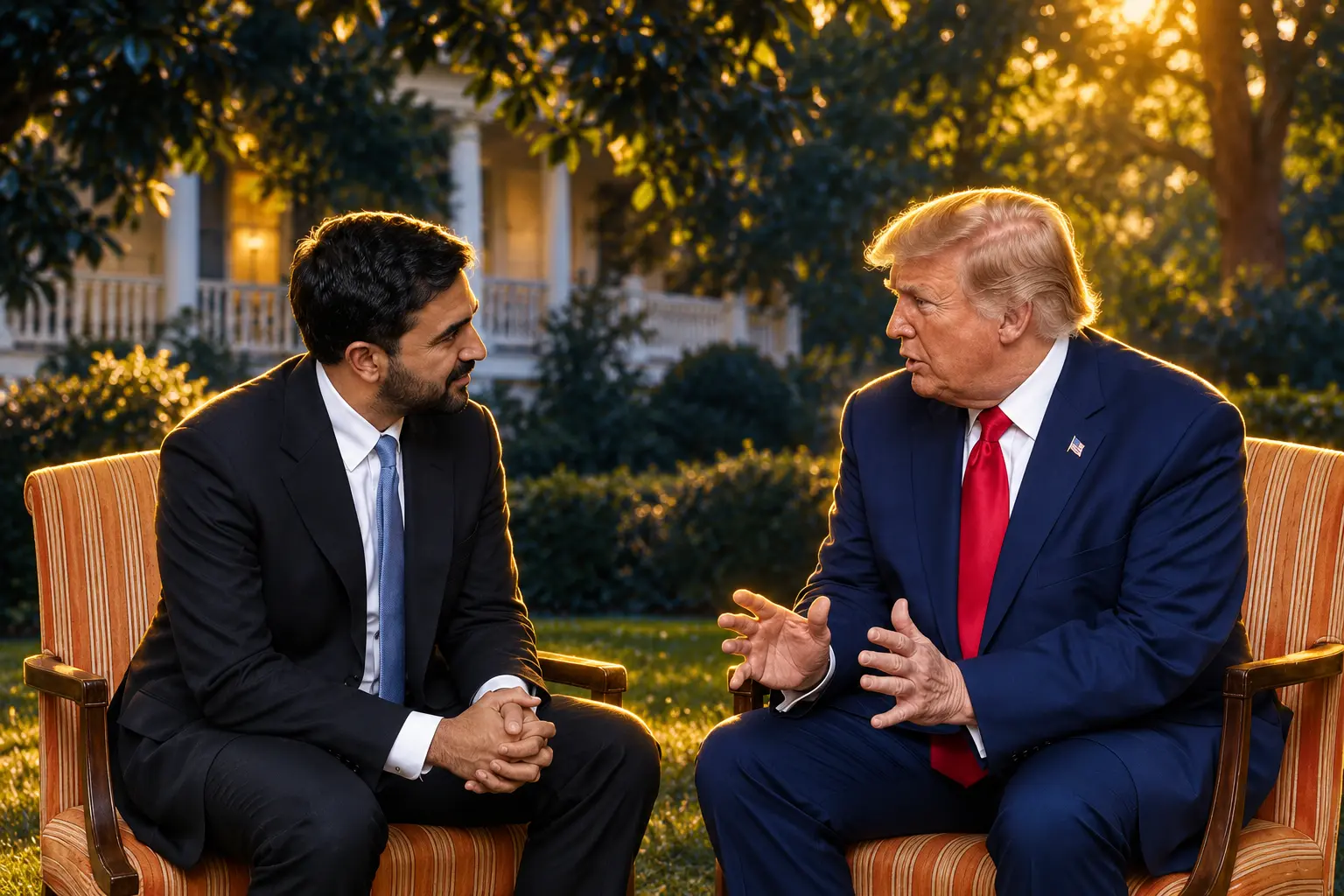
President Donald Trump left Gracie Mansion on September 21, 2026 hoping Zohran Mamdani would be a great mayor, after an hour on housing and immigration. It was the first visit by a sitting president to the East River house in 45 years.
The last president who stood on that lawn, Ronald Reagan, came with a stage-prop check and a promise that a West Side megaproject had begun. New York later dropped the project. Trump came with praise, a tap on the mayor’s arm, and an agreement to put City Hall and White House staff on the same file: a deck over Sunnyside Yard in Queens.
They Left Gracie With a Working Group
The session ran roughly an hour, with Trump’s chief of staff, Susie Wiles, and Mamdani’s chief of staff, Elle Bisgaard-Church, in the room. It was their third meeting. They had already sat together at the White House in November 2025, when Mamdani was mayor-elect, and again in February 2026, when the mayor walked in with a housing pitch and two mock newspaper pages.
One reprint was the Daily News of 1975, “Ford to City: Drop Dead.” The other was a fake front page that read “Trump to City: Let’s Build.” On the Gracie lawn, the build still had no dollar commitment and no date.
Mamdani said the two sides had “agreed to set up a new level of that conversation between our housing and operations team at City Hall and the White House team.” He put the next step in plainer language too: “technical and legal authorization of the construction of a platform” over the rail yard. He said that platform could support 12,000 homes and 30,000 jobs, a “new neighborhood” on land the city does not currently have.
Trump did not argue with the ambition. “Sunnyside’s a big job, I’ve been watching that for 35 years, everybody’s wanted to do something with Sunnyside Yard,” he said. “I would say that it’s a very federal-oriented job; you’re going to need a lot of federal approvals and probably some federal money to do it. But it’s always been a great location. I owned a building in Sunnyside, it was a great building. I know it very well.” He added, “Maybe they have a shot at doing it.”
He also said he wanted Mamdani to succeed. “I’ve seen it with numerous different mayors, and I said some great ones and some not so great ones, so hopefully you’re going to be a great one and you’re off to a start.” He told reporters he wanted what was good for New York and for the country, and that the 34-year-old Democratic Socialists of America member, sworn in on January 1, 2026 as the city’s 112th mayor, had “great potential.”
Mamdani, born in Kampala on October 18, 1991 and the city’s first Muslim mayor, had invited him. Trump, in New York to address the United Nations General Assembly on September 22, treated the stop as a homecoming. He is the fifth president to visit the yellow Federal house. His own last trip there was in 2003, for Rudy Giuliani’s wedding. “When you’re the mayor, you have to live there,” he said. “It was very nice inside, beautifully kept.”
Asked about the White House ban on CNN, MS NOW, and Politico, Mamdani said he had told Trump the lawn would be open. “I told the president that we’re going to have all of the members of the press here on the lawn, and that is something that I believe in.” Trump looked at the pack and said they had talked about boycotting him, “but they never boycott me, so I wasn’t very worried about that.”
Reagan’s $85 Million Check for Westway
Reagan arrived on Labor Day, September 7, 1981, and spoke at 2:12 p.m. on the East Lawn. He handed Mayor Ed Koch an $85 million check for Westway, which he called the first installment of a $1.3 billion federal commitment for a highway, park, and landfill along the Hudson.
The Westway project begins today.
Ronald Reagan, East Lawn of Gracie Mansion, September 7, 1981
He said the name had become a code for red tape, and that from that afternoon it should mean jobs. The project had sat for 10 years, he said. Tens of thousands of people out of work would be working again. Koch praised him. Union officials who had skipped the Fifth Avenue parade stood in the yard in hard hats. The ceremony was the point.
THE ROAD TO THE LAWN
- September 7, 1981: Reagan presents the $85 million Westway check at Gracie Mansion and says the project begins that day.
- September 19, 1985: Koch, Gov. Mario Cuomo, and New York’s senators abandon Westway after a federal judge blocks the landfill permit; Koch says, “It’s dead.”
- March 3, 2020: The New York City Economic Development Corporation releases a Sunnyside Yard master plan after 18 months of meetings.
- February 2026: Mamdani asks Trump at the White House for $21 billion in federal grants to build the deck.
- September 14, 2026: New York and a city coalition led by Mamdani sue over a new public charge rule.
- September 21, 2026: Trump and Mamdani agree to technical talks on the same deck, with no check and no timeline.
Four years after Reagan’s lawn speech, Westway was gone. A court fight over the Army Corps of Engineers’ environmental study, and a hard deadline to trade the federal highway money for transit, ended it. Koch took the loss in public. The riverfront highway was never built. The check had been real enough as theater and not enough as a road.
What the $21 Billion Ask Would Fund
Sunnyside Yard is an Amtrak property that also serves the Long Island Rail Road and New Jersey Transit. Amtrak asked the city in 2014 to study an overbuild while the yard was due for a rare upgrade. The 2020 plan that followed is still the public blueprint: 12,000 affordable homes on 140 acres, 60 acres of new open space, 30-plus child and health centers, 30,000-plus construction jobs, and 7,000 permanent jobs.
Mamdani’s figure of 30,000 jobs on the lawn matches the construction line in that plan, not the smaller permanent-jobs line. His $21 billion request is for the deck itself, the platform that would have to be built before anyone pours a foundation for a school or a tower. City Hall has not said which federal grant programs would pay for it, or how much city money would sit on top. A 2020 city estimate put a deck-and-housing package at about $14 billion, a different scope and a different year.
TWO GRACIE MEGAPROJECTS
| Westway, 1981 | Sunnyside Yard, 2026 | |
|---|---|---|
| Date on the lawn | September 7, 1981 | September 21, 2026 |
| What the president held up | $85 million check, $1.3 billion federal pledge | Staff-level talks, $21 billion city ask |
| The build | West Side highway, park, landfill | Deck over a 140-acre working rail yard, 12,000 homes |
| Where it stood after the visit | Reagan said it had begun | No timeline, no grant award |
| What followed | Abandoned on September 19, 1985 | Still tracks in Queens |
Past plans to cover those tracks have not left the station, including the 2020 version that faded after the cost landed. Trump noted the long wait. Mamdani said there is a financing piece and a legal piece, and that his government is “sincerely interested and committed to this as an idea.” He would not attach a calendar or a revised price.
A Public Charge Rule, Three Days Old
Housing was the file they could share. Immigration was the file they could only argue. On September 14, seven days before the visit, Attorney General Letitia James announced that New York and 21 other states and the District of Columbia sued to stop a Department of Homeland Security public charge rule. A second case, led by Mamdani, put New York City with Chicago, San Francisco, Santa Clara County, Seattle, and King County. The cities’ complaint in federal court names DHS, Secretary Markwayne Mullin, and U.S. Citizenship and Immigration Services.
The rule took effect on September 18, three days before Trump sat down in Gracie Mansion. For more than 140 years, “public charge” has meant a person likely to depend on the government for long-term subsistence. A 2022 rule limited the test to cash aid or long-term care at public expense. The new rule lets officers count almost any public benefit, used for any length of time, including benefits a U.S. citizen child receives. James said a parent’s green card could be at risk because a child used state health insurance or a free school lunch.
DHS has predicted a “chilling effect” that would cost states $4.05 billion a year in Medicaid and Children’s Health Insurance Program funding and $1 billion a year in SNAP. A prior version of the policy, James’s office noted, was followed by disenrollment as high as 35 percent among mixed-status families and 60 percent among refugees. Mamdani said the rule would push families away from programs that have kept people fed and healthy, and that the fear would not stop with the households the federal government is targeting.
He also raised Temporary Protected Status. In late June 2026, the Supreme Court allowed DHS to move ahead with ending TPS for Haitian and Syrian holders while other cases continue. Mamdani had already said the city would not help enforce that outcome and that Haitian New Yorkers were central to the city’s work and its economy. On the lawn he said he had shared “very strong opinions” about keeping immigrant New Yorkers safe, “especially Haitian New Yorkers,” and that he and Trump had been “very frank about the many disagreements we have.”
FIGHTS THE LAWN DID NOT SETTLE
- The public charge rule: It took effect on September 18; the state and city suits ask a Manhattan federal judge to vacate it.
- Haitian and Syrian TPS: The June ruling left DHS free to end the designations; Mamdani has said the city will not cooperate with the fallout.
- ICE in the five boroughs: The mayor’s sanctuary rules still bar local officers from joining federal immigration arrests.
- White House press access: CNN, MS NOW, and Politico remain barred from the grounds; Gracie’s lawn was open for one afternoon.
None of those fights produced a concession in the remarks that followed the meeting. The warmth was reserved for the deck, and for the idea that a democratic socialist mayor and a president who campaigns against “communists” can occupy the same frame without a funding term sheet.
Julie Won Wants the Money on Paper
In western Queens, the people who would live next to a 140-acre construction site were not in the Yellow-era living rooms of Gracie Mansion, and they were not on the lawn. Councilmember Julie Won, who represents the area, has been telling City Hall for months that no one has identified the money for the platform, that the project is not shovel ready, and that the major agencies have not been lined up. After the presidential visit she did not move.
It could be an amazing project but I’ll believe it when I see the actual funding for it. I’m a realist. I am not about chasing clouds. This isn’t I want to talk to my boy Donny on a sidechat about $20 billion.
Julie Won, New York City Councilmember, after the Gracie Mansion meeting
Her $20 billion is a round number; City Hall’s ask is $21 billion. The gap that bothers her is not the extra billion. It is that Congress has not voted, Amtrak has not signed off in public, and the White House has not named a grant. Queens Borough President Donovan Richards said he doubts a president’s interest in a project that will take decades, and that the city would get more homes, sooner, from a plan for about 3,000 apartments on the old Flushing Airport site.
That is the local test Reagan never had to pass on Labor Day 1981, because he brought the first check with him. Trump brought a process. Won is waiting for the process to print a number that a budget office can score.
The Midterm Attack Line Did Not Come Inside
Trump has spent the year using Mamdani, and the Democratic Socialists of America, as a national warning label. The mayor is the Ugandan-born Muslim who won New York in November 2025, beat Andrew Cuomo, and talks about ICE, rents, and Haitian status in the same sentence. The president’s midterm message still treats that profile as the threat. The lawn message on September 21 treated him as a colleague with potential.
Those two messages are for two rooms. The clip of Trump saying “great mayor” is already a problem for voters he has asked to treat Mamdani as an extremist, which is why the praise drew a harder edge from the right than the housing talk did. The same clip is a problem on the other flank, where the meeting reads as a socialist mayor posing with a president his movement ran against. Mamdani’s answer, repeated from the campaign, is that he will work with anyone who can “deliver” for New Yorkers. Delivery, on this file, still means a deck over live tracks, federal approvals, and a sum of money no one put on the lectern.
He said he had come to advance affordability. Trump said he knew affordability because he had built low-income and moderate-income housing “and had great success with it.” Both men can say that sentence without moving a single rail. The working group is the only new object the afternoon created.
After the cameras packed up, Trump still had the United Nations speech on September 22. The yard in western Queens still had the trains. Reagan left Gracie Mansion telling the city that Westway had begun. Trump left it telling the city that its mayor was off to a start.

A CubeSat Will Age Whisky That Never Comes Home

A Charity Quote Cost Shia LaBeouf the FKA twigs NDA

Looker Turned a Model’s Body Into Ad Inventory

Infinity Ward Bets a Paid DMZ Will Stick This Time

Disney Sidesteps a Kimmel Renewal as Failla Cites Losses

How to Get Pre Boarding on Southwest – Skip the Line with These Tricks

False AI Intel Nearly Put US Crews on a Chinese Ship

Tim Cook’s $4.6 Trillion Apple Still Runs on One Phone

Dunes Air Sues Nora Fatehi Over Its Luxury Jet

OpenAI Posts a Navier-Stokes Proof Clay Has Not Touched
-
 TRAVEL3 years ago
How to Get Pre Boarding on Southwest – Skip the Line with These Tricks
-
 NEWS1 month ago
False AI Intel Nearly Put US Crews on a Chinese Ship
-
 BUSINESS2 months ago
Tim Cook’s $4.6 Trillion Apple Still Runs on One Phone
-
 ENTERTAINMENT2 months ago
Dunes Air Sues Nora Fatehi Over Its Luxury Jet
-
 NEWS2 months ago
OpenAI Posts a Navier-Stokes Proof Clay Has Not Touched
-

 LIFESTYLE3 years ago
How Often Do You Have to Change a Monkey’s Diaper? The Truth About Pet Monkeys
-

 NEWS2 months ago
Australia Treats Cloud Software Payments as Taxable Royalties
-

 LIFESTYLE3 years ago
How Long Does It Take for Armpit Hair to Grow? The Stages of Hair Growth and How to Shave It