
NEWS
Lava Stakes the Virat Curve 5G on a Rear Mini Screen
Lava prices the Virat Curve 5G at ₹19,999 on Flipkart, betting a rear mini screen can sell a 6 GB phone.

Lava International launched the Virat Curve 5G on September 21 at ₹23,999, with a Flipkart offer of ₹19,999 from September 28.
The Noida phone maker is selling a 6.67-inch curved AMOLED, a rear mini screen, and 6 GB of RAM in one 128 GB model. That mix is a wager on looks in a price band that already lists 8 GB phones for less.
The Mini Screen on the Back Is the Pitch
Lava’s own launch line is “Go With The Curve.” The front is a 6.67-inch (16.94 cm) FHD+ 3D curved AMOLED at 120 Hz, 1080 x 2400 pixels, about 394 ppi, with 1,100 nits peak brightness and 800 nits in high-brightness mode. The panel is 10-bit, 1.07 billion colours, 100 percent DCI-P3, HDR10+, and 1,920 Hz PWM dimming.
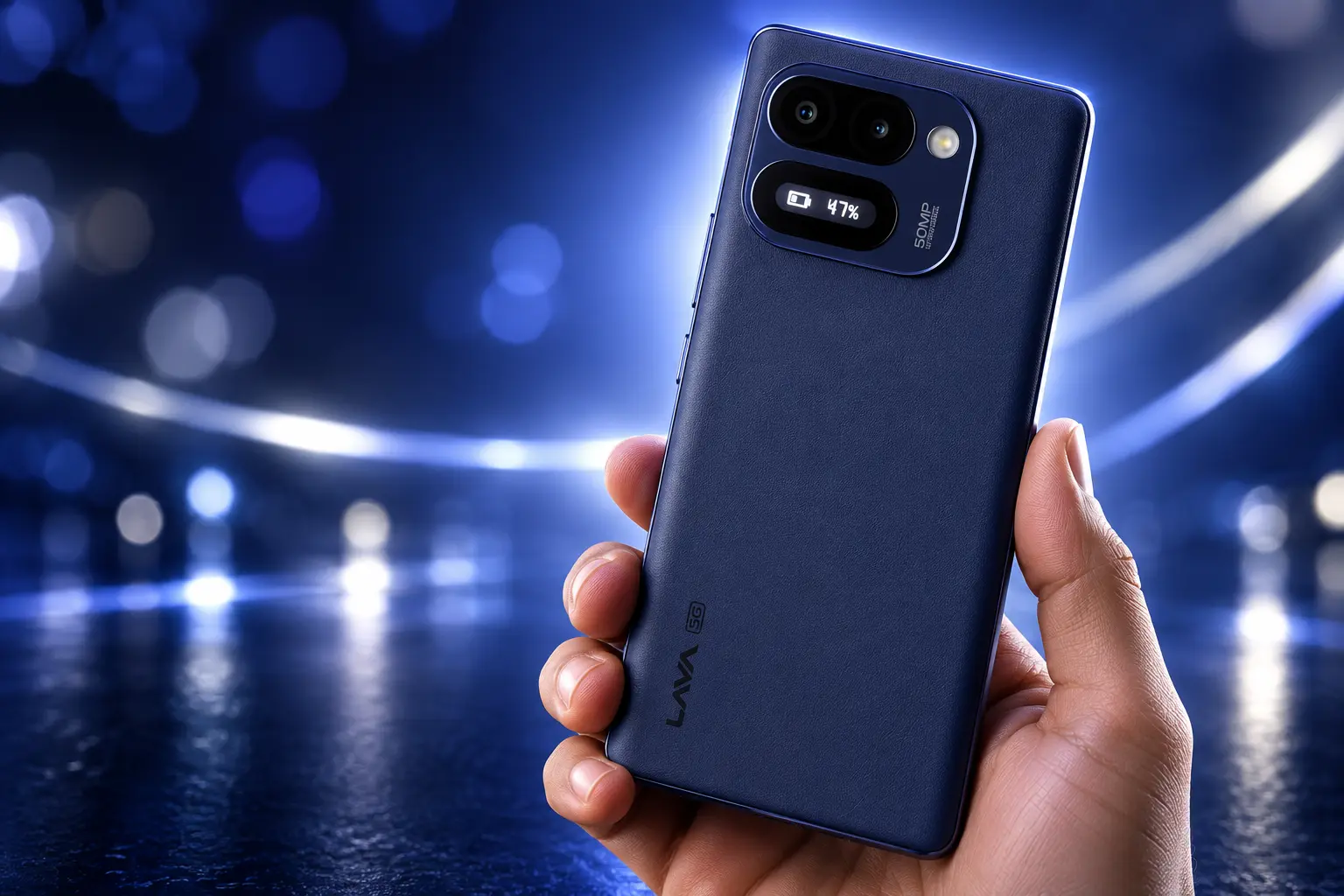
The part Lava is actually selling sits on the back. A small secondary display can show alerts, custom text, emojis, the clock, battery percentage, charging status, volume, and music controls without waking the main screen. The rear is vegan leather. The camera is a single 50-megapixel Sony IMX752 with a tiny screen next to it, not a triple array.
Lava already knows this trick. The Blaze Duo 3, still on the company site, puts a 1.6-inch secondary AMOLED on the back at 320 x 360 pixels. The Virat Curve’s mini screen is a smaller, cheaper cut of a feature the brand has already shipped. The new phone just makes that window the hero of a ₹20,000 listing.
THE REAR MINI SCREEN
- Alerts: Notifications and volume can be read without unlocking the main panel.
- Custom text: Users can park short messages and emojis on the back.
- Status: Clock, battery percentage, and charging state sit on the leather side.
- Playback: Music controls are listed among the glance functions.
Lava’s official account put that back-first pitch on the record the morning of the launch, with the offer price and the Flipkart clock attached.
Some things are better when they take a curve. ✨
Meet the all-new Virat Curve, with a 3D Curved AMOLED Display.
Built on 17 years of trust. 🤝
Special Launch Price: ₹19,999* Sale Starts on 28th Sep, 7 PM. Exclusively on Flipkart.
To know more, visit https://t.co/WgSglZTxme… pic.twitter.com/32geftPg22
— Lava Mobiles (@LavaMobile) September 21, 2026
Early unboxings treated the leather and the tiny screen as the reason to care. Colour polls split between Makrana Ivory and Heritage Indigo. The live argument is already about how the phone looks when it is face down, which is the wager Lava placed.
Six Gigabytes in a Segment Built for Eight
The only factory memory size is 6 GB of LPDDR5 RAM and 128 GB of UFS 2.2 storage, plus up to 6 GB of virtual RAM borrowed from that storage. There is no 8 GB model and no microSD slot in the spec sheets. In September 2026, buying guides in this band still tell people to start at 8 GB physical RAM.
Listings under ₹20,000 show why that advice stuck. The POCO X7 5G’s 8 GB and 128 GB model has been listed at ₹17,999 with a Dimensity 7300-Ultra chip, a 120 Hz curved AMOLED, a 50-megapixel main camera plus an 8-megapixel ultrawide, a 20-megapixel front camera, a 5,500 mAh battery, 45W charging, and an IP68 rating. The Motorola Edge 50 Fusion has been listed around ₹18,999 with 8 GB RAM, a Snapdragon 7s Gen 2 chip, and a 144 Hz pOLED panel.
Lava’s board is more conservative on the things those phones use to win comparison charts, and more extra on the things they do not bother with.
VIRAT CURVE AGAINST TWO PEERS
| Spec | Virat Curve 5G | Lava Blaze Curve (2024) | POCO X7 5G listings |
|---|---|---|---|
| Offer or list price | ₹19,999 | ₹17,999 | ₹17,999 |
| RAM | 6 GB LPDDR5 | 8 GB | 8 GB |
| Storage | 128 GB UFS 2.2 | 128 GB UFS 3.1 | 128 GB |
| Rear camera | 50 MP single | 64 MP triple | 50 MP + 8 MP ultrawide |
| Front camera | 13 MP | 32 MP | 20 MP |
| Battery and charge | 6,000 mAh, 45W | 5,000 mAh, 33W | 5,500 mAh, 45W |
| Chip | Dimensity 7100 | Dimensity 7050 | Dimensity 7300-Ultra |
The Virat Curve does beat Lava’s own older curve on battery size, peak brightness, and the extra rear window. It does not beat the 2024 phone on RAM, storage type, or camera count, and it does not beat current 8 GB listings on the spec sheet most shoppers still sort by.
What Flipkart Puts on Sale on 28 September
Sale time is 7 PM IST on September 28, Flipkart only. MRP is ₹23,999. The launch offer is ₹19,999 including bank offers, a ₹4,000 cut. One memory size. Three colours. Clean Android 16, with two OS upgrades and three years of security updates. Lava’s Vayu AI assistant is on board.
SALE TERMS
- Clock: Flipkart opens the listing at 7 PM on September 28.
- Price: ₹23,999 MRP, ₹19,999 as the special launch price with offers.
- Variant: One SKU, 6 GB RAM and 128 GB storage.
- In the box: A 33W charger, while the phone itself supports 45W.
The battery is a 6,000 mAh pack. Lava claims 55 hours of talk time, 11 hours of continuous YouTube playback, and 720 hours of standby. Spec sheets put a 0-to-100 percent charge at 92 minutes on 45W. Dual speakers, an IR blaster, an in-display fingerprint reader, and face unlock round out the daily kit. The body is 162.26 x 73.51 x 8.55 mm and 184 grams, with an IP64 splash rating and MIL-STD-810H durability testing.
The rear camera is a 50-megapixel Sony IMX752 at f/1.8 with EIS, 10x digital zoom, and 2K video at 30 fps. The front camera is 13 megapixels at f/2.0 with a screen flash. That is a step down from Lava’s own 2024 curve, which carried a 64-megapixel Sony primary, an 8-megapixel ultrawide, a 2-megapixel macro, and a 32-megapixel selfie camera.
Lava’s Older Curve Had More Memory for Less
March 2024’s Blaze Curve 5G is the awkward sibling. Lava still lists it with 8 GB RAM and UFS 3.1 storage at ₹17,999 for the 128 GB model, on a MediaTek Dimensity 7050, with that 64-megapixel triple camera and a 5,000 mAh battery at 33W. Same 6.67-inch 120 Hz curved AMOLED idea. No rear mini screen. More silicon for less money, two years earlier.
The Virat Curve is not a spec sequel to that phone. It is a design sequel. Leather instead of glass. A postage-stamp display on the back. A bigger battery. A newer 6 nm chip that is the 7050’s follow-on, not a leap into the 7300 class. Software starts on Android 16 rather than Android 13, with a short two-upgrade promise.
That trade only works if enough buyers in this band will pay for the back of the phone. Lava has spent 2025 and 2026 growing fastest at the bottom of the market. Counterpoint Research logged it as the fastest-growing brand in the sub-₹10,000 band in April-June 2025, up 156 percent year on year. The Virat Curve is the attempt to spend that momentum one shelf higher, where Chinese and Samsung listings still set the RAM floor.
A 2 Percent Brand Wants 10 Percent by 2030
Managing director Sunil Raina put the company’s math on the table in Kolkata in June 2026. Lava holds about 2 percent of India’s smartphone market and wants 10 percent of the sub-₹30,000 slice by 2030. India buys about 150 million smartphones a year, and about 70 percent of those sit under ₹30,000. The industry, he said, is flat. Lava, he said, is not.
It was a difficult phase for all Indian smartphone makers post 2017, and therefore, we had to pause our smartphone agenda then. We restarted in 2022 and have been witnessing a 40-50 per cent CAGR. The industry remained stagnant during this period, but we have been growing.
Sunil Raina, Managing Director, Lava International, in Kolkata
Raina also cited a zero-bloatware policy and after-sales service as the way a small Indian brand takes volume from larger names. Lava still holds about 29 percent of the feature-phone market, the business that kept the lights on after the 2017 squeeze. The company was founded in 2009 and now quotes a production capacity of about 42.5 million handsets a year. The launch posts keep repeating “Built on 17 years of trust.”
THE LAVA SMARTPHONE PATH
- 2009: Lava International is founded in Noida.
- 2017: Raina says Indian smartphone brands hit a wall and Lava pauses that agenda.
- 2022: Smartphone work restarts; Raina later cites 40-50 percent annual growth from that point.
- March 2024: The Blaze Curve 5G ships an 8 GB curved AMOLED phone at ₹17,999.
- June 2026: Raina sets a 10 percent target in the sub-₹30,000 band by 2030, from about 2 percent now.
- August 2026: The Virat V1 4G and 5G phones land as the first of the new line.
- September 21, 2026: The Virat Curve 5G is unveiled as the fourth Virat phone.
- September 28, 2026: Flipkart sale starts at 7 PM.
The Agni series is still the flagship track, with a UK launch on Raina’s overseas list alongside Africa. The Virat Curve is not that phone. It is the volume bet: a mid-price design object meant to pull Lava out of the sub-₹10,000 growth engine without crossing ₹30,000.
Heritage Indigo, Makrana Ivory, Ellora Slate
PTI’s launch copy said four colour options and then named three. Every later listing settles on three: Heritage Indigo, Makrana Ivory, and Ellora Slate. The names pull from Indian stone and monument language, which fits a campaign that keeps saying “Proudly Indian” next to the Flipkart lock-in.
Ivory is the leather showpiece in the colour polls. Indigo is the darker retail default. Slate is the third. That does not change the hardware. Every colour is the same 6 GB board, the same single rear camera, the same mini screen. Lava is not using colour to hide a second SKU. It is using colour to make a single SKU feel like a collection.
That is coherent brand work. It is also how a 2 percent player avoids a spec war it is not funded to win. Xiaomi, Vivo, Oppo, and Samsung still occupy the comparison charts in this band. Lava is asking shoppers to step off those charts and buy a leather back with a second, tiny display.
The Chip Leaves Headroom Lava Did Not Use
The processor is MediaTek’s Dimensity 7100, a 6 nm mid-range chip announced around the turn of 2026 as the follow-on to the Dimensity 7050. MediaTek’s own page lists four Cortex-A78 cores at 2.4GHz plus four Cortex-A55 cores at 2.0 GHz, and an Arm Mali-G610 GPU. The firm claims up to 5 percent better app efficiency, 23 percent better modem efficiency, and 16 percent better multimedia efficiency than the previous generation, with games up to about 8 percent faster. Peak 5G downlink is listed at 3.3 Gbps. The ISP can take a 200-megapixel sensor. The memory controller supports LPDDR5 and UFS 3.1. Wireless support includes Wi-Fi 6 and Bluetooth 5.4. Fast-charge logic on the platform goes to 45W.
Lava used some of that and left some of it on the table.
CHIP VERSUS THE PHONE
- Storage: The 7100 supports UFS 3.1; the Virat Curve ships UFS 2.2.
- Camera: The ISP is rated to 200 MP; Lava fitted one 50 MP Sony sensor.
- RAM: The chip takes LPDDR5, which Lava used, but only in a 6 GB package.
- Charge: 45W is supported; the box still holds a 33W adapter.
None of those cuts is a scandal in isolation. Together they show the budget that paid for the curved glass, the leather, and the extra rear window. Lava spent the bill of materials on the thing you see on a shelf, not on the thing a comparison table sorts by.
Flipkart opens the Virat Curve 5G at 7 PM on September 28, one memory size, three colours, ₹19,999 with offers. The next few sale days will show whether a mini screen on leather can move a 2 percent brand up a shelf that already sells 8 GB phones for less.

A CubeSat Will Age Whisky That Never Comes Home

A Charity Quote Cost Shia LaBeouf the FKA twigs NDA

Looker Turned a Model’s Body Into Ad Inventory

Infinity Ward Bets a Paid DMZ Will Stick This Time

Disney Sidesteps a Kimmel Renewal as Failla Cites Losses

How to Get Pre Boarding on Southwest – Skip the Line with These Tricks

False AI Intel Nearly Put US Crews on a Chinese Ship

Tim Cook’s $4.6 Trillion Apple Still Runs on One Phone

Dunes Air Sues Nora Fatehi Over Its Luxury Jet

OpenAI Posts a Navier-Stokes Proof Clay Has Not Touched
-
 TRAVEL3 years ago
How to Get Pre Boarding on Southwest – Skip the Line with These Tricks
-
 NEWS1 month ago
False AI Intel Nearly Put US Crews on a Chinese Ship
-
 BUSINESS2 months ago
Tim Cook’s $4.6 Trillion Apple Still Runs on One Phone
-
 ENTERTAINMENT2 months ago
Dunes Air Sues Nora Fatehi Over Its Luxury Jet
-
 NEWS2 months ago
OpenAI Posts a Navier-Stokes Proof Clay Has Not Touched
-

 LIFESTYLE3 years ago
How Often Do You Have to Change a Monkey’s Diaper? The Truth About Pet Monkeys
-

 NEWS2 months ago
Australia Treats Cloud Software Payments as Taxable Royalties
-

 LIFESTYLE3 years ago
How Long Does It Take for Armpit Hair to Grow? The Stages of Hair Growth and How to Shave It