
BUSINESS
Trump’s Press Ban Leaves His Own Events Without Sound
CNN, MS NOW and Politico sued after a White House ban. Fox then chaired a pool shutdown that left Trump’s helipad ceremony with pictures and no usable sound.

President Donald Trump’s ban of CNN from White House pool duty on Monday, September 21, 2026, left his own events without an independent television feed. Fox News Washington bureau chief Bryan Boughton, the acting chair of the five-network TV pool, told members there would be no replacement crew. CNN, MS NOW and Politico filed suit the same morning, asking U.S. District Judge Timothy J. Kelly to restore badges seized on Saturday, September 19.
The fight is a First Amendment case. The first practical result was quieter. At a midday ribbon-cutting for a new White House helipad, the administration’s own livestream carried pictures of the president and almost none of his words.
Fox News Chairs a Pool That Goes Dark
CNN had the pool assignment for Monday, including Trump’s trip to New York for the United Nations General Assembly. A Sunday-night White House guidance list named no network as primary TV pooler. Boughton, whose chairmanship rotates among the five shops on a quarterly basis, then shut the presidential rotation rather than let another network take CNN’s turn.
Effective today, the TV pool will not be covering events designated as pool coverage of the President. This follows the White House’s position preventing CNN from fulfilling its assigned pool duties. There will be no replacement pool put in place.
Bryan Boughton, Fox News Washington bureau chief and acting TV pool chair, email to pool subscribers
ABC, CBS, CNN, Fox News and NBC later put out a joint statement: the public has a vital interest in independent information about its government, and no administration should restrict a news organization because it objects to its reporting. Pool work for Congress, visiting officials and other Washington events would continue, Boughton wrote. Only the president’s designated pool events went dark.
That feed is how most of the country, and desks overseas, see close video of a president in rooms that cannot hold every camera. The five networks split the cost, share the pictures, and sell the same signal to about a dozen extra subscribers. CNN’s Kaitlan Collins told viewers that when the president did anything that day, there would be no TV camera with him broadcasting and sharing the footage with the wider press corps.
Print, radio and still photographers could still work. Several photo desks also sat out Monday’s pictures in a separate show of support. The television hole was the one the White House could not fill with a memo.
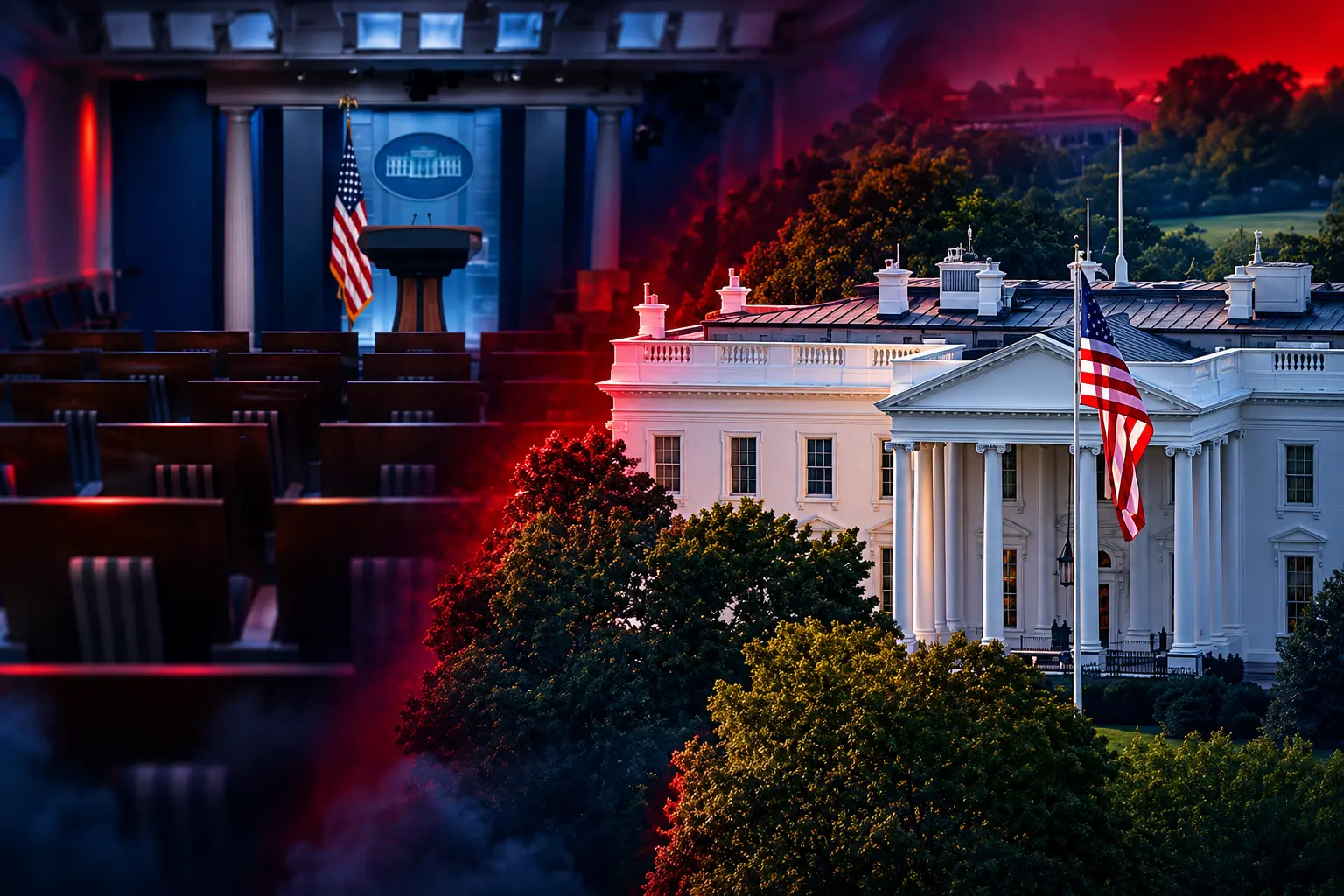
The Helipad Ceremony Nobody Could Hear
Trump’s first public event under the blackout was a ribbon-cutting for a new granite helicopter pad on the grounds. The White House put a livestream on its site. Without the pool’s boom microphones, the helicopter noise sat on top of his voice. Viewers got a ceremony with almost no usable sound.
That is the part of the ban that landed on the administration, not on the three locked-out desks. CNN, MS NOW and Politico could still report from an intersection outside the complex. They could still file, and they did. What went missing was the shared, independent record of what the president said in a space the public does not enter.
C-SPAN, which leans on the pool for clean audio and video of government events, said it would not show the president’s event without that feed. Reuters buys the same pictures for clients worldwide. The White House stream stayed up. It did not do the job the pool camera and the boom mic exist to do.
Vice President JD Vance told reporters the three outlets produce “effectively far-left propaganda” and said they could still report, just not from offices inside the White House. The helipad clip made a narrower point. Once the pool stood down, even a friendly camera plan could not put the president’s words on the air in usable form.
Judge Kelly Gets the Acosta Sequel
The three companies and three reporters sued in the U.S. District Court for the District of Columbia. The plaintiffs are Cable News Network, Inc.; MS NOW Cable, LLC, the channel that launched in 1996 as MSNBC and took the MS NOW name in November 2025 after Comcast spun it into Versant Media Group; Politico LLC, which has covered politics since 2007; MS NOW White House reporter Akayla Gardner; Politico White House reporter Cheyenne Haslett; and CNN senior White House reporter Betsy Klein.
They named Trump in his official capacity, along with White House communications director Steven Cheung, Secret Service Director Sean M. Curran, and chief of staff Susan Wiles. Their lawyer is Theodore J. Boutrous Jr. of Gibson Dunn, who represented CNN when the first Trump White House pulled Jim Acosta’s pass in 2018. The new complaint for declaratory and injunctive relief runs 27 pages. A separate 36-page request for a restraining order asks Kelly to block the ban while the case proceeds.
Kelly, a Trump appointee from the first term, was randomly assigned. He is the same judge who granted CNN a temporary restraining order in the Acosta fight, finding the correspondent had been given no due process. The White House restored that pass and later issued new conduct rules for briefings. Trump took the assignment as a warning. On Truth Social he called Kelly “a great Judge, for them, a man who ruled in favor of Jim Acosta,” added that Kelly was “sadly, appointed by ‘TRUMP,’” and said he would appeal any ruling that went against him.
Kelly set a Tuesday, September 22, deadline for the administration to respond and a hearing by videoconference on Wednesday afternoon, September 23, on the demand to lift the ban at once.
THE WEEK THE BADGES WENT DEAD
- September 18, 2026, 3:04 p.m.: Trump posts that he is banning CNN, MS NOW and Politico from the White House “effective immediately,” then tells an Oval Office gaggle the move is about “cumulative stories over the last two years,” not one piece.
- September 19, 2026: Hard passes fail at the gate. Officers seize credentials from Klein, Gardner and Haslett. The reporters go live from outside the complex.
- September 20, 2026: Sunday guidance to the press lists no primary TV pooler, names Hearst as secondary TV in Washington, and lists Real America’s Voice as secondary TV for the New York trip.
- September 21, 2026: The three outlets sue. Boughton suspends presidential TV pool coverage. Trump cuts a helipad ribbon on a livestream with almost no usable sound.
- September 23, 2026: Kelly hears the request for a temporary restraining order.
Jacqui Heinrich, president of the White House Correspondents’ Association, called for the three outlets’ access to be restored at once. A standard used to exclude one outlet because of its coverage, she said, could be applied to any outlet later.
Why the Grounds Ban Outruns the Oval Office Case
The White House’s public line is that a hard pass, a briefing-room seat and a pool slot are privileges. “The First Amendment protects their right to publish; it does not entitle them to a hard pass, briefing room seat, or place in the press pool,” the administration posted. Trump wrote that he was not attacking a free press he “cherish[es]” but “FAKE NEWS,” which he called a “Cancer” and “a threat to our National Security.”
That argument already has a win in a narrower fight. In February 2025 the White House barred Associated Press journalists from the Oval Office, Air Force One and similar rooms after the AP kept “Gulf of Mexico” in its stylebook instead of “Gulf of America.” Judge Trevor N. McFadden issued a preliminary injunction on April 8, 2025. On June 6, 2025, the D.C. Circuit stayed most of that order. Restricted presidential workspaces, the appeals court said, are not First Amendment forums, so the president retains discretion, including on viewpoint, over who comes in. The stay left the East Room injunction in place.
This new ban is written more broadly. The complaint says journalists from the three outlets “are simply not permitted anywhere on the grounds of the White House complex.” Badges were deactivated overnight. Offices next to the James S. Brady briefing room went dark. That is the hard-pass system, not a small-room guest list.
THREE PRESS FIGHTS, THREE DIFFERENT DOORS
| Dispute | When | What was taken | Where the law stood |
|---|---|---|---|
| Jim Acosta, CNN | 2018 | One correspondent’s hard pass after a briefing clash | Kelly restored the pass on due-process grounds; the suit was later dropped |
| Associated Press | 2025 | Oval Office, Air Force One and pool spaces over “Gulf of Mexico” | D.C. Circuit stay, except the East Room, while the appeal continues |
| CNN, MS NOW, Politico | September 2026 | Entire White House grounds and hard passes, plus CNN’s pool turn | TRO hearing set for September 23, 2026 |
The outlets’ papers treat those doors as different legal places. They argue the Brady briefing room and the press offices are a nonpublic forum the government already opened to bona fide Washington journalists, so officials may not kick people out for the tone of their copy. They also plead retaliation and a due-process claim: no notice, no standard, no chance to be heard before a Truth Social post became a deactivated badge.
Jameel Jaffer, executive director of the Knight First Amendment Institute at Columbia University, said the president’s decision to bar news organizations from the White House for the content of their reporting is a flagrant violation of the First Amendment. The institute said it will support the outlets in court. It has already filed briefs in the AP fight and in a New York Times challenge to Pentagon access rules.
Due Process for a White House Hard Pass
The due-process half of the case sits on a 1977 D.C. Circuit ruling, Sherrill v. Knight. Robert Sherrill, a correspondent for The Nation who already held House and Senate gallery passes, was denied a White House pass with no real explanation. The Secret Service later pointed to an old assault arrest. The appeals court did not hand every reporter a constitutional ticket to the West Wing. It did say that once the White House opened press facilities to Washington journalists, access could not be denied arbitrarily or for less than compelling reasons, and that a bona fide correspondent was entitled to notice, an opportunity to rebut, and a written decision.
The D.C. Circuit later applied the same logic in Karem v. Trump in 2020, when another hard pass was pulled without the required process. In Ateba v. Leavitt in 2025, the court described the White House Press Area, including the briefing room and press offices, as a nonpublic forum. Restrictions there still may not discriminate by viewpoint and must be reasonable in light of the forum’s purpose.
The new complaint quotes Trump saying it is “wrong” to “allow people to write purposely negative stories,” that the coverage is “one-sided” and “never good,” and that it “diminish[es]” him. He also said there was no single story behind the order. The papers treat those lines as the government admitting a content test. Before September 18, 2026, the filing says, no president had barred CNN as an organization from the White House. CNN has operated since 1980.
The same filing ties the lockout to a crowded week. It calls Trump “the commander in chief of a country at war,” notes the UN General Assembly trip, and says he is due to meet China’s President Xi Jinping at the White House on Thursday, September 24. Those dates are why the outlets asked Kelly to move in days, not months.
What Replaced the Independent Camera
With the five-network pool idle, the White House reached for substitutes that do not rotate, do not share, and do not carry boom mics into a rotor wash.
THE STAND-INS FOR A DARK POOL
- White House livestream: The administration kept putting events on its own site, including the helipad ceremony, with audio that collapsed once a helicopter spooled up.
- Trump TV: After the networks stood down, the White House promoted a branded feed of “top past moments, announcements, and the latest and greatest from the administration all in one place,” pitched as live events streamed “DIRECTLY to your phone.”
- Sunday guidance names: Hearst, which runs local stations, was listed as secondary TV in Washington. Real America’s Voice was listed as secondary TV for the New York trip.
- Sidewalk reporting: Klein, Gardner and Haslett, and their producers, worked from outside the fence, cut off from briefing-room workspaces and from pool slots they had held the week before.
On Tuesday, September 22, Trump defended the ban again at a joint appearance with New York City Mayor Zohran Mamdani. Mamdani told reporters the banned desks would be welcome at his event, and that “all of the members of the press” would be on the lawn. The White House and City Hall, for a day, ran on different access rules.
The three outlets, in a joint statement the morning they sued, said they were filing “to protect our First Amendment rights and defend the principle that the government does not decide what the press reports or publishes.” Left unchallenged, they said, the lockout threatens press freedom and the public’s right to independent journalism. Boutrous called the ban “a direct assault on the First Amendment and a blatant violation of due process.”
Kelly’s Wednesday hearing will not settle whether a president may pick favorites for a tight Oval Office huddle. That question is already in the D.C. Circuit on the AP record. The emergency papers ask a narrower, older question: whether the White House, having issued hard passes and opened a briefing room, may switch those passes off overnight because the president dislikes two years of copy. Trump has already said he will appeal if he loses. Until then, the independent camera that used to travel with him is not traveling, and the feed that replaced it still cannot out-shout a helicopter.
Disclaimer: This article is news reporting and analysis of a live federal case and related White House access rules. It is informational only and is not legal advice, is not a prediction of how Judge Kelly or any appeals court will rule, and is not a guide to press credentials, hard-pass applications, or any person’s rights or duties. Readers with a legal interest in the dispute, including journalists, newsroom managers and government employees, should consult a qualified First Amendment or media lawyer licensed in the relevant jurisdiction before acting on anything described here. Filings, hearing dates, pool arrangements and access rules reflect the public record through September 22, 2026, and may change with the next order or the next guidance email.

A CubeSat Will Age Whisky That Never Comes Home

A Charity Quote Cost Shia LaBeouf the FKA twigs NDA

Looker Turned a Model’s Body Into Ad Inventory

Infinity Ward Bets a Paid DMZ Will Stick This Time

Disney Sidesteps a Kimmel Renewal as Failla Cites Losses

How to Get Pre Boarding on Southwest – Skip the Line with These Tricks

False AI Intel Nearly Put US Crews on a Chinese Ship

Tim Cook’s $4.6 Trillion Apple Still Runs on One Phone

Dunes Air Sues Nora Fatehi Over Its Luxury Jet

OpenAI Posts a Navier-Stokes Proof Clay Has Not Touched
-
 TRAVEL3 years ago
How to Get Pre Boarding on Southwest – Skip the Line with These Tricks
-
 NEWS1 month ago
False AI Intel Nearly Put US Crews on a Chinese Ship
-
 BUSINESS2 months ago
Tim Cook’s $4.6 Trillion Apple Still Runs on One Phone
-
 ENTERTAINMENT2 months ago
Dunes Air Sues Nora Fatehi Over Its Luxury Jet
-
 NEWS2 months ago
OpenAI Posts a Navier-Stokes Proof Clay Has Not Touched
-

 LIFESTYLE3 years ago
How Often Do You Have to Change a Monkey’s Diaper? The Truth About Pet Monkeys
-

 NEWS2 months ago
Australia Treats Cloud Software Payments as Taxable Royalties
-

 LIFESTYLE3 years ago
How Long Does It Take for Armpit Hair to Grow? The Stages of Hair Growth and How to Shave It