
NEWS
United Russia Locks a Record Majority Into a Wartime Duma
United Russia is on course for 355 Duma seats, enough to pass war laws alone, with 49 veterans in the chamber and no anti-war party left.

United Russia is on course for 355 of 450 State Duma seats after Russia’s first wartime parliamentary vote, election chief Ella Pamfilova said Monday. With 95.18 percent of precinct reports in, the ruling party took 57.83 percent of the party-list vote and led in 208 of 225 local districts.
That haul beats the party’s 343-seat mark from 2016 and sits 55 seats above the 300 it needs to pass two-thirds measures alone. Forty-nine Ukraine war veterans are set to sit in that majority after the last anti-war party was struck from the federal ballot in August.
United Russia Claims a Record 355 Seats
Voting ran Friday through Sunday, Sept. 18 to 20, for the ninth State Duma. Pamfilova, chair of the Central Election Commission, put the party-list score at 57.83 percent and said United Russia was heading for 355 seats in the 450-seat house. In 2021 the same party took 49.82 percent of the list vote and 324 seats.
EARLY SEAT TALLY, 95.18 PERCENT OF PROTOCOLS
| Party | List vote | Seats | 2021 seats |
|---|---|---|---|
| United Russia | 57.83% | 355 | 324 |
| Communist Party | 13.81% | 40 | 57 |
| LDPR | 8.98% | 25 | 21 |
| New People | 7.96% | 20 | 13 |
| A Just Russia | 4.96% | 4 | 27 |
| Rodina | n/a | 1 | n/a |
| Independents | n/a | 4 | n/a |
Those seven lines add to 449 seats. One mandate was still open on the Monday count, and Pamfilova said A Just Russia, at 4.96 percent, still had a “big chance” of clearing the 5 percent line for list seats. Ten parties took part. Final figures are due Friday, Sept. 25.
Turnout was 59.32 percent, more than 62.6 million people, up 7.60 points from 51.72 percent in 2021. Pamfilova called the figure a record for this kind of race. Kremlin spokesman Dmitry Peskov said the numbers pointed to “the highest level of consolidation within Russian society around the head of state.” In Chechnya, Ramzan Kadyrov was returned for a fifth term with 99.85 percent.
A Supermajority That Needs No Other Party
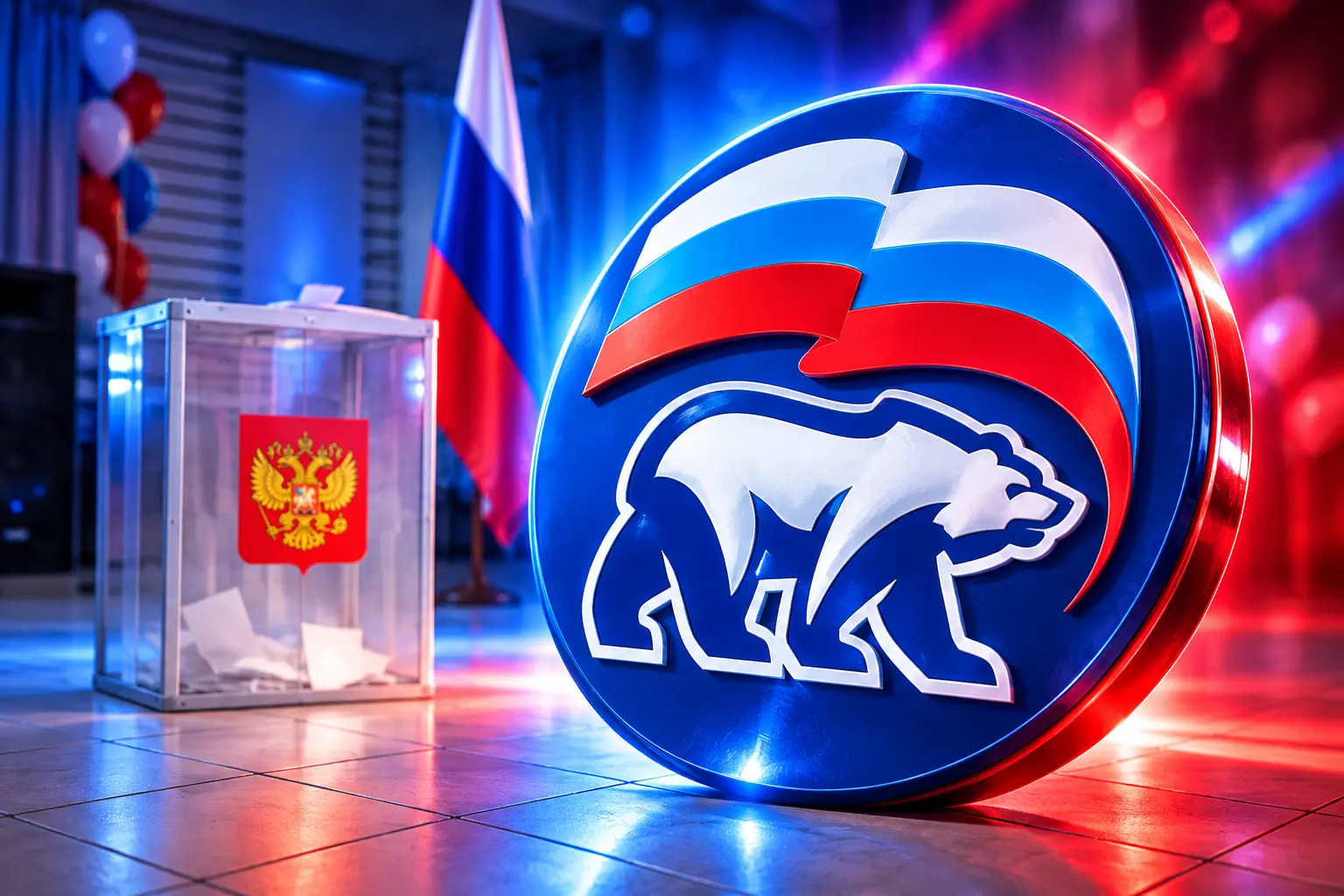
Two-thirds of 450 is 300 seats. United Russia’s 355 leave it able to carry, inside the Duma, any measure that needs that share, including federal constitutional laws, without a vote from the Communists, LDPR, New People or A Just Russia. Ordinary statutes already needed only a simple majority, which the party has held for years.
WHAT 355 SEATS CAN DO ALONE
- Two-thirds bills: Federal constitutional laws can pass the Duma with no other faction in the room.
- Constitution chapters 3 to 8: The party can start those amendments in the lower house, though the Federation Council and two-thirds of regional assemblies still have to agree.
- The other 95 seats: Communists, nationalists, New People and A Just Russia can speak. They cannot block the majority on any count that matters to the war.
The 2021 house already had a two-thirds bloc, at 324 seats. This one is larger by 31, and it will sit through 2031. President Vladimir Putin framed the vote as a test of public support for the war. The early count gives him a chamber that can write that war into statute for a full five-year term.
49 War Veterans Take Duma Seats
United Russia general secretary Vladimir Yakushev first said “about 86” war participants were heading into the Duma, calling it “quite a substantial contribution.” He later revised the figure to 49. That is about 11 percent of the house, not a fifth. Pamfilova had said roughly 200 veterans were competing for Duma seats. A named count of United Russia’s certified lists found 83 candidates with war credentials.
In February 2024 Putin launched Time of Heroes, a training track that moves fighters into civilian posts. He said a genuine elite drawn from the war should take jobs in schools, state firms, business and local government, replacing people who had “lined their pockets in the 1990s,” and that they could be the generation to which “Russia might one day be entrusted.” Kremlin records show he returned to the line at least 22 times through July 2026.
The federal list’s top five made the mix plain: Foreign Minister Sergei Lavrov, Moscow Mayor Sergei Sobyanin, war correspondent Yevgeny Poddubny, children’s rights commissioner Maria Lvova-Belova, and Vladislav Golovin, 29, a Hero of Russia who lost a leg in the assault on Mariupol and now heads the Young Army youth group. Lvova-Belova faces an International Criminal Court warrant, with Putin, over the deportation of Ukrainian children. Golovin is under Western sanctions.
A September paper from the European Council on Foreign Relations, written before the count, projected about 50 veterans in the new Duma and warned their presence could become an institutional brake on foreign policy moderation after a ceasefire, or even after a change at the top. The point is not that 49 people can outvote 355. It is that a bloc whose status is tied to the war will be in the room for every budget, every mobilisation rule, and every talk of a deal.
Yabloko’s Peace List Never Reached Voters
Yabloko was the only registered party that ran on an anti-war platform. Its slogans included “For a ceasefire agreement, diplomacy and peace!” The Central Election Commission had put the party on the federal ballot as line 2, just after United Russia. Then the courts took it off.
HOW THE ANTI-WAR LIST LEFT THE BALLOT
- July 29, 2026: The commission registers Yabloko’s federal list.
- August 10, 2026: The Supreme Court cancels that registration on a suit by Rodina, a small nationalist party, citing copyright claims, “extremist” slogans and money from abroad.
- August 17, 2026: The same court rejects Yabloko’s appeal.
- August 18, 2026: Commission secretary Natalya Budarina says line 2 is excluded; numbering of the other lines stays put, so the ballot jumps from United Russia to LDPR.
- September 21, 2026: In Novgorod, the only one of eight regions where Yabloko’s list made a regional ballot, the party has 6.2 percent with 96.86 percent of precincts in.
Yabloko’s own note on the Supreme Court’s formal grounds for disqualification said the real reason was its “For Peace and Freedom!” platform. Party leader Nikolai Rybakov said excluding Yabloko meant “refusing dialogue with people who ask questions that are uncomfortable for the authorities.” After the polls closed he said millions had backed “peace, freedom, a life without fear and a ceasefire agreement,” and claimed the party would have finished second if the list had stood. Single-member candidates who were not struck won no Duma seats.
The other parties that won seats all back the “special military operation.” A Just Russia’s collapse, from 27 seats in 2021 to four on the Monday tally, and the Communists’ drop from 57 to 40, shrink the already narrow space for even mild dissent inside the house.
Why 57.83 Percent Became 355 Seats
The Duma is filled by two parallel races: 225 seats from party lists with a 5 percent cutoff, and 225 local districts decided by first past the post. United Russia’s 57.83 percent of the list vote, once seats are shared among parties over the line, is only half the story. The other half is the district map.
Candidates in the party’s colours were ahead in 208 of 225 districts. That is where 57.83 percent becomes 78.9 percent of the chamber. Add about 147 list seats to 208 district wins and the total is 355. The Communists were ahead in five districts, A Just Russia and independents in four each, LDPR in two, and Rodina in one, on the same Monday snapshot.
The 8.01-point jump from 49.82 percent in 2021 did not have to be a landslide in every town. It had to be large enough, in a first-past-the-post half of the house, to turn a loyal plurality into a near-clean sweep. The 57.83 percent also landed close to a round campaign target, the kind of figure a managed count tends to produce. Kadyrov’s 99.85 percent in Chechnya is the same pattern at regional scale.
Remote electronic voting, rolled out in 33 regions, posted a 90.88 percent turnout among the people registered to use it, about 3.65 million ballots. Putin cast his own vote online on Sept. 18 from his Kremlin office. Independent watchdogs have long said the remote system is hard to observe. The commission said more than 336,702 observers were present at polling stations, most of them sent by United Russia.
Occupied Districts Cast Ballots Russia Will Count
This was the first Duma election run in the four Ukrainian regions Moscow claims as its own since 2022. The 2025 map created seven new local districts there: three in Donetsk, two in Luhansk, one in Kherson and one in Zaporizhzhia. Crimea’s older districts were redrawn. Polling was also organised in Transnistria.
OCCUPIED-TERRITORY COUNT, OFFICIAL FIGURES
- Donetsk: Local officials put turnout above 81 percent and closed stations at 14:00 on Sept. 20, citing a difficult “operational situation.” Early voting there began Aug. 30 and had already passed 75 percent before the three main days.
- Luhansk: The local commission put final turnout, including early votes, at 79.33 percent.
- Early volume: Pamfilova said more than 4.2 million people voted early in the four new regions and eight regions bordering the front.
Ukraine’s foreign ministry said any voting organised on its territory is illegal and produces no legal result. The European Union, in a Sept. 21 statement, said it would not treat elections held on occupied Ukrainian territory as valid, and it pointed to Yabloko’s removal as further proof that voters were denied a real choice.
Russia did not to invite OSCE observers. ODIHR director Maria Telalian said on Aug. 6 that the snub was “deeply regrettable” and broke commitments every OSCE state made in 1990. It is the third national vote in a row, after the 2021 Duma race and the 2024 presidential vote, that the OSCE could not watch. EU foreign policy chief Kaja Kallas said the outcome “was never in doubt.”
The Kremlin silenced dissent, barred the only registered party that opposed its war in Ukraine and shut out international election monitors. The veneer of democracy is all that remains in Russia.
Kaja Kallas, EU high representative for foreign affairs
Pamfilova said the commission had fended off more than 100 million potential cyber threats and that a Ukrainian drone attack on Moscow on Sunday had not stopped the vote. The prosecutor general’s office said it had found no serious breaches of the law. A monitoring group that logged complaints counted more than 900 filings by 8 p.m. on Sept. 20, about one in three of them over observers’ rights, with the largest share from Moscow, the Moscow region, St. Petersburg, Perm and Krasnodar.
Five Years of Law With No Anti-War Faction
The new house is due to hold its first sitting no later than Oct. 19, and Putin is expected to meet the incoming deputies. Pamfilova said the certified result would be out by Friday, Sept. 25. Until then the 355-seat figure can still move by a seat or two, and A Just Russia can still crawl over 5 percent. The shape will not.
United Russia will have a larger two-thirds bloc than in 2016. The Communists will have 17 fewer seats than in 2021. The last party that campaigned for a ceasefire will have none. Forty-nine veterans of the war, on the party’s own revised count, will take the oath with them. The ninth convocation runs until 2031. That is the period in which budgets, recruitment rules and any political settlement would have to pass this room.

A CubeSat Will Age Whisky That Never Comes Home

A Charity Quote Cost Shia LaBeouf the FKA twigs NDA

Looker Turned a Model’s Body Into Ad Inventory

Infinity Ward Bets a Paid DMZ Will Stick This Time

Disney Sidesteps a Kimmel Renewal as Failla Cites Losses

How to Get Pre Boarding on Southwest – Skip the Line with These Tricks

False AI Intel Nearly Put US Crews on a Chinese Ship

Tim Cook’s $4.6 Trillion Apple Still Runs on One Phone

OpenAI Posts a Navier-Stokes Proof Clay Has Not Touched

Dunes Air Sues Nora Fatehi Over Its Luxury Jet
-
 TRAVEL3 years ago
How to Get Pre Boarding on Southwest – Skip the Line with These Tricks
-
 NEWS1 month ago
False AI Intel Nearly Put US Crews on a Chinese Ship
-
 BUSINESS2 months ago
Tim Cook’s $4.6 Trillion Apple Still Runs on One Phone
-
 NEWS2 months ago
OpenAI Posts a Navier-Stokes Proof Clay Has Not Touched
-
 ENTERTAINMENT2 months ago
Dunes Air Sues Nora Fatehi Over Its Luxury Jet
-

 LIFESTYLE3 years ago
How Often Do You Have to Change a Monkey’s Diaper? The Truth About Pet Monkeys
-

 NEWS2 months ago
Australia Treats Cloud Software Payments as Taxable Royalties
-

 LIFESTYLE3 years ago
How Long Does It Take for Armpit Hair to Grow? The Stages of Hair Growth and How to Shave It